Orthodox worship: The daily cycle and the layperson’s home prayer
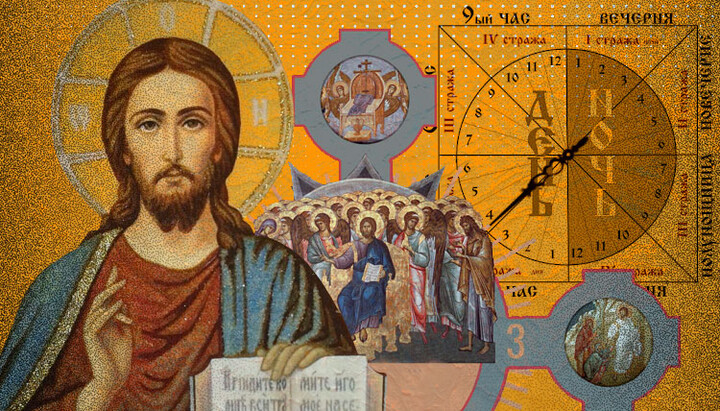
The daily cycle – the foundation of worship. Photo: UOJ
Why the structure of worship matters
Through its services, the Church not only offers prayer to God but also reveals to humanity the fullness of faith, life in Christ, and spiritual wisdom. As St. John of Kronstadt once wrote: “By its worship, the Orthodox Church educates us to be citizens of heaven.”
Understanding the order of services is not the privilege of clergy alone – it is a vital necessity for every Orthodox Christian. Our home prayer life should be modeled on the Church’s worship: its rhythm, sequence, and content.
This means that every layperson should not only know the order of services but also be able to use at least the basic liturgical books.
Though this may seem difficult today, for many centuries – even up to the 19th century – our ancestors used these books not only in church but also at home, especially when a priest was absent.
From liturgical books to the prayer book
The modern prayer book became widespread only by the late 18th century, especially in regions influenced by Uniate (Greek Catholic) practice. It was in the Catholic tradition that a distinction arose between the private prayers of the clergy and those of the laity. Over time, this distinction became fixed, and the morning and evening rules, originally intended as a simplified substitute for the liturgical texts, became obligatory for all.
However, many historical and patristic sources describe an older practice. For example, the Domostroi instructs laypeople to read Vespers and Matins at home. Even in the 19th century, St. Theophan the Recluse advised lay Christians to supplement the prayers from the prayer book with readings of Vespers with Compline, Matins with the Hours, and even the Typika.
The depth and dynamic nature of home prayer
When home prayer loses its connection with the church services, it also loses the dynamic balance between constancy and renewal that is so vital to the human soul.
On the one hand, we need a firm foundation and regularity; on the other, we need movement and freshness.
If a person’s home prayer rule lacks this inner rhythm, the Church’s liturgical texts introduce us to a rich spectrum of spiritual states – from repentance and supplication for help to thanksgiving, joy, and praise.
Living through the days of the year together with the Church’s services, we not only experience the spiritual freshness of every feast and fast, but also pray, learn faith, reflect, and enrich our spiritual life through the experience and wisdom of the Church. And this is not mere rhetoric.
Every church service is not simply a sequence of prayers, but a multifaceted spiritual act that includes the study and contemplation of God’s commandments, supplication to God, exposition of Holy Scripture and the lived experience of the Holy Fathers, the re-creation of spiritual feelings, instruction in the dogmatic truths of the faith, moral precepts, and the history of the Church.
The nine services of the daily cycle
Each service sanctifies a particular time of day and recalls key events in the history of salvation. According to the Typikon, the daily cycle includes nine services:
- Vespers begins the liturgical day (since the Church reckons a new day from the evening). Its prayers attune the heart to gratitude for all that has been experienced.
- Compline is the service performed after the evening meal (that is, after supper), and therefore, according to the Typikon, it is not joined to Vespers, after which the common meal is to follow. Compline is precisely the service “at the approach of sleep.”
- Midnight Office is to be performed around midnight. It is based on the parable of the ten virgins who kept vigil, awaiting the Bridegroom – the Lord.
- Matins, performed after sleep, gives thanks to God for the night that has passed and for the new day, and recalls the manifestation of the Savior to the world. In it, all the elements of worship mentioned above are most fully revealed.
- The Hours (First, Third, Sixth, and Ninth) are short services tied to specific times of day and to significant events – the descent of the Holy Spirit, the Lord’s crucifixion and death, and other moments that sanctify the passage of time and unite the believer’s personal life with the history of salvation..
- The Typika holds a special place among the services. It is not an obligatory daily office because of its origin – an ancient monastic rite of self-communion with the Holy Gifts, symbolically representing the Divine Liturgy.
The Liturgy itself does not belong to the daily cycle and is celebrated under particular conditions – a subject for separate discussion.
Conclusion
This has been only a brief introduction to the order of daily services. Each has its own meaning and time. In future reflections, we will look at each one more closely, to see how profoundly and wisely the Church’s prayer life is arranged – and to discover in it inspiration and spiritual benefit for our own lives.
Read also
Trial of a dead pope
Once in Rome, the body of a deceased pope was seated on the throne and put on trial. The accusation relied on a church canon that had once saved his see.
Monastery built in defiance of king
When Orthodox believers in Minsk were left with just one church, townspeople decided to build another – and even a royal decree did not stop them.
Young Mother and Sleeping Christ
Michelangelo carved a Virgin Mary who looks younger than her Son – and signed his name in marble for the only time in his life. Neither of these peculiarities was accidental.
Orthodox books from a Uniate printing press
In the 18th century, Uniate monks at Pochaiv printed books used in prayer by Orthodox Christians and Old Believers alike.
The story of the honey brotherhood
The Mogilev Brotherhood began with members pooling money to brew honey drinks for feast days – and eventually grew to have its own printing press.
Golgotha in the midst of a pogrom
In the autumn of 1938, the Jewish artist Marc Chagall painted the crucified Christ. Synagogues burn and refugees flee around the cross, while the Crucified One Himself is wrapped in a prayer shawl.