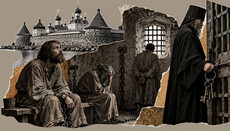

The wooden bell: why the sound of the semantron rings louder than bronze today
He who is used to the pomp of bronze will hardly understand this dry knocking. Yet it was precisely this sound that once called people into the Ark. The history of the semantron is a challenge to the modern age.
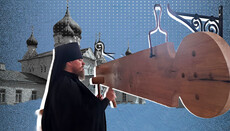
The monastery courtyard at dawn is immersed in silence, and suddenly – a sharp, rhythmic strike of wood against wood. Without the copper resonance, without the sound flying for kilometers – simply the knock of hammer against board, which monks call bilo, Greeks – semantron, Romanians – toacă. This is a board nearly four meters long, carved from the heartwood of maple or ash, which in the hands of a monk becomes a voice calling to prayer.

The Christian East did not know bells until the 9th century – the world prayed to this wooden sound. In 865, Venetian Doge Orso I sent twelve bronze bells to Constantinople as a gift to Emperor Michael III, and the Byzantines built a tower for them next to Hagia Sophia. When they rang for the first time, people ran out into the streets – they thought angels had descended. But before this, for nine centuries the Church prayed to the knock of wood, and this sound outlived empires.
The humility of wood against the pride of iron
On May 29, 1453, Constantinople fell to the Ottoman assault, and one of the sultan's first decrees was the prohibition of bell ringing. Officially – the ringing "disturbs the souls of dead Muslims," in fact – the bell was a symbol of Christian triumph, it claimed rights to space, thundered over the city like a victor's trumpet. The Turks removed crosses from temples, banned processions, but allowed the semantron.
Why? The Ottoman Porte officials despised the knock of the semantron as an "inferior sound" – a carpenter's workshop, physical labor, something mundane and earthly. They did not understand the main thing: Christianity began in a carpenter's workshop, where Joseph the Betrothed hammered, and Christ grew up among shavings and sawdust.
The Church is indeed a workshop, where the image of God is carved from human material.
Despising the semantron as a sign of defeat, the conquerors left Christians an instrument of spiritual resistance – the humility of wood defeated the pride of bronze. The semantron continued to sound in the occupied city when the great cathedrals were silent. This was a whisper that proved stronger than a cry.
The voice of Noah and the echo of Golgotha
The Syriac Orthodox tradition traces the invention of the semantron to righteous Noah, whom God commanded to make a bell from boxwood – three cubits in length, one and a half in width, with a hammer from the same wood. Noah knocked on the wood of the ark being built, calling people and animals to salvation from the coming flood. The world mocked: the old man had gone mad, beating on a board and shouting about water. And then the flood came, and those who laughed drowned, while those who heard the knocking were saved.
Saint Sophronius of Jerusalem in the 7th century wrote that the semantron signifies the angelic trumpets of the Last Judgment. Each of its strikes reminds of the Second Coming, that history has a finale. But there is also more frightening symbolism: blessed John Moschus in "The Spiritual Meadow" (6th century) describes how demons feared the sound of the semantron, because it reminded them of the Tree of the Cross, which destroyed their power.
The knock of hammer on wood is the echo of Golgotha, of nails being driven into Christ's hands. The semantron is not just a signal for service, it is a spiritual weapon, quiet but deadly to darkness.
Athonite rhythm: "Adam, where are you?"
On Mount Athos, a monk takes the small semantron – a portable board about two meters long – and walks around the church three times. The first circuit is a call to prayer, the second – a remembrance of the creation of the world, the third – an anticipation of the Second Coming. Then comes a special rhythm: three short strikes in honor of the Holy Trinity and a long sequence that, to the ear, imitates the phrase: “Adam, Adam, where are you? Adam, Adam, come to paradise!”
God seeks man through this knocking, as He once sought Adam in Eden – you have hidden, you have run away, but I call you, come home.
And each of us is this Adam, hidden and lost, whom God seeks through the knocking of the semantron of our life.
In Romania, the art of playing the toacă has reached such a level that festivals are held – masters play on boards of maple, ash, beech, walnut, pear, where each species gives its own timbre. Dry wood sings, wet wood is silent. If the board is saturated with moisture, there will be no sound – a simple metaphor: a heart moist with passions does not resonate with God, only a dry one, "baked" by temptations, gives a pure sound.
Alektor: the rooster that awakens from sleep
The hammer for the semantron is called "alektor" (Ancient Greek: ἀλέκτωρ, aléktōr) – a rooster, because it awakens from spiritual sleep. Remember the Apostle Peter? The threefold denial, and the rooster crowed – Peter remembered Christ's words and wept bitterly. The knock of the semantron is this very rooster that awakens, reminds, and does not let one forget the main thing.
Too long a stay in comfort under the melodious chiming of bells has formed the illusion that prosperity is the norm. The semantron destroys this illusion: the norm is the carpenter's labor, building an ark amid the mockery of the crowd, nails being driven into wood.
The partisan sound of faith
We live in an era when faith must be quiet but firm – when open bell ringing can provoke aggression, accusations of "disturbing the peace." In Europe this is called "respect for multiculturalism." The essence is the same: loud faith is inconvenient.
The semantron is the perfect instrument for such a time, because it is difficult to prohibit – it is simply a board that any carpenter can make. Its sound is local, it does not fly for kilometers, it "breathes" within the monastery courtyard, within the community. This is a sound for one's own, a sound of internal mobilization, not external demonstration.
The semantron is the partisan sound of faith: when you cannot shout – whisper, when you cannot ring bells – knock on wood, when you cannot build bell towers – take a board in your hands.
To hear God, you do not need megawatts of sound – you need a heart that responds.
If the bells fall silent
History shows: bells know how to fall silent – in 1453 in Constantinople, in 1917 in the Russian Empire, in the 1990s in the Balkans. They were thrown down, melted, and prohibited. But if the bells fall silent – and this is not fantasy but a real threat that history has already shown – the Church will not be struck dumb.
The knock of wood will be heard in Heaven clearer than any bronze thunder, because in it is the rhythm of a heart that continues to beat despite everything.
The semantron does not ask permission to sound, it simply sounds – quietly, stubbornly, and endlessly, like a connection test between earth and heaven.
Today the Church is an Ark, around which is a flood, not of water, but worse – a flood of lies, hatred, war, and despair. And the semantron sounds its ancient call: enter while it is not too late, time is short, the door will soon close. Adam, where are you? Come to paradise.