The Holy Eucharist – a window to divine knowledge
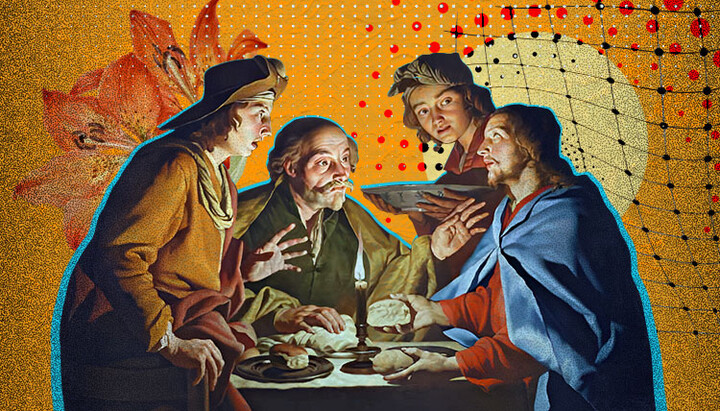
Supper in Emmaus. Photo: UOJ
For both scholars of the Gospel and ordinary believers, the main Eucharistic passage of Scripture is the account of the Last Supper. Indeed, the Church’s greatest Sacrament was instituted under the cover of the night of Holy Thursday, when Christ reclined with His disciples in the upper room and gave them His Body and Blood under the guise of bread and wine. But few remember another event when the Savior gave Communion to two of His apostles. The account of this story was read yesterday at the All-Night Vigil.
The path to recognition
The story of the appearance of the Risen Christ to Luke and Cleopas is found only in the Gospel of Luke. This indicates his direct participation in the events of that wondrous day. Two travelers, walking from Jerusalem to Emmaus, were fervently discussing the latest news. They knew that Jesus, whom they did not yet call God but regarded as “a prophet mighty in deed and word before God and all the people” (Luke 24:19), had recently been crucified. While the crucifixion of Jesus was for them an undeniable fact, they still doubted the reality of His Resurrection.
Suddenly, in the midst of their discussion, the Savior Himself appeared to them but not openly, rather in a veiled way, in the guise of a fellow traveler.
Joining their conversation, He reproaches the disciples for their lack of faith and gradually explains to them “what was said about Him in all the Scriptures” (Luke 24:27). Then the travelers invite the mysterious stranger into their home and share a meal with Him.
“In the breaking of the bread”
Although the account of this meal is brief, it is clear that it had all the features of the Eucharist. Just as at the Last Supper, the Lord takes bread in His hands, blesses it, breaks it, and gives it to His disciples to eat. While the evangelist says nothing about wine, the Eucharistic nature of this meal is indisputable, as shown by the following words: “Then their eyes were opened, and they recognized Him” (Luke 24:31).
Having partaken, the apostles came to the knowledge of God, and the One who had seemed to them merely a fellow traveler was revealed to their spiritual sight as the true God and Savior.
Moreover, when the disciples told the other apostles what had happened, they emphasized that “He was known to them in the breaking of the bread” (Luke 24:35).
From theory to practice
This story once again reminds us of the true purpose of attending Sunday services – to partake of the Body and Blood of Christ in the Sacrament of Communion. Unfortunately, not everyone understands this. Some come to church simply to honor tradition. Others – to submit prayer notes or light candles. Some cross the threshold of the church with the seemingly pious intention of praying during the Liturgy, yet forget that every prayer of the Liturgy draws the Christians nearer to the Eucharist and calls them to unite with God in Holy Communion.
The first Christian communities were established precisely so that their members could gather regularly and partake of the Holy Chalice together.
Whatever the parish may be, large or small, whether it meets in a great cathedral or a modest chapel, all members of the community are called to receive Communion together as one spiritual family. Experience shows that the stronger the parishioners’ zeal to the Eucharist, the firmer their faith and the greater their resolve to defend their Church in times of persecution.
Holy Communion is not merely a Sacrament sanctified by God. It is a window through which we can behold God with the eyes of the soul, come to know His nature, just as the travelers to Emmaus once did, and bear witness to the Risen Christ before the whole world.
Teacher and High Priest
When reflecting on the Gospel accounts of the Eucharist, it is important to notice one more fact: in giving His Body and Blood to the apostles, Christ acts at once as Teacher and as High Priest. First, He instructs the disciples in spiritual truths, explains the meaning of the Sacrament, and reveals to them the doctrine of Himself as the Messiah. Then He proceeds to the sacred action, sanctifying the bread and wine by the grace of the Holy Spirit and imparting the Holy Gifts to the apostles as a testimony to their salvation.
Honoring God as the Teacher of the Gospel, let us strive to follow His commandments in daily life. And in giving glory to Christ as the High Priest, let us seek to receive Communion as often as possible for the forgiveness of our sins and for eternal life.
Read also
Prayer commemorations instead of loving embraces
At every Orthodox wedding, the choir sings a hymn to the martyrs. For families separated by war, these words carry a special meaning.
Honest atheism vs. spiritual hypocrisy
The 70th anniversary of Albert Camus’s Nobel Prize recalls an uncompromising challenge to Christianity. An honest unbeliever brings theology back to the mystery of the Cross.
The valley of trouble and the gateway of hope
One soldier buried an expensive cloak and some gold beneath his tent. Because of this, all Israel lost a battle. Why did one man’s sin bring disaster upon an entire nation?
From love spells to bishop's throne
Antioch’s most powerful sorcerer sent demons against a devout young Christian woman three times – and failed every time. In the end, a demon himself revealed the truth that led to his conversion.
The Weeping Queen of Blachernae
On the night of the Feast of the Protection, only two people witnessed the miracle in the Church of Blachernae. Everyone else prayed and saw nothing. Yet they, too, received grace.
Deadly spiral of human hatred
The tragedy of Lebanon's civil war lays bare how dehumanization and fear can turn human beings into monsters.