A book presented in Rome on “papacy” of Constantinople and Ukrainian schism
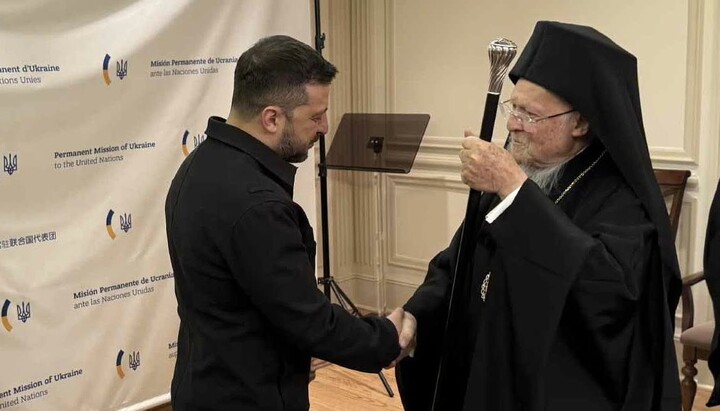
Patriarch Bartholomew with Zelensky. Photo: Press Service of the Ecumenical Patriarchate
On October 24, 2025, the presentation of a collective work titled Orthodox Ecclesiology and the Schism in Ukraine took place in Rome, reports the UOJ’s Greek edition. The book was published by Theosis and authored by Dr. Vasilios Touloumtzis, Athonite monk Fr. Paisios Kareotes, Fr. Epiphanios Kapsaliotis, and Dr. Georgios Karalis.
The authors draw a striking parallel between the growing authority of the Ecumenical Patriarch of Constantinople and the position of the Roman Pope in Catholicism. They claim that the Ecumenical Patriarch has assumed the same prerogatives as the Pope of Rome.
They explain that in the Roman Catholic Church, the Bishop of Rome has direct jurisdiction over all local and particular churches and may intervene in any diocese. He is not regarded as primus inter pares (“first among equals”) – since the First Vatican Council declared his ex cathedra infallibility and universal jurisdiction.
In contrast, the Orthodox tradition holds that bishops possess equal authority and must gather in local or ecumenical councils to make decisions on matters of faith and canon law. The primus inter pares – the patriarch, archbishop, or metropolitan presiding over the council – is subject to it and accountable to his fellow bishops. He may convene and chair the council but cannot infringe upon the autonomy of other bishops or interfere in their dioceses, as he has no universal jurisdiction.
“However, in recent times everything has changed,” the book’s introduction states. “The Ecumenical Patriarch of Constantinople has claimed for himself the same rights as the Pope, and primus inter pares has become primus sine paribus (‘first without equals’) – he now exercises universal jurisdiction. The schism in Ukraine demonstrated the abolition of the Orthodox conciliar tradition – the shift from a synodal ecclesiology of equal bishops to a primacy without equals.”
The authors note that the Seventh Ecumenical Council (787), like the six before it, consolidated and affirmed the Church’s conciliar and canonical tradition, establishing a clear reference point for receiving heretics and schismatics. “Although this Council was invoked by the Patriarchate of Constantinople as an ecclesiological model for recognizing schismatics and undecided Ukrainians, it is clear that no ecclesiological principle was actually observed. As a result, the move did not heal the schism but merely appropriated the title of ‘canonical Church,’” the authors write. “Therefore, this approach has nothing in common with the method or spirit of the Seventh Ecumenical Council.”
According to the authors, the move toward a “primacy without equals” reflects a broader trend of diminishing and marginalizing the patristic tradition. In a hybrid form of theology, it is now used by church institutions merely to serve “political correctness” and achieve harmony with secular powers. The book provides a theological analysis of current ecclesiological developments within Orthodoxy and their consequences for church unity.
The presentation in Rome became a notable event in contemporary Orthodox theological discourse, demonstrating the international resonance of the Ukrainian church issue. Earlier, Patriarch Bartholomew had repeatedly defended granting the Tomos to the OCU, invoking both environmental themes and geopolitical arguments.
Earlier, the UOJ reported that Patriarch Bartholomew had justified the OCU’s Tomos with reference to environmental concerns.
Read also
Metropolitan Onuphry congratulates Georgia on 1,700 years of Christianity
The Primate of the UOC sent a message to Patriarch Shio III on the anniversary of Christianity becoming the state religion in Georgia.
Zakarpattia marks 25th anniversary of Alexis of Carpatho-Russia's glorification
An all-night vigil was served at St. Nicholas Monastery in the village of Iza-Karputlash to celebrate the 25th anniversary of the glorification of St. Alexis of Carpatho-Russia.
DESS finds Balta Eparchy of UOC affiliated with ROC
Yelensky-headed state service said it found signs of affiliation of the Balta Eparchy Administration of the UOC with the ROC.
Upper Lavra court hearing postponed
The next court hearing in the Upper Lavra case has been scheduled for November 3.
UOC priest blesses ambulances at Kamianske medical center
A UOC priest in Kamianske blessed ambulances for a medical facility and wished its doctors God's help in their work.
Dumenko to German ambassador: Law targeting UOC also applies to other groups
Epifaniy Dumenko sought to defend Ukraine’s law restricting religious organizations during a meeting with the German ambassador.