A personal super-history: How to find God in a world of degeneration?
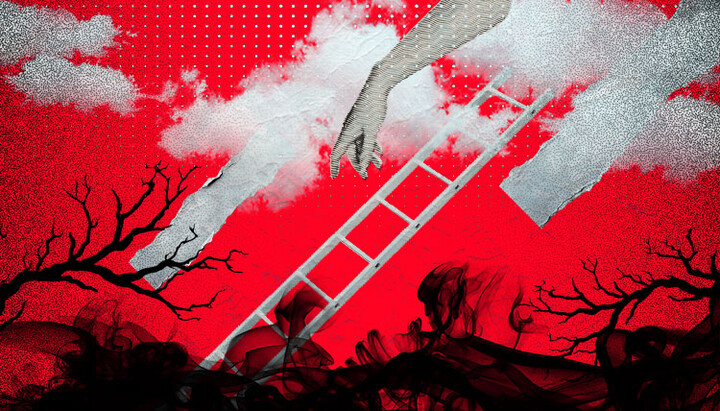
Photo: Spiritual life – liberation from the vortex of degradation. Source: UOJ
This Sunday we commemorate St. Nestor the Chronicler, rightfully regarded as the father of our history and the founder of chronicle writing. In connection with his memory, I would like to reflect on the relationship between each person’s individual life story and the history of the world.
The horizontal of Chronos: the vortex of degradation
The personal story of every human being is woven into the broader fabric of humanity’s story.
Each destiny is a thin, almost invisible thread in the immense, variegated tapestry woven from the fates of nations and peoples.
Our life is like a small lamp among millions of others – flaring up for a brief moment and then fading forever.
But this participation in the linear flow of time is given to us for one purpose: to manage, within the horizontal stream of Chronos, to write our own sacred history – one that will allow us to enter the realm where there is neither time nor shadow of change.
In world time reign entropy, death, and the heaviness of decay. Sin possesses tremendous gravitational power. It resembles a terrible gaping vortex of hell that seeks to draw every soul into itself, convincing us of the futility of resistance, the omnipotence of evil, and the hopelessness before death.
The vertical of Kairos: the birth of a super-history
Yet precisely here, in this darkness of all-consuming night, the path of each soul’s super-history begins – the journey of the one who has found the courage to resist the magnetism of evil and the inevitability of eternal death.
It begins with an act of radical separation from this world, a decision not to take part in the devil’s masquerade. In the depths of the personal cosmos of the heart, one shifts the center of being from the outer world to the inner. One becomes a participant in the New Covenant with Him Who Is – the Only One Who truly exists.
In the depths of a Christian’s inner life, the Holy Scripture of one’s personal relationship with God begins to be written.
Then every breath, every moment washed by repentance, mindfulness, and prayer becomes a point of initiative directed toward Eternity.
We cease to look with revulsion upon the raging world and its frenzied inhabitants. We no longer wait for “better times” – most likely they will not come. Instead, we create our own world within ourselves. We build the ladder of our personal destiny, which rises from the horizontal Chronos dragging us toward non-being, and lifts us into the air of heavenly heights.
Step 1. Purification
This ascending line is the mystical path of the soul, traditionally beginning with inner purification. It is the first and hardest step in spiritual life, accompanied by an inner battle against the passions, aided by the weapon of asceticism and strict discipline over the desires of flesh, mind, and will.
The world’s degradation projects its vices into us and tries to awaken our internal consent.
When we begin to react to the events around us not in prayer, but emotionally or intellectually, we immediately fall into the gravitational field of evil.
Refusing to accept the spirit of the age that justifies decline is the true beginning of ascent. Here the chief weapon is the Jesus Prayer, through which we gather the mind into the heart, freeing our reason from the chaos of the external world and directing our consciousness toward the inner temple.
Step 2. Illumination
The next stage is illumination. Amid the world’s moral darkness, a conscience enlightened and purified by repentance becomes a compass unfailingly pointing toward the will of God. This inner, personal law becomes higher than any other – whether social norms or state decrees.
The Gospel truth, reflected in a pure prayerful heart, becomes the only law a person follows uncompromisingly.
The moral decay of the world has become the source of suffering for millions. Yet on the path of illumination these sufferings are transformed into participation in the Passion of Christ. We begin to understand their meaning and redemptive purpose – first of all for ourselves. We come to accept suffering without fear, but with gratitude, as medicine that heals and transfigures the soul.
Step 3. Deification
The third and final stage is union with God – deification. At this point the human being becomes a partaker of eternity and of the Divine Nature (2 Peter 1:4). This is the creation of the super-history.
The fruit of this stage is the real awareness of one’s divine sonship or daughterhood in the Holy Spirit.
Such a Christian becomes a living witness against the world’s degradation – not in words, but by his very being. Yet the world instantly recognizes such a person and unleashes upon him the full force of its slander, malice, and destruction.
The three pillars of the super-history
Metaphysically, one’s personal super-history rests on three pillars, beyond the reach of worldly decay:
- Personal seeking of God: the priority of direct encounter with the Living God over all earthly affairs.
- Life in an eschatological perspective: living in expectation and preparation for eternal life, which renders all temporal troubles secondary, no matter how serious they may seem.
- Participation in Church worship and the Sacraments: for in them we touch eternity, which enters into our personal story.
Thus, within Chronos, we discover our Kairos – the moment that leads us out of darkness into light, from corruption into incorruption, from the world of eternal death into the world of eternal life.
Read also
The Time of the Soul's Ripening
Modern society has turned youth into a cult and calls old age a period of "living out one's days." The Christian view reveals the deep spiritual meaning of one's later years.
Faith is not a checker piece in a spectator sport
Arguments about faith on social media increasingly resemble no-holds-barred fights. We turn to a saint who, sixteen centuries ago, knew how to speak to those interested only in turning theology into a combat arena.
The metropolitan who fought with a pen
St. Cyprian of Kyiv was robbed, expelled, and barred from his see. He answered with letters, books, and canons – and before his death, forgave everyone.
Loneliness under one roof
Spouses can share a home for years, raise children, and faithfully attend church – yet remain strangers to each other.
The cross – the deepest healing of the human soul
Emotional exhaustion and anxiety have become a way of life. Ancient Christian tradition offers an unexpected way out – embracing one's own cross.
The Prophet Elisha and the mystery of the Bethel massacre
The story of the prophet Elisha and the two bears seems to be the harshest in the Bible. But in reality, it carries a profound theological meaning.