Catharsis and theosis: two stages of salvation in the Gospel of Mark
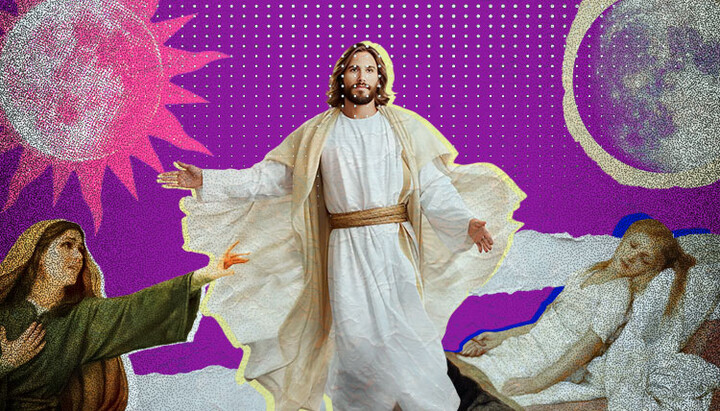
Purification and deification – two paths to salvation. Photo: UOJ
The theme of this week's Gospel reading is the healing of the bleeding woman and the resurrection of Jairus' daughter. From it, we learn about a woman who, for twelve years, could not be healed of her illness. And about Jairus' twelve-year-old daughter, who died before she could reach the fullness of maturity.
The number twelve is deeply symbolic. 12 tribes of Israel, 12 apostles, 12 gates in the Heavenly Jerusalem – it is a number of fullness, completeness.
This is a metaphor saying that no human completeness can bridge the chasm between us and the Source of Life.
To be healed or to come alive, we need to touch God, and God needs to touch us.
Step 1. Catharsis (purification): the touch of faith
When the bleeding woman touches the edge of Christ's garment (the "tzitzit" – the fringe, to be precise), something astonishing happens. Christ speaks of a mysterious power, in the Greek translation – energy, that went out from Him.
In the theology of Gregory Palamas, this power is not a magical substance.
It is the uncreated energy of God Himself. Better to say: it is God Himself, acting beyond His Essence.
We can partake in the energies of God because God became man.
But for the mystical perception of Divine energies to occur, we need an organ of perception. And the Gospel passage teaches us that this organ is human faith. It is the result of synergy (joint action) of human will, faith, and Divine power.
Elder Paisios of Mount Athos said that "the bleeding woman was healed because her will met with Divine power. She took her step (the touch), and the Lord gave His grace (power). This is synergy."
As Saint John of Kronstadt writes, the faith of the bleeding woman was active, not dreamy. Faith is not an empty feeling, but a force that attracts Divine energy. "If you believe, then grace flows from Christ and enters you like an electric current," he writes in his diaries.
Step 2. Theosis (deification): resurrection in silence
The healing of Jairus' daughter paints a slightly different picture. The girl had died. She could no longer do anything for herself. Similarly, our heart is dead, deprived of eternal life.
Christ, upon entering Jairus' house, first drives out all noise – the mourners, the crowd, the bustle, and the skeptics. Only then, with His Word, that is, the direct power of absolute Divine authority, does He resurrect the girl.
The Lord addresses her in Aramaic: "Talitha – kumi."
"Talitha – kumi" (maiden, arise) – these are not just words. This is the life-giving Light, Divine energy, which can directly vivify the created world, resurrecting it from the dead.
This scene is a protocol of how the Divine Logos can revive our dead heart. First of all, we need to drive out all bustle, passions, and idle thoughts from it – just as Christ drove the crowd out of Jairus' house.
He allowed only three witnesses to remain: Peter, John, and James. These are the three powers of the soul: mind, will, and emotions. Or, according to another interpretation, the three main virtues: faith, hope, and love, which become the recipients of resurrection.
In hesychia (the silence of stillness) and purity of heart, the soul begins to breathe again, receiving the life-giving Word of Christ, which grants eternal life.
The path from purification to deification
Thus, this Gospel story is not just a chronicle.
It is an illustration of two stages of salvation, a living example of the practice of spiritual life.
The bleeding woman is the path of purification (catharsis). The path of healing from the chronic ailment of sin through the active touch of faith to Divine energy.
Jairus' daughter is the path of deification (theosis). Resurrection from death through the Word of Christ, which occurs in hesychia (inner silence), where the soul, cleansed from worldly noise, becomes receptive to the Logos.
The Lord invisibly stands at the doors of our heart. He waits for us, like the bleeding woman, to touch His grace with faith, and for us, like Jairus, to drive the noise of the world out of our heart, to hear His life-giving Word: "Arise!"
Read also
Honest atheism vs. spiritual hypocrisy
The 70th anniversary of Albert Camus’s Nobel Prize recalls an uncompromising challenge to Christianity. An honest unbeliever brings theology back to the mystery of the Cross.
The valley of trouble and the gateway of hope
One soldier buried an expensive cloak and some gold beneath his tent. Because of this, all Israel lost a battle. Why did one man’s sin bring disaster upon an entire nation?
From love spells to bishop's throne
Antioch’s most powerful sorcerer sent demons against a devout young Christian woman three times – and failed every time. In the end, a demon himself revealed the truth that led to his conversion.
The Weeping Queen of Blachernae
On the night of the Feast of the Protection, only two people witnessed the miracle in the Church of Blachernae. Everyone else prayed and saw nothing. Yet they, too, received grace.
Deadly spiral of human hatred
The tragedy of Lebanon's civil war lays bare how dehumanization and fear can turn human beings into monsters.
Woe to expectant mothers – or to those of little faith?
God commanded one prophet not to have children, yet told his people in exile to bear sons and daughters. What does this apparent contradiction tell us today?