Opening a bust of Mazepa: A new era for Kyiv–Pechersk Lavra. Or not?
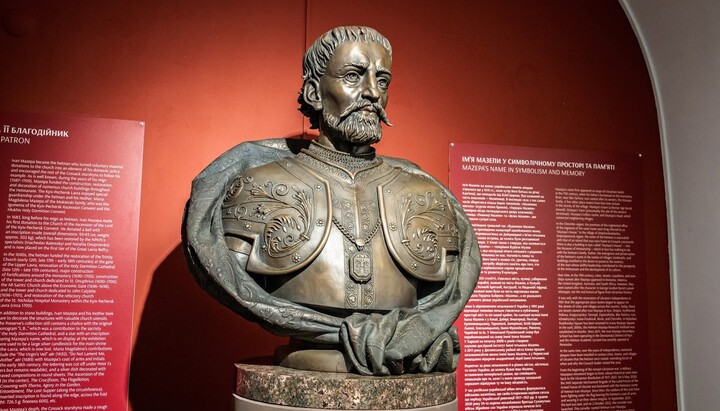
Bust of Mazepa in the Lavra. Photo: Kotliarevska’s Facebook page
In the empty, desolate Kyiv–Pechersk Lavra, the stream of “remarkable” events continues. The director of the Lavra Reserve, S. Kotliarevska, proudly announced the beginning of a “new era” in the life of the ancient holy site – a half-meter bust of Ivan Mazepa has been unveiled in one of the premises.
A couple of weeks earlier, Kotliarevska had just as proudly declared that graffiti depicting a woman in a bathrobe, holding a fire extinguisher, wearing a gas mask and curlers, had been installed in the Lavra. Even before that, the reserve held courses on project management and marketing inside the monastery.
Before that, in the Lavra’s Refectory Church, officials presented a sociological survey probing whether Ukrainians are proud of their citizenship. Before that, they organized lectures on what a Cossack’s zhupan looked like, what the design of a woman’s katanka-menta was, and whether people wore sharovary in the mid-seventeenth century.”
Before that came a 3D-model exhibition in the Refectory, concerts by a song and dance ensemble, cooking shows, lectures by a Muslim mufti, and so on.
All of this merges into one continual “new era” in the life of the Kyiv–Pechersk Lavra, where there is space for every variety of cultural and informational garbage. There is only no place left for prayer – the very purpose for which this holy site was built and preserved for a thousand years. And we all understand perfectly well that there is nothing “new” about this era. It is simply the reincarnation of the Soviet mindset, which today’s new commissars are attempting to repaint from red into yellow-and-blue. And they are doing it so incompetently that the old paint clearly shows through the fresh layer.
It is telling that on the very day the Mazepa bust was unveiled, the head of DESS, Yelensky, held a “congress of the indigenous peoples of Ukraine,” meaning, in today’s usage, the Crimean Tatars, Karaims, and Krymchaks. According to the official, the government must do everything it can to support their development, insisting that they “do not want and will not agree to live in textbooks, ethnographic brochures, or museums.”
Which raises a question – what about the Orthodox people? Do they not need support? Do believers supposedly want to “live in a museum”? Do Zelensky, Yelensky, and the Kotliarevska entourage truly believe that in ancient churches, instead of divine services, one should hold these ridiculous Soviet-era, village-club-level events? Is there really nowhere else to stage them?
We are convinced that today’s “ruin” will pass, that the new Shvonders will vanish, and that the people will once again enter their Lavra sanctuaries and venerate the relics of the Venerable Fathers of the Caves.
For now, we must pray that this day comes sooner.
Read also
Why is Jerusalem “wrong” about OCU, but Constantinople isn’t?
In the eight years since the OCU was established, we have never once heard its leader suggest that the Patriarch of Constantinople is capable of error.
Who destroyed and restored Kyiv Lavra? MinCulture's video reveals the truth
The Culture Ministry’s propaganda about the Kyiv-Pechersk Lavra has inadvertently revealed the truth.
Ternopil post on Feast of Intercession: Has calendar reformn failed?
A significant number of believers have rejected the new church calendar introduced by the OCU and UGCC with government support.
Shoulder straps or a cassock: who writes the script for UOC "fighters"?
Everything indicates that both Veliar and Pshenychny are ordinary performers of someone else's script. There is only one question – does the scriptwriter wear shoulder straps or a cassock?
Why is it legal to kill a person before birth but not after?
Children are the most privileged members of society. Yet that same society officially permits children to be killed – and on a massive scale.
Honoring the Bolsheviks’ successors at Kyiv Lavra
It was under the Reserve that the relics of the saints were desecrated, Lavra churches were turned into an atheism museum, and toilets were installed in sanctuaries.