Liturgical and canonical violations during the Pope’s visit to Constantinople
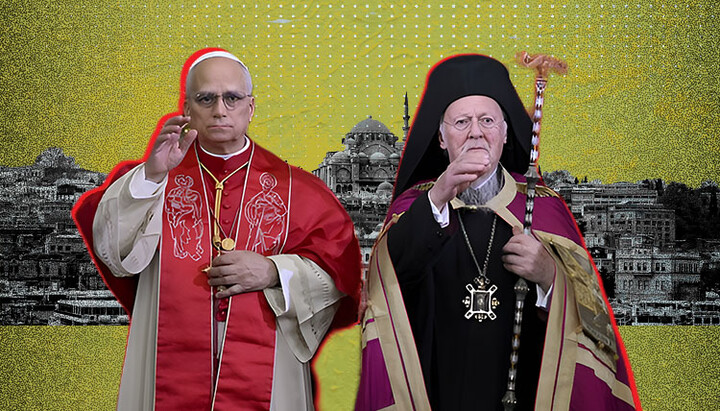
A significant step toward “unity” with Catholics was taken on the Phanar. Photo: UOJ
On November 30, 2024, an event took place in the Church of St. George on the Phanar that caused profound concern among Orthodox Christians. The visit of Pope Leo XIV to Constantinople and his presence at a service presided over by Patriarch Bartholomew exposed numerous liturgical, canonical, and ecclesiological irregularities that demand careful theological scrutiny. What exactly happened?
Liturgical anomalies and canonical violations
The first striking detail evident from the recordings is the Pope’s arrival on the Phanar on November 29 and his act of blessing Orthodox Christians – something absolutely inadmissible according to Orthodox canon law. In particular, Apostolic Canon 45 states that Patriarch Bartholomew should not have permitted this (“A bishop or presbyter or deacon who has merely prayed with heretics shall be suspended; if he allows them to perform anything as though they were ministers of the Church, he shall be deposed”).
Moreover, the Pope processed with a pastoral staff that may be used only by the true shepherd of the Church of Christ – again raising the question of why Patriarch Bartholomew allowed such actions.
Violation of the order of commemoration in the diptychs
Another canonical violation occurred when the Pope was commemorated first in the diptych, before Patriarch Bartholomew. During the doxology the deacon proclaimed: “Again we pray for the most holy bishop of Rome, Pope Leo, and for our archbishop and patriarch Bartholomew.”
This is a blatant affront to the foundations of Orthodox ecclesiology. According to Orthodox teaching, the Patriarch of Constantinople occupies the first place of honor among Orthodox primates – because the Bishop of Rome fell into heresy and is excluded from the diptychs of the Orthodox Church. The Ecumenical Patriarchate is called the First Throne precisely because its Primate presides at liturgical services and councils. In the diptychs, the name of the Ecumenical Patriarch must always stand first among Orthodox hierarchs.
To commemorate the Pope first reinstates a pre–1054 order of precedence. After the Great Schism, the Pope cannot hold first place; restoring it amounts to recognizing his primacy and, in a sense, abandoning Orthodox ecclesiology.
Use of liturgical vesture by the Pope
A highly significant moment is that the Pope entered the church during the singing of the Trisagion – precisely the moment when, according to Greek tradition, the bishop who presides at the Divine Liturgy enters the sanctuary. The Pope was vested in the Pallium pretiosum (Papal stole) – a distinctive liturgical vestment used only at solemn liturgies.
This means that the Pope was not merely present as a guest but participated prayerfully as a hierarch.
Liturgical glorification of the Pope
After the Liturgy the chanters intoned: “Τὸν αγιώτατον καὶ μακαριώτατον κύριον κύριον, τὸν Πάπαν Ῥώμης Λέοντα, Κύριε φύλαττε, εἰς πολλὰ ἔτη” – “Preserve, O Lord, for many years the most holy and most blessed lord, the Pope of Rome Leo.”
It must be remembered that in Orthodox worship the formulas “Κύριε φύλαττε” and “εἰς πολλὰ ἔτη” are pronounced only for those who are in Eucharistic communion with the Church. To commemorate and glorify a hierarch in this manner signifies recognition of him as a legitimate bishop in unity of faith and Eucharistic fellowship.
To use such a formula for the Pope, who is not in communion with Orthodoxy, is a grave canonical violation.
Such a formula expresses blessing, recognition of hierarchical dignity within one Church, and liturgical unity. In effect, it is a liturgical acknowledgment of the Pope as an Orthodox hierarch – which is a falsehood and a deception of the faithful. For an Orthodox Christian to use such a formula for a heretic is to violate fundamental ecclesial canons and betray Orthodoxy.
Irregularities in the order of liturgical commemoration
During the Liturgy itself numerous departures from the Orthodox order were committed. Patriarch Theodore of Alexandria did not commemorate Patriarch Bartholomew, though according to liturgical order a concelebrating bishop who receives the Holy Chalice must commemorate the presiding patriarch.
Even more strange was the order of commemorations after the consecration of the Gifts. According to Orthodox practice, Patriarch Bartholomew, as the celebrant, should commemorate all Orthodox patriarchs, and then all concelebrating bishops and priests jointly commemorate him.
But on the Phanar that day the order was reversed. Patriarch Bartholomew commemorated all Orthodox; then Patriarch Theodore did the same; then the representative of the Patriarchate of Antioch commemorated Patriarch John “first,” the representative of Jerusalem commemorated Patriarch Theophilos “first,” then hierarchs of the Ecumenical Patriarchate commemorated Patriarch Bartholomew one by one, and only at the very end did they commemorate him jointly as “first.”
A natural question arises: who, then, is “first”? According to the commemorations of November 30, the “first” would be Patriarch John of Antioch. Yet this contradicts Orthodox ecclesiology; such confusion creates liturgical chaos and reveals either complete ignorance of Orthodox order or its deliberate distortion.
Why did this occur? One possible explanation is the desire not to “offend” the Pope – who, before 1054, held the first place.
The kiss of peace before the Creed
Another striking detail concerns the kiss of peace before the Creed. After the deacon’s call “Let us love one another, that with one mind we may confess,” the Pope was led to the center of the church, and Patriarchs Bartholomew and Theodore came out of the sanctuary to exchange the kiss of peace with him. Only afterward did they exchange the kiss with the concelebrating hierarchs.
It must be stressed that the words “that with one mind we may confess” indicate that the celebrants are united in faith, having no dogmatic disagreements.
The kiss exchanged with the Pope at this moment creates the impression that no dogmatic differences remain.
A Roman Catholic theologian recently stated precisely this – that Orthodox and Catholics “share a common faith properly defined in the Nicene–Constantinopolitan Creed and have achieved mutual understanding regarding the sacraments; the main issue now concerns the structure of the Church, that is, the ministry.” According to him, the only remaining obstacle to full unity is the question of the Pope’s primacy and infallibility.
Such claims not only distort reality but intentionally mislead the faithful. The Roman Catholic Church continues to uphold the Filioque and many other doctrinal errors separating it from Orthodoxy. There is no dogmatic unity between Orthodoxy and Catholicism – and therefore such a kiss during the Liturgy constitutes liturgical falsehood.
The issue of the Pope’s recitation of the Creed without the Filioque
Defenders of Patriarch Bartholomew attempt to justify the kiss of peace and joint prayer by claiming that Pope Leo XIV accepted the Nicene–Constantinopolitan Creed without the Filioque, thereby supposedly drawing closer to Orthodoxy. Such reasoning reveals either theological ignorance or deliberate manipulation.
Catholic apologetics have long developed a sophisticated strategy to justify their insertion into the Creed, reducing the dogmatic problem to a supposed difference between Greek and Latin theological language. According to this concept, the Greek term ἐκπορεύομαι (ekporeuomai), used by the Fathers of the Second Ecumenical Council, denotes the ontological, eternal procession of the Holy Spirit – His hypostatic origin from the Father. The Latin procedere, Catholic theologians claim, refers not to this ontological origin but to the Spirit’s temporal mission and activity in salvation history.
They then construct a theory: the Holy Spirit proceeds ontologically from the Father as the sole source of the Godhead – but is sent into the world by the Son, which supposedly justifies the Latin procedit.
This scholastic distinction between “eternal procession” and “temporal mission” allows Catholics to argue that no real contradiction exists – only different emphases.
But such theological acrobatics collapse under scrutiny.
The Fathers of the Church who formulated the Creed knew both Greek and Latin and, had they deemed such distinctions necessary, would have expressed them. The Creed is a confession of faith, not an academic treatise; every word carries binding dogmatic meaning, and no additions are permissible regardless of intent.
Most importantly: the Filioque issue did not arise from linguistic misunderstanding. Its root lies in the unilateral action of the Western Church, which presumed to alter the Creed without a council and without the agreement of the entire Church. This violation of conciliarity makes the Filioque unacceptable even if it were theologically sound – which it is not.
Furthermore, Pope Leo XIV is not the first to “recite” the Creed without the Filioque; John Paul II did the same. Such gestures change nothing.
The Vatican’s repeated claim that dogmatic differences no longer exist – that the only obstacle is papal primacy – makes the Phanar’s actions all the more troubling. Analysts note that in the event of union, the Ecumenical Patriarchate would likely receive the status of a sui iuris church – similar to the Armenian Catholics, Syro–Malabars, Malankara Catholics, or the Ukrainian Greek Catholics – with no expectation of expanded rights.
Manipulations involving the legacy of Fr. Ioil Yiannakopoulos and the stance of Elder Paisios
Against the backdrop of the Pope’s visit to Turkey and strong criticism from Greek clergy and theologians, the pro–Phanar website Fos Fanariou published, on November 28, fragments of previously unpublished correspondence between the revered spiritual father and theologian Archimandrite Ioil (Yiannakopoulos) and Patriarch Athenagoras.
In a letter dated December 1966, Fr. Ioil wrote: “Undoubtedly, the unity of the Churches – which we always desire in peace, in the Liturgy, and for which the Lord Himself prayed in His High–Priestly prayer (John 17:11) – is still far away because of our doctrinal differences. Yet our love for other Churches must, for reasons of prudence and substance, be cultivated intensively through dialogues and meetings.”
How these words can justify what happened on the Phanar remains unclear. At the same time, the Phanar–aligned media fully ignored the view of Saint Paisios the Athonite, who said: “When the Patriarch meets with the Pope, what benefit does it bring to the Church? None. And what harm? Great harm. Because it misleads simple people.”
These words describe with precision what is happening now.
Simple believers, seeing the Patriarch pray with the Pope, receive his blessing, and exchange the kiss of peace with him during the Liturgy, inevitably conclude that no serious differences remain between Orthodoxy and Catholicism. They are misled, given a false impression of dogmatic unity where none exists.
Saint Paisios also stressed the need for unity among Orthodox Christians before any discussion of unity with Catholics. He taught: “First the Orthodox themselves must be united, and only then should we think of others. What is the point of uniting with those in heresy if we ourselves are not at peace with one another?”
These words resonate powerfully today, as the Orthodox Church faces deep internal divisions. The Ecumenical Patriarchate is not in Eucharistic communion with the Russian Orthodox Church because of the Ukrainian schism. Significant disagreements exist among Local Churches. In such a situation, seeking unity with Catholics appears absurd and reveals utterly distorted priorities.
In modern ecumenism, theology has long receded into the background. Even the Filioque was introduced primarily as a political act – a demonstration of Western self–assertion and authority, a declaration that Rome could alter the Creed without a council. The theological justifications appeared only later.
Today, when the Vatican readily displays remarkable flexibility by reciting the Creed without the Filioque, it becomes evident that the dogma itself was never the true end. Rome is prepared to offer any “concessions” regarding secondary doctrines for the sake of its principal goal – the primacy of the “Roman Pontiff.” Everything else is negotiable.
***
The events that unfolded on the Phanar on November 30, 2024 lead to sobering and alarming conclusions. We have witnessed egregious violations of Orthodox canon law, distortions of the liturgical order, and the deliberate misleading of the faithful regarding the dogmatic gulf that still separates Orthodoxy and Catholicism. All of this reveals a profound crisis within the Ecumenical Patriarchate. The Catholic Church has neither renounced its errors nor shown any intention of doing so, and all talk of a “historic event” or a “step toward unity” is nothing more than empty rhetoric masking stark and uncomfortable realities.
What is required of us now is sobriety of mind and resistance to manipulation. The unity of the Church is possible only in truth – never through compromise with heresy. As Saint Paisios warned: “Our duty is not to betray what we have received from the saints.” This admonition of the holy elder must remain our guiding star in these troubled times.
Read also
Yelensky’s plan: Why is DESS demanding what the UOC has already done?
DESS is demanding that the UOC take steps it has already taken, while offering no assurance that further demands will not follow. What is behind Yelensky’s ultimatum?
Why OCU hierarchy lacks canonical ordination: what Local Churches say
The OCU head refuses to address invalidity of his ordinations. But almost all Local Churches speak of it – even those that recognized the OCU.
Why nation-first advocates do not call for peace
Ukraine’s population is declining by nearly one million people a year, and experts are warning of the nation’s demographic extinction. Yet the leaders of the Orthodox Church of Ukraine (OCU) and the Ukrainian Greek Catholic Church (UGCC) continue to call for war and mobilization.
The deception that decided the fate of the Tomos
In 2008, the "Filaret problem" derailed Yushchenko's plan. In 2018, Poroshenko solved it in just one hour – with a police escort for the Greeks and verbal promises to Filaret.
Lawyers in the crosshairs: How UOC is being stripped of its right to defense
Activists harass UOC lawyers outside courthouses, call them “traitors” on air, and promise them a “warm welcome” at hearings. The Church’s right to a legal defense is at stake.
How to respond to persecution: Lessons from St. Silouan the Athonite
The Church can and should be defended, but without malice. Why love for persecutors is not weakness but the only way to preserve the Spirit of Christ in the midst of the struggle.