Theology of the OCU: Do Christians and Jews have one Messiah?
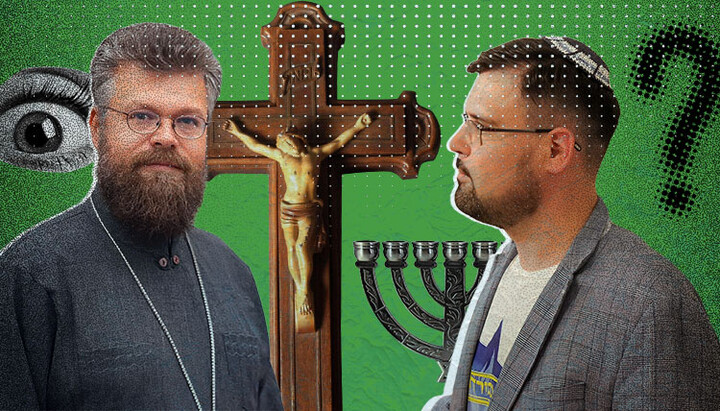
An OCU member believes that Christianity is a new stage of Judaism. Photo: UOJ
The podcast «Christianity and Judaism: Are We Seeking One God?» features: the secretary of the Theological-Liturgical Commission of the OCU and associate professor of the Theological Academy Andriy Dudchenko and Torah teacher Yuri Radchenko. In this conversation, among other things, one of the main theologians of the OCU voiced three theses: firstly, that Christianity is a more advanced version of Judaism. Quote: "If we take the faith of the 1st century, the faith of Judaism of the period between the Testaments – before and during the life of Jesus Christ, – this, I would say, is Judaism 1.0. What we have today – modern versions of Judaism – is Judaism 1.5. And we have Judaism 2.0, to which, I believe, we, Christians, belong."
Secondly, that Christianity and Judaism are different paths to one God. Quote: "And the diversity of traditions indicates that there are certain different paths to this one God."
Thirdly, that the Savior in Christianity and the Mashiach in Judaism are the same person. Quote: "Yeshua Mashiach, ben Yosef, ben David – Jesus Christ, son of David, son of Joseph. I think that the Mashiach – if the Jews wait for their true Mashiach – they will be surprised that it is the same. For us, he will come for the second time, and for them, he will come for the first time».
His interlocutor categorically disagreed with this and stated that "we (Judaism and Christianity – Ed.) are separate religions, separate worldviews." In this, he is absolutely right, although it is necessary to make an important clarification here: modern Judaism or, so-called post-Temple Judaism, which was formed after the rejection of Christ by the Jews and the destruction of the Jerusalem Temple in 70 AD, is indeed a separate worldview from Christianity, a separate religion. From Old Testament Judaism, it is also a separate worldview, but we will not develop this thesis now.
Why Christianity is not Judaism 2.0
In general, reducing complex theological and worldview questions to primitive computer terminology is ill manners. The level of Sharikov from the story " The Heart of a Dog". These are not the simple parables through which Jesus Christ revealed the greatest meanings of existence. This is primitive vulgarity, which, on the contrary, leads the listener away from understanding the essence.
A. Dudchenko claims that Christianity is an improved version of Judaism. But in fact, it is quite the opposite. Christianity arises BEFORE Old Testament Judaism. And this Old Testament Judaism performs not an independent, but only an auxiliary function: to prepare people for the coming of the Savior.
This is what the Apostle Paul says about the Mosaic law: "What purpose then does the law serve? It was added because of transgressions, till the Seed should come to whom the promise was made; and it was appointed through angels by the hand of a mediator" (Gal. 3:19), and adds: "…the law was our tutor to bring us to Christ…" (Gal. 3:24).
Jesus Christ speaks directly about the primacy and original nature of Christianity in His conversation with the Jews. When they ask Him, “Are You greater than our father Abraham, who is dead?” (John 8:53), He answers them, bluntly speaking: “Most assuredly, I say to you, before Abraham was, I AM.” (John 8:58)
Why the God of Christians is not the same as that of the Jews
In the same conversation of Christ with the Jews, described by the Apostle John in the 8th Chapter of the Gospel, the Lord also answers this question. During the talk, the Jews proudly called themselves descendants of Abraham and claimed that God was their father: "They answered Him, 'Abraham is our father.' …> They said to Him, 'We were not born of fornication; we have one Father – God'» (John 8:39-41).
To this, the Lord said very harsh and even shocking words: "If God were your Father, you would love Me, for I proceeded forth and came from God; nor have I come of Myself, but He sent Me. …> You are of your father the devil, and the desires of your father you want to do. He was a murderer from the beginning, and does not stand in the truth, because there is no truth in him. When he speaks a lie, he speaks from his own resources, for he is a liar and the father of it» (John 8:42-44).
That is, whoever worships the True God must love Christ, because Christ came from God. Whoever does not accept Christ has the devil as their father.
This is also mentioned in one of the epistles of the Apostle John the Theologian: “Who is the liar, if not the one who denies that Jesus is the Christ? This is the antichrist, who denies both the Father and the Son. Whoever denies the Son does not have the Father; but whoever acknowledges the Son has the Father also.” (1 John 2:22–23).
Do all paths lead to God?
Many liberal theologians say that all or many religions lead to God, just by different paths. For example, the head of the American Archdiocese of the Ecumenical Patriarchate, the author of the "first without equals" theory and one of the main contenders for the patriarchal throne, Archbishop Elpidophoros (Lambriniadis) even stated that all religions are "myriads of paths leading to the same place".
But the Gospel says quite the opposite. In the last hours before His arrest, Christ said to His disciples: “I am the way, the truth, and the life; no one comes to the Father except through Me” (John 14:6). Likewise, the apostles of Christ taught: “He is the stone you builders rejected, which has become the cornerstone; and there is salvation in no one else, for there is no other name under heaven given among men by which we must be saved” (Acts 4:11–12).
In the already mentioned conversation of Christ with the Jews, He directly says: "If you do not believe that I am He, you will die in your sins" (John 8:24). And then follows a more than eloquent statement: "Then they said to Him, 'Who are You?' And Jesus said to them, 'Just what I have been saying to you from the beginning'" (John 8:25). A little later, the Lord repeated this thought in other words: "I and My Father are one» (John 10:30). The Jews understood this thought quite correctly and wanted to stone Jesus Christ "for blasphemy, and because You, being a Man, make Yourself God" (John 10:33).
Is the Messiah in Christianity and Judaism the same?
The patristic teaching quite unequivocally states that the Messiah expected by the supporters of post-Temple Judaism will be the Antichrist. This teaching is based on the words of Christ: “I have come in My Father’s name, and you do not receive Me; but if another comes in his own name, you will receive him” (John 5:43).
The Holy Fathers write that this refers to the Antichrist.
"But of whom does He speak: 'comes in his own name'? Here Christ hints at the Antichrist, and at the same time presents irrefutable evidence of their ill will," (St. John Chrysostom).
«And another will come, that is, the Antichrist, who will prove that he is the only God," (St. Theophylact of Bulgaria).
«But you 'will receive,' of course, – as God, I know the future – the falsely named (stranger), not attributing glory to God and the Father and demanding faith from you, but working 'for his own name'» (St. Cyril of Alexandria).
This is how the Apostle Paul describes the coming of the Antichrist: “Let no one deceive you by any means; for that Day will not come unless the falling away comes first, and the man of sin is revealed, the son of perdition, who opposes and exalts himself above all that is called God or that is worshiped, so that he sits as God in the temple of God, showing himself that he is God.” (2 Thessalonians 2:3–4).
John of Damascus writes: “The Jews, accordingly, did not accept the Lord Jesus Christ, Who was the Son of God and God, but accepted an impostor calling himself God. …> For he will not come to us, but to the Jews; not for Christ, but against Christ and Christians; hence he is called the Antichrist.”
Cyril of Jerusalem: “If he comes to the Jews under the name of Christ and wants the Jews to worship him, then—so as to deceive them more effectively—he will take special care concerning the Temple…”
Hippolytus of Rome: “…none other than the Antichrist, who himself is also to restore the Kingdom of the Jews.”
Why speak falsehoods?
One should not think that the secretary of the Theological Commission of the OCU, A. Dudchenko, is unaware of everything mentioned above. Certainly, he knows. So why, then, does he assert the opposite? It seems that the issue here is one of priorities. For some, the priority is to remain faithful to Christ and the Gospel; for others, it is to please their interlocutor – or at least to try.
To be an attribute of statehood, to correspond to the expectations of society, to fit in – this is what many church figures prioritize today. To sacrifice the Gospel truth, to close one’s eyes to the words of Christ, to forget the teaching of the Holy Fathers – this is, for them, an entirely acceptable price to pay in order to be liked by society, and especially by those in power.
“We all have one God,” “all religions teach the same thing,” “we accept everyone regardless of sexual orientation,” and so on – today we often hear such narratives. And the Scripture also speaks about this: “For the time will come when people will not put up with sound doctrine. Instead, to suit their own desires, they will gather round them a great number of teachers to say what their itching ears want to hear…” (2 Timothy 4:3).
The conclusion from all this is the following: we must flee from teachers "to say what their itching ears want to hear" and listen only to those whose words and deeds are in accordance with the Gospel.
Read also
The deception that decided the fate of the Tomos
In 2008, the "Filaret problem" derailed Yushchenko's plan. In 2018, Poroshenko solved it in just one hour – with a police escort for the Greeks and verbal promises to Filaret.
Lawyers in the crosshairs: How UOC is being stripped of its right to defense
Activists harass UOC lawyers outside courthouses, call them “traitors” on air, and promise them a “warm welcome” at hearings. The Church’s right to a legal defense is at stake.
How to respond to persecution: Lessons from St. Silouan the Athonite
The Church can and should be defended, but without malice. Why love for persecutors is not weakness but the only way to preserve the Spirit of Christ in the midst of the struggle.
Where the Spirit of the Lord is, there is freedom
Reflections on the controversies surrounding the creation of the OCU.
Pentarchy with Rome: A return to the roots or a new schism?
Patriarch Bartholomew wants to revive a council of five patriarchates, including Rome. What would reunion with Catholics look like, and what role would be left for the other Churches?
Concubine or daughter? On words that cannot be used about the Church
An archon of the Church of Constantinople likened the UOC to Moscow’s “concubine.” But for St. Epiphanius of Cyprus, “concubines” are heresies.