God in the soul or a phone charger? An honest conversation about the Church
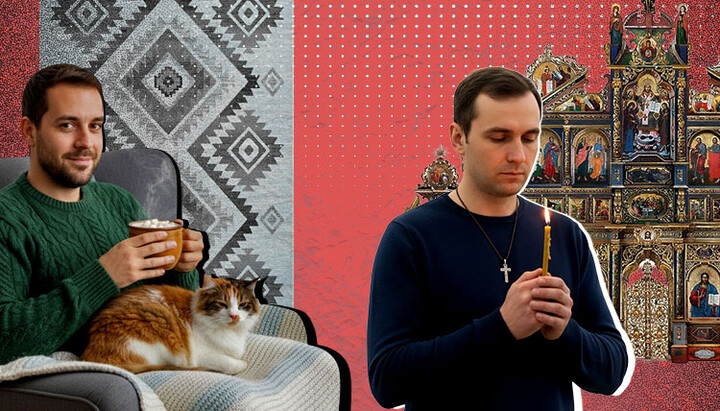
"Comfortable" and true Christianity. Photo: UOJ
Let us be honest with ourselves: sometimes going to church feels like an endurance test. We step under the vaults, and we are immediately hit by the heavy smell of wax, the whispering disapproval of elderly women, and endless services where half the words are impossible to make out. At moments like these, the thought “God is in my soul” seems not just logical, but saving.
We imagine a cozy armchair, a cup of hot tea, an open Gospel, and a quiet conversation with the Creator. No intermediaries. No lines for confession. No sticky stuffiness.
It sounds so right. So modern. But this is precisely where the main trap lies. We often confuse psychological comfort with spiritual healing, and the theory of life with life itself.
Comfortable coziness versus “spiritual bleach”
The church often frightens us with its “imperfection.” We see a somewhat rough priest rushing somewhere, or parishioners whose behavior is infinitely far from any image of holiness. And we draw a quick conclusion: if it is so uncomfortable there, then God is not there.
But imagine an ordinary hospital. Do we turn around at the entrance to surgery just because it smells of bleach and the nurses do not smile like in an advertisement for a luxury hotel? We go there because we need medicine. And it is impossible to make that medicine in your own kitchen, no matter how hard you try.
The church is not an exhibition of flawless people. It is an intensive care unit, where everyone – including the priest – is lying under the IV drip of God’s grace.
When we say that we believe “in our soul,” we make the same mistake as a person studying a swimming textbook while lying on the couch. He may know the crawl technique perfectly, understand the chemical composition of water, and remember all Olympic records. But he remains dry. The Church is always a jump into the water. It is a transition from beautiful reflections about God to a real, physical encounter with Him.
Why does our inner processor freeze without recharging?
Christianity is a religion of flesh and blood. God did not merely send us His “right ideas.” He became incarnate. He took on a human body. He could be touched. He could be embraced. And He left us a way of the same tangible contact with Himself.
To understand how this works, let us look at our smartphone. Our soul is a very complex device with a powerful processor. We can believe in the existence of electricity as much as we like. We can even admire the laws of physics. But if the phone is dead, it will not come back to life by the sheer force of our belief. It needs physical contact with the socket. You have to plug it in.
The Church and its Sacraments are that very socket through which energy flows. Communion is not just a “beautiful symbol” or an ancient ritual. It is a direct injection of Divine life into our de-energized nature.
Without this contact, our inner “processor” gradually slows down. Applications shut off, the screen dims, and we are left holding a piece of dead plastic that we continue, out of habit, to call “spirituality.”
How “inconvenient” people save us from a “pocket god”
Many of us are afraid of the Church also because it is an overly honest mirror. At home, alone with ourselves, we very easily create a “pocket god.” This god is always on our side. He always understands us, gently forgives us all our small meannesses, and – by a strange coincidence – shares all our habits. Such a god never tells us “no.”
But in the Church we encounter reality. We encounter other people who irritate us, who step on our feet, or sing off key. And it is precisely in this “inconvenience” that our real salvation begins.
The Apostle Paul calls us the “Body of Christ” (1 Cor. 12:27). This is not a poetic metaphor. It is the biology of our spirit.
In a living body, cells do not exist on their own. If a cell decides that it is “healthy by itself” and does not need a connection with the rest of the organism, medicine calls this a tumor. In the Church, we acquire a common immunity. There are dark days when we have no strength even for a short prayer. Inside – only a scorched desert and gray despondency. At such moments, we are carried by the prayer of the Church. Someone near us is burning with faith right now, and that fire warms us too.
The school of love
We often grumble: why endure these strange, sometimes heavy people in church? The answer is sober and even a little ironic. We learn to live together now, because in Paradise there are no “solitary confinement cells.” The Kingdom of Heaven is a feast. It is a huge table. It is an endless dialogue of love.
If we cannot endure our fellow parishioner for a couple of hours now, how do we intend to spend an entire Eternity with him?
The Church is our training ground. Here we scrape the rust of egoism off our soul in order simply to become capable of love. It is painful, but it is the only correct path.
Going to church is toil. It is discipline. It is a struggle with our own “I don’t want to.” This labor turns a “good person” into a living Christian. We do not become saints simply by standing in church, just as we do not become cars by walking into a garage.
But it is precisely there, in the mysterious silence after the service, when the noise of the world subsides for a moment, that we suddenly feel: our “phone” is back on the network. We hear again the voice of the One who has been waiting for us all this time. And waiting not in abstract clouds, but here – in the Chalice, in the Word, in the face of that very “inconvenient” neighbor.
Let us stop looking for an “ideal church” with flawless service. Let us begin to seek in it the Living Christ. He is always there where two or three are gathered in His name (Matt. 18:20). And then we will see that the external form is only temporary scaffolding, behind which the majestic building of our eternal life is being constructed.
As St. Cyril of Jerusalem said, approaching the Sacraments we become “of one body” with Christ. We become part of something infinitely greater than our small “I.” As St. Cyprian of Carthage wrote: “He who does not have the Church as his mother cannot have God as his Father.” And there is no threat in these words. There is boundless care, so that we do not remain orphans while having a living and loving Parent.
Read also
Prayer commemorations instead of loving embraces
At every Orthodox wedding, the choir sings a hymn to the martyrs. For families separated by war, these words carry a special meaning.
Honest atheism vs. spiritual hypocrisy
The 70th anniversary of Albert Camus’s Nobel Prize recalls an uncompromising challenge to Christianity. An honest unbeliever brings theology back to the mystery of the Cross.
The valley of trouble and the gateway of hope
One soldier buried an expensive cloak and some gold beneath his tent. Because of this, all Israel lost a battle. Why did one man’s sin bring disaster upon an entire nation?
From love spells to bishop's throne
Antioch’s most powerful sorcerer sent demons against a devout young Christian woman three times – and failed every time. In the end, a demon himself revealed the truth that led to his conversion.
The Weeping Queen of Blachernae
On the night of the Feast of the Protection, only two people witnessed the miracle in the Church of Blachernae. Everyone else prayed and saw nothing. Yet they, too, received grace.
Deadly spiral of human hatred
The tragedy of Lebanon's civil war lays bare how dehumanization and fear can turn human beings into monsters.