2025: Twelve defining events
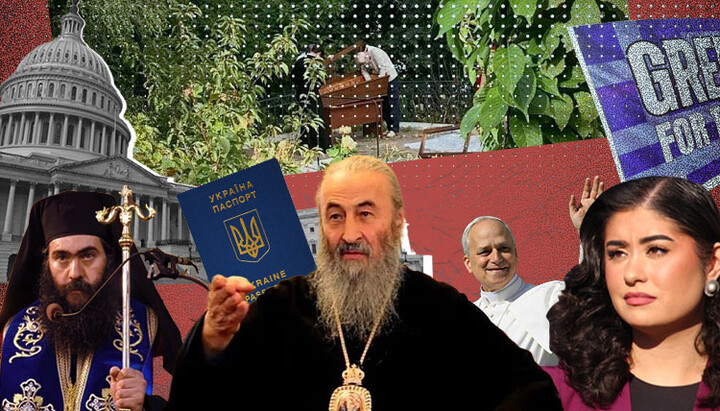
Results of 2025 for Orthodox Christians. Photo: UOJ
As is customary at the close of the year, we offer our readers a review of its major events, accompanied by brief commentary. What kind of year was 2025 for Orthodox believers?
The death of the Primate of the Albanian Church, Archbishop Anastasios, and the election of Archbishop Ioannis
On January 25, at the age of 95, His Beatitude Anastasios, Archbishop of Tirana and All Albania and Primate of the Albanian Orthodox Church, reposed in the Lord.
He is especially dear to us because, despite his Greek ethnicity, he upheld the truth and refused to recognize the actions of Patriarch Bartholomew in Ukraine. His correspondence with the head of the Constantinople Church is well known, in which the hierarch pointed out the impossibility of the grace of the priesthood being conferred retroactively upon individuals who had received their “ordinations” while in a state of excommunication from the Church.
On March 15, Metropolitan Ioannis of Korçë was elected as the new Primate of the Albanian Church. It is expected that he will continue the line of Archbishop Anastasios, since he was not only his disciple but also his constant assistant for many years. After his election, Archbishop Ioannis stated that the position of the Albanian Church regarding the recognition of the OCU is clearly expressed in the decisions of the Synod and will not be changed.
The mobilization of UOC priests and bishops
On February 24, the State Service of Ukraine for Ethnopolitics and Freedom of Conscience approved criteria for reserving clergy from military service. The list of religious organizations whose representatives received exemption included members of various religions and sects – except for the largest Church in the country, the Ukrainian Orthodox Church.
Government representatives openly stated that UOC clergy could avoid mobilization only on the condition that they transfer to the OCU. This amounted to an attempt to force the clergy to betray their Church and join the OCU. However, despite high expectations, this policy did not result in an increase in clergy transfers.
Today, the number of mobilized priests is already counted in the dozens – possibly even hundreds – despite the fact that, according to Church canons, a priest is forbidden to take up arms. Clergy with serious illnesses and priests with many children have been taken. The situation has reached the point where even bishops are being mobilized.
On September 2, officers of the Territorial Recruitment Center abducted Bishop Seraphim of Novovorontsovka, a vicar of the Novokakhovka Eparchy. Along with him, Hieromonk Gabriel (Kinashchuk) was also taken. Their subsequent fate remains unknown.
Desecration of relics in the Kyiv-Pechersk Lavra
On March 5, the Ministry of Culture established a commission to verify the “presence of the remains of saints in the tombs of the Near and Far Caves” and to determine the “historical and scientific value of the relics.” On March 28, members of the commission, accompanied by police, broke the locks on the doors leading to the caves and replaced them with their own.
The commission included veterinarians, archaeologists, embryologists, pathologists, and other specialists. The results of its work were classified. However, several months later, photographs appeared online showing secular individuals rummaging through the reliquaries of the saints, while the reliquaries themselves were piled haphazardly in one of the rooms. Believers have not been allowed into the caves – or into the Lower Lavra at all – since August 10, 2023.
The death of Pope Francis and the election of Leo XIV
On April 21, at the age of 89, Pope Francis passed away in the Vatican.
On May 8, the Vatican conclave elected a new pope – Cardinal Robert Francis Prevost, who chose the name Leo XIV.
As is well known, Pope Francis pursued a liberal agenda: sympathy toward LGBT ideology, support for ecumenism, and similar positions. Many wondered whether this policy would change under the new pontiff. Half a year later, it can be said that Leo XIV continues the line of his predecessor.
The deposition of Metropolitan Tychikos of Cyprus
On May 22, the Holy Synod of the Cypriot Orthodox Church, at an extraordinary session, voted by majority to depose Metropolitan Tychikos of Paphos from his episcopal see. The reasons cited were alleged “canonical violations” and poor administration of the eparchy.
However, as the hierarch’s defenders later demonstrated, Metropolitan Tychikos committed no canonical violations whatsoever, and under his leadership the eparchy, on the contrary, flourished in every respect within just a few years. They assert that the hierarch was deposed for his faithfulness to Orthodoxy – his refusal to participate in ecumenical events, his rejection of the OCU, and similar positions. Moreover, the very process of his removal involved numerous violations of procedure and of the Charter of the Cypriot Church. The Church’s faithful stood firmly behind Metropolitan Tychikos.
The hierarch filed an appeal with Patriarch Bartholomew of Constantinople against the decision of the Cypriot Synod. However, the Synod held at the Phanar on October 17 upheld the deposition.
The failed attempt to seize the cathedral in Chernivtsi
On June 17, an attempted seizure of the Holy Spirit Cathedral of the UOC in Chernivtsi took place – an episode striking in its cynicism and brutality. First, OCU militants staged a “theatrical performance” in the church, bringing one of their members inside in a wheelchair. Once inside, the “disabled man” sprang to his feet. At that moment, around fifty individuals burst onto the cathedral grounds and began beating everyone in their path.
Two priests who attempted to defend the shrine were severely beaten. One of them, Fr Roman, suffered broken ribs and internal injuries. The other, Archpriest Vitaliy Honcharyuk, sustained serious head injuries – a broken nose and deep lacerations.
An ambulance took them away. The attackers broke into the candle shop with a crowbar and stole 60,000 hryvnias. All of this unfolded amid the complete inaction of the police. Moreover, police officers beat believers with batons and used tear gas against those who had gathered to defend the cathedral. One of the militants even threw Metropolitan Meletiy of Chernivtsi and Bukovyna to the ground.
Despite this, so many faithful gathered that they managed to drive the attackers off the cathedral grounds. Later it was discovered that the altar had been desecrated – the intruders had smoked there and relieved themselves. Most strikingly, it emerged that the aggressors had been brought in by OCU clergy – Epifaniy’s uncle, Ivan Chokaliuk, and Vasyl Kapriian.
The deprivation of citizenship of His Beatitude Metropolitan Onuphry
On July 2, the Security Service of Ukraine announced that Volodymyr Zelensky had signed a decree stripping His Beatitude Metropolitan Onuphry of Ukrainian citizenship. The stated grounds were allegations that Metropolitan Onuphry allegedly held Russian citizenship and allegedly supported the policies of Patriarch Kirill and the leadership of the Russian Orthodox Church.
This step marked yet another stage in the campaign to destroy the UOC being pursued by the current Ukrainian authorities. Now, despite the falsity of the accusations, the authorities have obtained a formal basis for expelling His Beatitude Onuphry from Ukraine.
The persecution of Metropolitan Arseniy of Sviatohirsk
This year saw the continuation of the persecution of Metropolitan Arseniy of Sviatohirsk, who was imprisoned back in April 2024.
The hierarch is accused of allegedly disclosing the positions of the Armed Forces of Ukraine in one of his sermons. The accusations are absurd, as the video of the sermon is publicly available, and in it the hierarch merely laments that pilgrims were not allowed into the Sviatohirsk Lavra at one of the checkpoints.
On October 28, 2025, the authorities released Metropolitan Arseniy on bail – but only for a few minutes. The Security Service immediately rearrested him. Since then, disgraceful court hearings have continued, repeatedly extending his detention. Despite his grave health condition and medical indications for urgent heart surgery, he remains in pretrial detention.
All attempts by defense attorneys to change the measure of restraint have been rejected. Metropolitan Arseniy endures his imprisonment with Christian humility, blesses his jailers, and calls everyone to prayer, love, and forgiveness.
Court proceedings to ban the Kyiv Metropolia of the UOC
On August 29, 2025, the State Service of Ukraine for Ethnopolitics and Freedom of Conscience filed a lawsuit with the High Administrative Court seeking to terminate the activities of the Kyiv Metropolia of the UOC.
This lawsuit became possible after the Service, acting under the Law of Ukraine “On the Protection of the Constitutional Order in the Sphere of Activities of Religious Organizations” (commonly known as the law banning the UOC) of August 20, 2024, conducted a so-called examination of the UOC Statute and “discovered” a canonical connection between the Kyiv Metropolia and the Russian Orthodox Church. Following this, the Service issued orders demanding that the alleged violations be “remedied” and shortly thereafter filed the case in court.
Under the logic of the UOC ban procedure, once the court rules to prohibit the Kyiv Metropolia, the Service will then examine the eparchies for canonical ties to the already banned Metropolia and, upon finding such ties, ban the eparchies through the courts. The same process would then be applied to parishes and monasteries.
To date, only one court hearing has taken place, dealing solely with procedural issues. Two additional hearings did not occur – one due to the judge’s illness, the other due to the absence of documents in the case.
The visit of Serhii (Epifaniy) Dumenko to Mount Athos
On October 10, the head of the OCU arrived on Mount Athos for a four-day visit. Afterward, Dumenko assured that he had come “as a humble monk.” However, judging by photographs in which he is dressed in episcopal vestments, as well as reports from Athonite monks that access to Karyes, the administrative capital of Athos, was closed during his visit, there was little evidence of monastic humility.
He visited several Athonite monasteries known to varying degrees for their loyalty to Constantinople’s policies. The supreme governing body of Mount Athos, the Holy Community, refused to receive Dumenko officially. Most Athonite monasteries likewise did not wish to see him within their walls. In some monasteries, such as Vatopedi, the brotherhood stated that they would leave the monastery if Serhii Dumenko were received there.
Cell-dwelling monks issued an open letter protesting the visit, calling it a “fall,” and called for all clergy who had concelebrated with the OCU leader to be prohibited from ministry.
The anniversary of the First Ecumenical Council
This year marked the 1,700th anniversary of the First Ecumenical Council in Nicaea. Events were held in Turkey with the participation of Patriarch Bartholomew of Constantinople and Pope Leo XIV.
Services were conducted in Istanbul and Nicaea during which a number of grave canonical violations were permitted. In the Church of Constantinople, the Roman pope was received not merely as a fellow believer, but as an Orthodox hierarch. Moreover, he was placed above Patriarch Bartholomew in the liturgical order. For example, one of the litanies included the petition: “Again we pray for the most holy bishop and pope Leo and our archbishop and patriarch Bartholomew.”
At these events, Patriarch Bartholomew was implicitly positioned as the “head of Orthodoxy.” Yet apart from him, only the head of the Alexandrian Church, Patriarch Theodore, participated in the services. The primates of Antioch, Jerusalem, and all the other Churches declined to attend.
Nevertheless, Patriarch Bartholomew and Pope Leo XIV reaffirmed their commitment to the cause of full unity between Orthodoxy and Catholicism.
The defense of the UOC by Orthodox Churches in the United States
On December 16, an Orthodox Christian Action Day took place on Capitol Hill in Washington, DC. Approximately 200 bishops, clergy, and laypeople – representatives of the Russian Orthodox Church Outside Russia, the Serbian Orthodox Church, the Antiochian Orthodox Church, the Orthodox Church in America, as well as other Orthodox jurisdictions and Christian communities in the United States – spoke out in defense of the UOC and called on American politicians to pay attention to the persecution in Ukraine.
Participants held around eighty meetings with members of Congress and representatives of the US administration. These efforts were preceded by meetings with Congresswoman Anna Paulina Luna and other politicians. The Orthodox advocacy in support of the UOC encountered fierce resistance from archons of the Constantinople Patriarchate and lobbyists for the Ukrainian authorities in the US, who accused Church representatives of “working for the Kremlin.”
Such a large-scale public defense of the UOC in the United States is unprecedented. There is hope that the actions of the Ukrainian authorities will not only receive proper evaluation from American politicians, but that concrete steps will also be taken to protect the Church.
Conclusion
The year 2025 became yet another year of persecution for the UOC. The mobilization of clergy, the desecration of relics in the Kyiv-Pechersk Lavra, the launched proceedings to ban the Kyiv Metropolia, the ongoing seizures of churches, and the deprivation of Ukrainian citizenship from the Primate of the UOC – all of this testifies that the current Ukrainian authorities have not abandoned attempts to completely destroy Orthodoxy in Ukraine.
Yet the main event of 2025 is something else. The main thing is that the Church lives. It is not falling apart, it has not ceased its ministry. Communities deprived of their churches find other places for worship. New churches are being built, new altars consecrated, priests ordained, the number of monastics is growing. Not a single bishop, not a single monastery, not a single theological school has left the persecuted Church. Priests and parishes that departed for the OCU are just a few.
All that means our Church has a future. God will not abandon us unless we abandon Him.
Read also
Pentarchy with Rome: A return to the roots or a new schism?
Patriarch Bartholomew wants to revive a council of five patriarchates, including Rome. What would reunion with Catholics look like, and what role would be left for the other Churches?
Concubine or daughter? On words that cannot be used about the Church
An archon of the Church of Constantinople likened the UOC to Moscow’s “concubine.” But for St. Epiphanius of Cyprus, “concubines” are heresies.
Shameful chronicle of one week: how the OCU was born
Exarchs under escort, a call from the operations room, and 36 votes for Epifaniy: what a member of the Phanar delegation revealed about the 2018 "Council".
Can UOC eparchies be dissolved before court ruling on Metropolia?
DESS is launching separate proceedings against UOC eparchies, monasteries, and institutions while the case involving the Kyiv Metropolia is still pending.
Two murders, one silence
Zelensky condemned the killing of a Catholic priest in Poland the very same day. A month earlier, a UOC monk was murdered at the Sviatohirsk Lavra – and the president has remained silent ever since.
A bow to Phanar? Why did UOC academy congratulate Constantinople’s exarch?
A delegation from the Kyiv Theological Academy congratulated the Phanar’s exarch, who has remained silent about the persecution of the UOC. Who authorized this gesture, and why did even OCU supporters fail to appreciate it?