A throne made of old wood: The story of Bethlehem manger
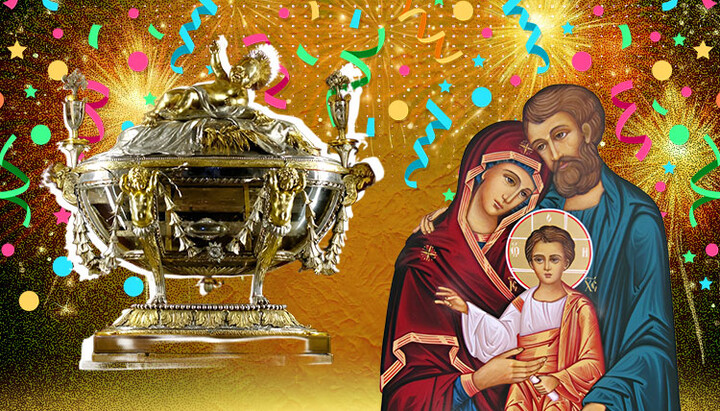
A shrine that outshines festive splendor. Photo: UOJ
Rome on the night of January 1 resembles a drunken patrician. The Eternal City explodes with thousands of fireworks. Prosecco flows on Piazza del Popolo, tourists storm boutiques, and the price tag for dinner at a restaurant shoots into the stratosphere. The world celebrates the changing of a digit, bowing before success, brilliance, and the promise of a new life.
But if you turn away from the noisy streets into the Basilica of Santa Maria Maggiore and descend into the crypt beneath the main altar (the Confessio), you enter a zone of absolute silence. Here, in the half-light, stands a strange object. It is a crystal reliquary created in 1802 by the architect Giuseppe Valadier. It is magnificent: silver, gold, crystal, a figurine of the Infant above. Yet if you look closely at what lies inside this jeweler’s masterpiece, you are seized by astonishment.
Inside there are no diamonds. Inside lie five rotten, time-darkened planks. This is the Sacra Culla – the Holy Manger. The remnants of that very feeding trough into which the Virgin Mary laid God, because there was no place for Him in the inn (Luke 2:7).
Wood and carbon
Let us immediately set aside pious myths about a “golden cradle.” Before us is the harsh reality of the first century. Scholars have repeatedly examined these boards. They are not Lebanese cedar, from which palaces were built. They are not costly cypress. Studies conducted in the Vatican (including those carried out before a fragment was returned to Bethlehem in 2019) established that this is wood characteristic of the Palestinian region of that era. Radiocarbon analysis dates the wood to approximately the first century AD.
These were not “cribs” in our modern sense. This was a feeding trough.
Rough-hewn beams, joined in an X-shape or as a basin to hold hay. Wood soaked with the saliva of oxen and donkeys. Wood that smelled of manure and the dampness of a cave. It was precisely this object that God chose as His first throne on Earth. Not the marble of Rome, not the gold of the Jerusalem Temple, but a feeding trough for livestock.
Operation “Evacuation”
How did these boards end up in Rome? This was not a gift or a souvenir. It was an evacuation.
Let us move to the seventh century. The Middle East is in flames. The Caliphate is rapidly expanding. In 638, Patriarch Sophronius surrenders Jerusalem to Caliph Umar in order to save the inhabitants from massacre. Christian shrines find themselves in a zone of risk.
At this time, between 642 and 649, Pope Theodore I occupies the Roman throne. A unique figure – Greek by origin, the son of a bishop from Jerusalem. He understands that the “cradle” of Christianity is in danger. According to tradition, a highly complex logistical operation was carried out. The shrine was secretly removed from occupied Palestine and delivered to Rome by sea.
For Rome, this became the event of the century. The Basilica of Santa Maria Maggiore began to be called Sancta Maria ad Praesepem (“Saint Mary at the Manger”). Rome became a “Second Bethlehem” not metaphorically, but physically.
Incidentally, the Valadier reliquary we see today is itself a later creation. The previous silver casket from the Renaissance era was stolen by Napoleon’s soldiers when they plundered Rome in 1798. Gold and silver interested them, but the rotten boards, fortunately, they shook out onto the floor. For looters, it was merely trash.
The diplomacy of a splinter
In November 2019, an event occurred that once again made the world speak about the Sacra Culla. Pope Francis decided to return part of the shrine home. Not the entire manger, of course – that would have been too risky for the preservation of the relic. But a tiny fragment, about the size of a finger phalanx, was removed, placed in a separate reliquary, and sent to Bethlehem.
It was like the return of the prodigal son. In Jerusalem and Bethlehem, the fragment was met by crowds numbering in the thousands. People wept. For Eastern Christians living today in the harshest conditions, amid blockade and poverty, this small piece of wood became a sign: God has not forgotten the place of His Birth.
A manifesto of poverty
Why, on this New Year’s night, should we mentally stand before these boards? Because the Sacra Culla is a slap in the face to our notion of success.
We are accustomed to thinking that God loves the rich and the successful. We ask Him for comfort, stability, a new car. And He shows us five old maple boards.
God could have been born in the palace of Caesar Augustus on the Palatine Hill. He could have been born in the house of the high priest. But He chose extreme, shocking poverty. He chose the fate of a homeless man.
These boards are a manifesto. True Love does not need decorations. Gold is cold. Marble is cold. Wood is warm – especially when it is warmed by the breath of an Infant.
While the world beyond the basilica walls finishes its festive dishes and launches millions of euros into the sky in the form of fireworks, silence reigns in the crypt of Santa Maria Maggiore. Five rough boards lie behind glass like mute witnesses. They saw Him Who created the galaxies. And they remind us: do not be afraid to be poor. Do not be afraid to be simple. Fear only one thing – that in your heart, as in that Bethlehem inn, there should appear a sign reading “No vacancies.”
Read also
Facade of bones and facade of light
Antoni Gaudí spent forty-three years building a church in Barcelona, knowing that this construction was for the ages.
Trial of a dead pope
Once in Rome, the body of a deceased pope was seated on the throne and put on trial. The accusation relied on a church canon that had once saved his see.
Monastery built in defiance of king
When Orthodox believers in Minsk were left with just one church, townspeople decided to build another – and even a royal decree did not stop them.
Young Mother and Sleeping Christ
Michelangelo carved a Virgin Mary who looks younger than her Son – and signed his name in marble for the only time in his life. Neither of these peculiarities was accidental.
Orthodox books from a Uniate printing press
In the 18th century, Uniate monks at Pochaiv printed books used in prayer by Orthodox Christians and Old Believers alike.
The story of the honey brotherhood
The Mogilev Brotherhood began with members pooling money to brew honey drinks for feast days – and eventually grew to have its own printing press.