The saint who was “canceled”: first encounter with Nektarios of Aegina
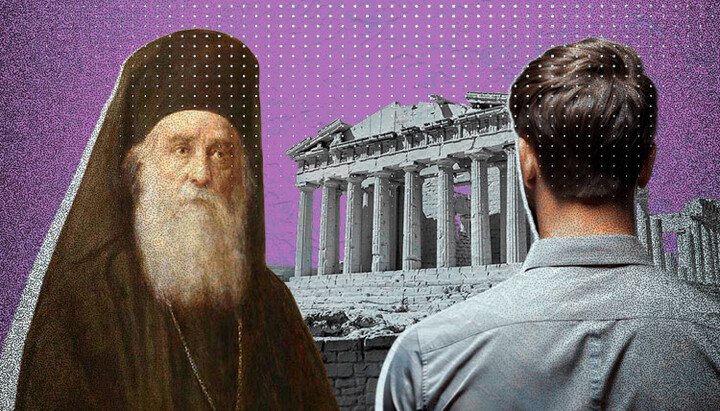
Saint-Exile Nektarios of Aegina. Photo: СПЖ
This conversation is an artistic reconstruction, based on the teaching and life of Saint Nektarios of Aegina.
In the corridors of the Rizarios Seminary, the air reeks of cheap chlorine and soaked rags. I am walking through the Athens of the late nineteenth century, and yet my smartphone is vibrating in my pocket. Each notification lands like a punch to the gut. “Another church has been seized.” “A priest has gone over to the schism.” “The media published a fresh serving of filthy gossip about our bishop.”
I came here, to this building, to find answers. I want to scream from helplessness. I need to ask a man who has lived through this how not to go insane from injustice.
They told me the seminary’s director is Metropolitan Nektarios of Pentapolis. I expect to see him in an office, behind a desk strewn with papers.
But the office is empty. The only sound is the splash of water somewhere down the corridor. And then, around the corner, in a restroom, I see a gaunt old man in a worn cassock, greyed by countless washings. He is on his knees, methodically scrubbing the tiles. His hands are knotted and work-worn, blotched red from caustic lye.
“Your Eminence?” I almost drop the phone. “What are you doing? You’re a metropolitan…”
He lifts his eyes to me. There isn’t a trace of pomp in them, no desire to look holy. Only a deep, almost otherworldly peace.
“Quiet, my child,” he whispers. “The janitor, Kostas, has fallen seriously ill. If the director finds out the work wasn’t done, he’ll be fired. He has five children. Let them think Kostas is on duty.”
I sit down straight on the floor, my back against the cold wall. My smartphone, with its endless newsfeed, feels absurd here – a loud, screaming toy.
The exile’s dossier: how they killed a saint’s reputation
Before we begin our conversation, you have to understand the scale of the catastrophe this man lived through. Nektarios of Aegina is not some saccharine, gilded saint from an icon card. He is a man who was “canceled” with maximum cruelty.
Here is only a brief sketch of the main milestones of his truly confessor-like life:
- A start in poverty: Anastasios (the saint’s name in the world) was born in 1846 in Selymbria (modern Silivri, Turkey) into a desperately poor family. To obtain an education, he walked a road from village schoolteacher to student at the University of Athens, and then to the Halki Theological Seminary in Constantinople.
- Rise and betrayal: In 1889 he was ordained a bishop and appointed Metropolitan of Pentapolis (a titular see with residence in Cairo). People adored him for his preaching, his care for the poor, and his building of schools. And that very love became his sentence. Fellow bishops, fearing his growing influence, formed a conspiracy.
- Slander: He was accused of lust for power, financial misconduct, and, worst of all for a monk, immoral behavior. There was no evidence – but rumors travel faster than truth ever does.
- A “wolf ticket”: In 1890 the Patriarch of Alexandria, Sophronius III, without investigating and without giving Nektarios a word in his defense, simply suspended him from service and expelled him from Egypt. No right to serve, no means of support, stamped with disgrace.
- Hunger in Athens: In Greece he was not welcomed. He was “that scandalous bishop.” For a long time he literally had no money for bread, until in 1894 he received a post as director of the Rizarios Theological School in Athens.
- The end: Until his death they spied on him, wrote denunciations, and accused him of heresies. He died on November 8, 1920, in a hospital for the poor in Athens.
- The decisive fact: After his death, mass healings began. According to his life, when the nurses removed his cassock and laid it on the neighboring bed where a paralyzed man lay, the man immediately stood up and walked. God answered slander with miracles.
“Don’t grab the rag”: lessons in silence
I show the hierarch the phone screen. Screenshots of mocking posts, videos of shouting crowds at seized churches, photographs of people who yesterday kissed his hand and today write denunciations.
“Your Eminence, look at what they’re doing!” My voice trembles. “It’s lies! Why are we supposed to be silent? Why don’t we sue on every corner, shout this madness to the whole world? You were silent too, when they threw you out of Alexandria. Why?”
Saint Nektarios sets the bucket aside and sits on the edge of a low bench. His voice is quiet, a little rough – as if it has spent a long time keeping silence before God.
“Justice, the kind you’re screaming for,” he says, “is a human category. It is blind and often vindictive. God works with Truth. And Truth has no need of hysteria.”
He looks at my clenched fists and continues:
“Listen to the first lesson. When they pour filth on you, your first reflex is to grab a rag and start scrubbing yourself clean immediately. You want to prove to everyone you’re clean. But you’ll only smear the filth further and soil yourself in it. Stand still. Simply stand before God. The rain of His Providence will wash it all away when the time comes. Your vindication is not in your words, but in your life.”
“But they’re destroying the Church!” I cry out. “They’re taking the churches, they’re rewriting history!”
“The Church is not buildings,” Saint Nektarios says with a gentle smile, “and not even patriarchal decrees. The Church is Christ. And Christ cannot be ‘fired’ by a memo from an office – or ‘seized’ with the help of police.”
“The one who hates you today is your best trainer in endurance. He does more for your soul than a dozen friends who sing your praises. If you answer his hatred with your own – you’ve lost the bout. You’ve become the same as him. If you keep silent and pity him – you’ve won.”
A human failure – a victory by God
I look at him and understand: by the standards of “successful management,” this man is a total loser. His career was destroyed at forty-four. He did not build a media empire. He did not win back his see in the courts. He did not extract apologies. He simply cleaned toilets, wrote books, and prayed for his enemies.
It seems to us now that if we lose a church building or our status in society, life is over. But Saint Nektarios shows something else: life begins where hope in “our people” and “the influential” ends.
He picks up the rag and returns to his work. It does not matter to him what they will write tomorrow in the Athenian newspapers. It matters how God will see him in this restroom today.
“Go,” he tells me at last. “And remember: slander is only dust. It settles only on the one who fusses.”
I step out of the seminary. The smartphone in my pocket vibrates again – another message about a “seizure.” But I don’t hurry to open it. I’m thinking about a metropolitan’s hands in bleach. I’m thinking about how the Church survived not because of “the powerful of this world,” but because of these “canceled” old men who knew one thing – that Christ, in exile, feels at home.
Read also
Honest atheism vs. spiritual hypocrisy
The 70th anniversary of Albert Camus’s Nobel Prize recalls an uncompromising challenge to Christianity. An honest unbeliever brings theology back to the mystery of the Cross.
The valley of trouble and the gateway of hope
One soldier buried an expensive cloak and some gold beneath his tent. Because of this, all Israel lost a battle. Why did one man’s sin bring disaster upon an entire nation?
From love spells to bishop's throne
Antioch’s most powerful sorcerer sent demons against a devout young Christian woman three times – and failed every time. In the end, a demon himself revealed the truth that led to his conversion.
The Weeping Queen of Blachernae
On the night of the Feast of the Protection, only two people witnessed the miracle in the Church of Blachernae. Everyone else prayed and saw nothing. Yet they, too, received grace.
Deadly spiral of human hatred
The tragedy of Lebanon's civil war lays bare how dehumanization and fear can turn human beings into monsters.
Woe to expectant mothers – or to those of little faith?
God commanded one prophet not to have children, yet told his people in exile to bear sons and daughters. What does this apparent contradiction tell us today?