Grandmaster Logic: Why God does not play by our rules
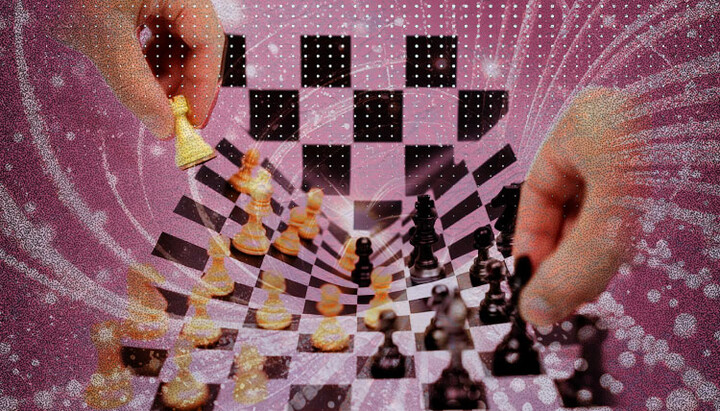
God is a great grandmaster. Photo: UOJ
On January 14, at the initiative of UNESCO and the International Council for Philosophy and Human Sciences, World Logic Day is observed. TToday, the discussion will focus on our ability to understand God and what happens in our lives. A believer is used to asking himself and God questions: "What for?", "Why?", "And what will happen if...?" We want to understand the logic of God's Providence. But what is logic, and where does it originate?
Logic is the geometry of exile. Adam in Paradise did not have logic; he possessed gnosis. He did not need proofs. He had what the Church Fathers call the nous – the ability to grasp truth directly. Before the catastrophe, knowledge was intuitive (from the Latin intueri – "to look closely").
Man saw the essence of things directly.
Adam gave names to the animals, perceiving their logoi – that is, the existential meanings of each creature’s being, God’s plan for each of them – and according to this plan, they received their names. After the Fall, we lost the ability to see the whole and became forced to construct logical chains to connect the dots in the darkness.
The illusion of security
Along with the loss of gnosis, we also acquired the fear of stumbling. We stopped seeing God with the inner vision of the spirit and began trying to understand Him with the mind. We try to calculate Him through dogmatic formulas and logical chains, forgetting that He is not the sum of His attributes, but a Person accessible only through the direct experience of encounter.
Logic is important to man because it gives him an illusion of security. "If I observe the commandments, then I am safe." "If I live in accordance with His will, then He will protect me." This is logical, but how could it be otherwise?
We use logic as a wall to avoid contact with God's frightening freedom.
We prefer to believe in a logical system because a system is predictable, but God is not. Logic is our attempt to "tame" the Creator, to make Him understandable and, consequently, safe for our ego.
When the system fails
But then something happens that doesn't fit into our system of logic. God did not preserve, did not save, did not protect, did not answer the request. He took away a single mother from four minor children. He deprived a righteous person of their last piece of bread. God acted illogically. There are millions of such examples in life.
A mother who had no children for a long time literally prayed for a child, who died of cancer ten years later. She cursed God and left the Church. "How is this possible, others give birth and throw them in the trash, while I shed so many tears. What kind of God is this?" This is an example from life.
The idol of logic forbids us to suffer "just like that". It demands explanations.
Some certified specialists in the field of Christian theology try to awkwardly justify God, for Whom they somehow feel embarrassed. They even invented a whole discipline for this – theodicy.
The idol of the "right" God
We see God in the role of a vending machine for miracles and grace. Particularly destructive is the Orthodox faith in "miraculousness". "Oh, God saved my incurably ill child! I prayed, asked, and God heard. The doctors were amazed..."
Thousands of other mothers will pray and ask in exactly the same way. But if their children die, they will ask God the question: "Is my child worse?" Of these thousands of mothers, hundreds will turn away from Him forever. This will be the fault, among others, of those preachers who so sweetly tell the flock about miracles that happen one in a million. Such sermons lead not to faith, but to disappointment.
All this is because we invented the "right" God.
We wanted to make faith understandable. We created within ourselves a cozy, logically consistent model of the Creator. In this model, God always acts according to the rules: He punishes the wicked, rewards the virtuous, and always answers “properly formulated” prayers.
But this is not the biblical God; it is an idol we invented. When we squeeze God into the confines of our logic, He ceases to be God and becomes our projection. Then we worship not the Living Lord, but our own idea of Him.
Ivan Karamazov's ticket
Logic becomes an idol because it promises us predictability. We fear God Who can "break out" beyond the limits of our schemes. If God fit into our logic, then He would be, figuratively speaking, no bigger than the size of our brain. But our faith is not logical, it is supra-logical. The teaching about the Trinity and the Incarnation is paradoxical and does not fit into the law of excluded middle.
We can say the same about God's Providence. Ivan Karamazov in Dostoevsky returns his ticket to paradise because his "Euclidean mind" cannot logically justify a child's tear. But the logic of Providence is not the logic of retribution or arithmetic balance.
Imagine a weaving loom. From the back, we see a chaos of threads, knots, meaningless fragments, and a tangle of colors. This is our life, seen through the lens of earthly logic. We ask, “Why is this knot here? Why did this black thread cross out the golden one? It’s illogical!” But the Weaver sees the front side. There, every “illogical” knot is a necessary part of the pattern, which will only be revealed in Eternity.
God's Providence is a nonlinear system.
We are inside the "fabric" of history and see only tangled knots on the back side of the carpet. God sees the pattern on the front side. Logic is an attempt to guess the pattern by the knots. But the pattern (meaning) belongs to another dimension.
The risk of trust
Faith cannot be built on understanding – only on trust. Trust in Providence is a refusal of the control that logic gives us. Logic promises predictability. Faith promises meaning, but through risk and uncertainty. The logic of Providence operates in categories of Eternity, while our logic operates in categories of momentary comfort.
Faith is trust in "higher logic" in moments when "earthly logic" fails.
The only "logical" conclusion in a situation when God, as it seems to us, was wrong and cruel, is to stop asking questions. We must allow God to be "illogical". We must allow Providence to be "unjust" from our point of view. Only when the idol of logic falls, the living greenery of faith begin to sprout in its place.
We stop “understanding” God and begin to truly know Him. We need to learn to stand before God not for the sake of what we ask, but for His own sake. We simply must accept that we do not understand His Providence and cannot understand it. All that remains is complete trust.
Prayer in emptiness
The purest prayer is prayer "in emptiness". When everything goes not as we expected, and not as we want. When God "is silent and does not hear our requests". When we knock, and He "locked the door with a bolt and does not answer". This is the moment when a person says: "Even if everything goes wrong... You are still my God."
In this moment of "illogical" trust, peace enters the soul, which is "beyond all understanding".
This is the nonlinear response of Providence: God did not change the circumstances, He changed the person, making him greater than these circumstances.
We want to be "like gods", knowing good and evil, that is, fully controlling our destiny. But faith is a transition from the state "I must foresee everything" to the state "I accept Your will". At this moment, the logic of "risk calculation" is replaced by a filial relationship. Our path lies from the logic of proofs to the logic of presence. From God as a theorem to God as breath.
Let our inability to understand Divine Providence become not a reason for complaint, but an invitation to mystery. If we could fully comprehend God, He would cease to be God. We are called to live in a space where 1 + 1 can equal infinity, if Love stands between them. And in this “madness” of faith lies the firmest and most unshakable logic in the Universe — the logic of the Creator, who will not rest until He brings the exile home, beyond all syllogisms, into the radiant silence of His light.
The Grandmaster's Game
God is a great grandmaster. We make a "stupid" or "evil" move (commit sin or error). Our logic says: "It's all over, the game is lost." But God does not sweep the pieces off the board. He makes His move, incorporating our mistake into a new combination that still leads to salvation.
This does not mean that sin is good. This means that God's love is smarter than our evil. It has the ability to "process" our falls, turning them into fertilizer for future flowers of repentance.
Celebrating Logic Day, we must acknowledge: our algorithms cannot calculate the architecture of the highest meaning. Logic says, “Death is the end.” Providence says, “Christ is risen.” We are called not to “understand” Providence, but to cooperate with it — to do what must be done in the place where we are, and to trust the rest to the One who sees the entire pattern as a whole.
Read also
From love spells to bishop's throne
Antioch's greatest sorcerer sent demons against a humble Christian girl three times and was defeated three times. A demon himself led him to the truth.
The Weeping Queen of Blachernae
On the night of the Feast of the Protection, only two people witnessed the miracle in the Church of Blachernae. Everyone else prayed and saw nothing. Yet they, too, received grace.
Deadly spiral of human hatred
The tragedy of Lebanon's civil war lays bare how dehumanization and fear can turn human beings into monsters.
Woe to expectant mothers – or to those of little faith?
God commanded one prophet not to have children, yet told his people in exile to bear sons and daughters. What does this apparent contradiction tell us today?
The help God never asked for
Uzzah wanted only to keep the Ark of the Covenant from falling into the dust. Why did this well-intentioned act cost him his life, and who was really responsible for his death?
Freedom begins when there's nothing left to take
Fear of persecutors takes root in our attachment to possessions. We turn to St. Basil the Great to understand why the prefect's threats held no power over him.