God under the knife: Why the Church celebrates Christ's first pain
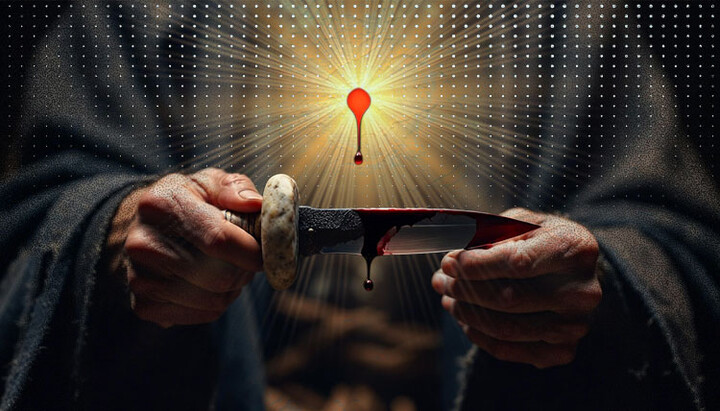
God saves man through wounds. Photo: UOJ
In the church calendar, there are feasts that are not customarily spoken about loudly. January 14 is one of such days. There are many people in churches, but most come to congratulate each other on the "Old New Year" or to honor the memory of Saint Basil the Great. And that event which gave the holiday its name – the Circumcision of the Lord – remains in the shadows. Preachers often speak of it hurriedly, blushing and choosing evasive phrases about "humility" and "fulfillment of the law".
We feel awkward. We feel uncomfortable thinking about God in the context of a surgical operation. It's difficult for us to connect in our minds the Almighty Creator and the crying Infant over Whom a painful, bloody ritual is performed.
We want "spirituality," lofty matters, light and incense. But here – a knife, blood and severed flesh.
But precisely this "uncomfortable" physiology is the center of the feast. If we bashfully avert our eyes from the knife, we miss the essence of Christianity. On January 14, the Church delivers a fatal blow to humanity's most beautiful and dangerous illusion – to the idea that God is distant from our pain.
Test of reality
In the early centuries of Christianity, the heresy of Docetism was popular. Intelligent, educated people claimed: God is too pure and great to be defiled by matter. They said that Christ was not a real human being. His Body was a phantom, an optical illusion. He only seemed to be suffering, but in reality the Godhead cannot feel pain. This was beautiful, "convenient" theology.
The Feast of the Circumcision shatters this theory to pieces.
Holograms don't bleed. Phantoms don't undergo operations. An optical illusion doesn't cry out in pain when touched by iron.
On this day, God passed a harsh test of reality. He proved that His incarnation is not a carnival costume that can be removed when one gets tired of it. He took human nature seriously. With nerve endings, with a pain threshold, with a blood type and Rh factor.
God became vulnerable. He Who created the laws of physics now submits to them. He feels the cold of steel just like any of us. This is not "playing a human". This is complete immersion.
First Blood
We are used to thinking that redemption began on Good Friday, on Golgotha. That Christ grew up, taught, performed miracles and only at the end of His path ascended the Cross. This is a mistake. His path to the cross did not begin at 33 years old. It began on the eighth day of life.
Circumcision is the shedding of the first blood. This is the first installment of that price which God decided to pay for us. He did not wait for maturity. Having barely been born, He already begins to suffer.
This changes our conception of God. We often picture Him as a kind grandfather who watches us from a cloud. But Christ is not an observer. He is a participant. He came into this world not on vacation and not on inspection. He immediately signed a contract in blood.
The Old Testament ritual of circumcision was a sign of the Covenant – an agreement between God and the people. The seal of this agreement was a wound on the body. God concluded an alliance not on paper, but on living flesh. And when Christ, the Lawgiver, Himself lies under the knife of the law, He shows: "I am here to fulfill everything. I take upon Myself all the weight, all the responsibility, all the pain of this world. I seek no privileges."
The first drops of blood in Bethlehem are a prologue to the streams of blood on Golgotha. The cup of suffering was offered to Him not in the Garden of Gethsemane but still in the cradle. And He did not push it away.
Name and pain
In the Bible, there is a harsh law: a name is given together with pain. Precisely on the day of circumcision, at the moment of the surgery, the infant officially received his name.
The angel said to Joseph: "And you shall call His name Jesus, for He will save His people from their sins" (Mt. 1:21). Jesus (Yeshua) translates as "Savior".
Notice this connection. The name "Savior" is assigned to Him at the moment of bloodshed. This is the deepest spiritual law, which we feel with our skin today. One cannot become a Savior theoretically. One cannot save someone while sitting in a comfortable office. Salvation is always connected with sacrifice. Identity and mission are "soldered" into a person through pain.
God receives His name not to the applause of angels but to crying. This tells us about the price of salvation more than volumes of theological books.
To save means to give part of oneself. To save means to agree to a wound.
God with scars
For us, living in the reality of war, this theme sounds particularly acute.
We are a people with scars. Visible and invisible. Some have scars on their bodies from shrapnel, others on their souls from losses, betrayal and fear.
It sometimes seems to us that God, Who is perfect and good, cannot understand us. That He is too distant from trench mud, from operating tables, from cold basements. That He is a sterile absolute.
But the Feast of the Circumcision, and then the Resurrection, reveals to us another truth: our God has scars. Even after the Resurrection, in the glorified, shining body of Christ, the wounds from nails and spear remained. He showed them to Thomas. He took these scars with Him into Eternity.
This means that a scar is not a disfigurement. It is not a defect. It is a document. It is testimony that you were in battle, that you went through pain and survived. It is a seal of love.
A God Who has no scars could not understand an old woman who lost her home. Could not understand a soldier who had his leg amputated. But our God began His life with a wound. He knows how healing flesh hurts. He bears on His body the signs of human history.
Sanctification of physiology
And finally, this feast heals our attitude toward our own body. For centuries in culture (and even in church circles) lived the idea that the body is something low, dirty, shameful, and a "prison of the soul".
Christ destroys this lie. If God Himself did not disdain to become flesh that can be cut, then matter is holy. If the Creator allowed His body to be touched by a knife, then there is nothing shameful in our physiology.
God entered all stages of human development. He was an embryo. He was an infant. He endured pain. He wanted to drink and eat. He grew tired. Thereby He sanctified every atom of our being.
Our pain is not a system error. It is not punishment. It is the reaction of a living organism to a non-living world broken by sin. And Christ went through this reaction to show: even in pain one can remain with God. Even on an operating table one can be a Son of God.
We often seek God in miracles and signs. But He awaits us in reality. In that very reality where there is blood, sweat and tears. He does not flee from it. He takes it upon Himself to change it from within.
Today, looking at the icon of the feast, we see not an abstract symbol. We see God Who decided to be honest with us to the end.
Read also
The Weeping Queen of Blachernae
On the night of the Feast of the Protection, only two people witnessed the miracle in the Church of Blachernae. Everyone else prayed and saw nothing. Yet they, too, received grace.
Deadly spiral of human hatred
The tragedy of Lebanon's civil war lays bare how dehumanization and fear can turn human beings into monsters.
Woe to expectant mothers – or to those of little faith?
God commanded one prophet not to have children, yet told his people in exile to bear sons and daughters. What does this apparent contradiction tell us today?
The help God never asked for
Uzzah wanted only to keep the Ark of the Covenant from falling into the dust. Why did this well-intentioned act cost him his life, and who was really responsible for his death?
Freedom begins when there's nothing left to take
Fear of persecutors takes root in our attachment to possessions. We turn to St. Basil the Great to understand why the prefect's threats held no power over him.
The bride in the window frame
The author of the earliest account of St. Thecla’s life was defrocked. Yet it was his book that preserved the only ancient description of the Apostle Paul’s appearance.