When you’ve been written off: St Nektarios on life after the loss of status
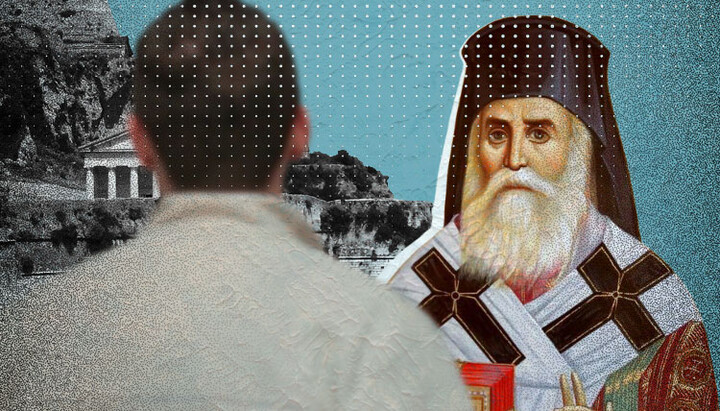
"We must not be afraid of struggle." Photo: UOJ
The island of Aegina greets me not with seaside coolness, but with dust and scorching heat. I climb a rocky path toward a monastery under construction. My legs throb, and one thought keeps pounding in my head, poisonous as the local viper: “You are nobody.”
Only a couple of years ago – before the war, before the collapse – each of us had a name. There was a business card with a title, an office, the respectful whisper of colleagues. We were “people of standing.” Now we are a line on a list for humanitarian aid. Refugees. Extra mouths. Our degrees and experience are useless here. We feel like defective parts thrown onto the scrap heap of history.
I am looking for Bishop Nektarios. I was told he is here. I expect to find him receiving pilgrims in the shade of an olive tree, but instead I find him at the construction site. A gaunt, stooped old man in a faded cassock, almost bleached white by the sun. He is hauling a massive stone for a new wall. Hands that once blessed crowds in the overflowing cathedrals of Egypt are now black with soil and scraped raw.
He notices me, sets the stone down, and wipes the sweat from his face with his sleeve. There is not a trace of humiliation in his eyes.
“Geronda,” I say, my voice breaking, “I cannot go on like this. I’ve been written off. I feel like trash. Everything that made me who I was has been taken from me.”
A mask grown into the skin
Nektarios of Aegina sits down on the stone he has just carried. He does not rush to console me with clichés. He knows exactly what I am talking about.
He had been a rising star of the Alexandrian Patriarchate – Metropolitan of Pentapolis, a man spoken of as a future patriarch. Then came slander, envy, and a sudden fall. Exile without explanation. In Athens, where he arrived, doors slammed shut one after another. For years, the former metropolitan went from office to office, begging even for the position of an ordinary preacher, and was mocked. He could not afford bread.
“You think they took you away from yourself?” he asks quietly. “No, my child. They took away your stage set.”
He scoops up a handful of dry Aeginetan soil and lets it run through his fingers.
“All our lives we build ourselves a pedestal – position, bank account, the respect of neighbors. We grow so accustomed to this costume that it fuses with our skin. Then the Lord allows a storm, and that costume is torn off – together with the skin. It is painful. Unbearably painful. But only then do you become real.”
Bishop Nektarios looks straight into my eyes:
“God does not test us in order to learn what we are made of – He already knows that. He does it so that we may come to know ourselves.”
“As long as you were a ‘director’ or a ‘manager,’ you did not know yourself,” he continues. “You knew your role. Now look into the mirror. There stands a human being with nothing left to cover himself except God. This is the most honest moment of your life.”
A throne amid ruins
“But all I feel is resentment,” I burst out. “Why is this happening to me? I tried to live rightly.”
The elder shakes his head. He knows this trap. When the world rejects us, it seems as though God has turned away as well. But in exile the saint discovered a different law.
“You are looking for your worth outside yourself,” he says. “You are waiting for the world to hand you another certificate saying, ‘You’re doing well.’ But the world is a liar. Today it cries ‘Hosanna,’ tomorrow it writes a denunciation against you. I went through that. When I was expelled from Egypt, I thought I had lost everything. Only later did I understand that I still possessed what no synodal decree could take away.”
He places his hand on his chest:
“Happiness lies within us, and blessed is the one who has understood this… Happiness is a pure heart, for such a heart becomes the Throne of God.”
“Do you understand?” his voice grows firmer. “You may sleep on a folding cot in a refugee gymnasium. You may wear secondhand clothes from someone else’s shoulder. But if there is purity and peace in your heart, you carry royal dignity within you. Your social status has collapsed, but your ontological dignity is untouchable. You are a bearer of God. Is that not enough?”
Either death or victory
I look at his hands. They tremble with effort, yet they are filled with immense strength. He did not break. He did not drink himself into oblivion, did not curse his persecutors, did not sink into despair. He is building a monastery on bare rock.
“But how do I not give up, Geronda?” I ask more quietly. “I have no strength left to start over.”
Nektarios rises. He lifts the stone again. For him, labor is not punishment, but a form of prayer.
“No one promised it would be easy,” he replies. “Despondency is a luxury we cannot afford. When you are knocked to the ground, you have two choices: stay there and pity yourself, or get up and do what must be done.”
He quotes words he once wrote to his nuns when local authorities were persecuting them:
“We must have a firm resolve: ‘Either I will die, or I will prevail.’ We must not be afraid of struggle… God will not allow us to be tested beyond our strength.”
“Your struggle now is not to reclaim an old chair or salary. Your struggle is not to grow bitter. It is to remain human when you are treated as a statistic. If you can bless this day while standing amid the ruins of your former life – you have won.”
The elder lifts the stone and carries it toward the wall. He walks slowly, scuffing his worn shoes through the dust. His back is bent, but his spirit is straight as a column of an ancient temple.
I stand and watch him go. Our problems have not vanished. Tomorrow we will again go to the social services office, again feel the sidelong glances. But something has changed.
We no longer feel like trash. We feel like people from whom a carnival costume has been torn away. Cold. Uncomfortable. Frightening. Yet now we know for certain: what remains beneath the costume belongs only to God. And no one can take that from us.
Read also
Honest atheism vs. spiritual hypocrisy
The 70th anniversary of Albert Camus’s Nobel Prize recalls an uncompromising challenge to Christianity. An honest unbeliever brings theology back to the mystery of the Cross.
The valley of trouble and the gateway of hope
One soldier buried an expensive cloak and some gold beneath his tent. Because of this, all Israel lost a battle. Why did one man’s sin bring disaster upon an entire nation?
From love spells to bishop's throne
Antioch’s most powerful sorcerer sent demons against a devout young Christian woman three times – and failed every time. In the end, a demon himself revealed the truth that led to his conversion.
The Weeping Queen of Blachernae
On the night of the Feast of the Protection, only two people witnessed the miracle in the Church of Blachernae. Everyone else prayed and saw nothing. Yet they, too, received grace.
Deadly spiral of human hatred
The tragedy of Lebanon's civil war lays bare how dehumanization and fear can turn human beings into monsters.
Woe to expectant mothers – or to those of little faith?
God commanded one prophet not to have children, yet told his people in exile to bear sons and daughters. What does this apparent contradiction tell us today?