Should the law banning the UOC be repealed?
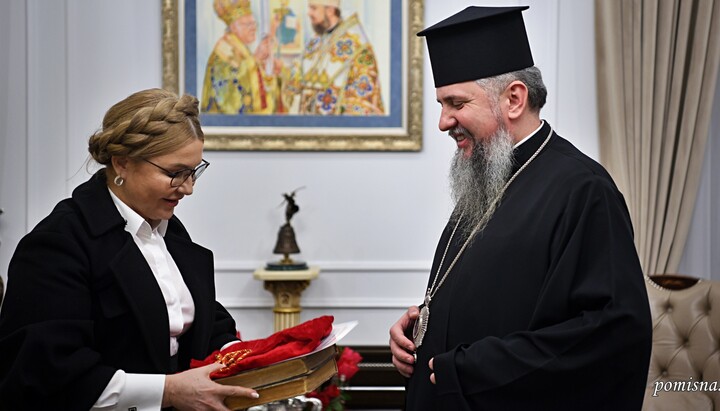
Did Tymoshenko’s faction vote in the interests of the OCU? Photo: OCU website
Ukraine has been rocked by yet another shameful scandal at the very top of power. The head of Batkivshchyna, Yulia Tymoshenko, was handing out money to her MPs in exchange for “correct” voting. In an audio recording published by NABU, Tymoshenko, counting out the needed amount, explains how they should vote in this case or that.
What immediately strikes you (more precisely – what hits your ears) is that the participants speak to each other in “the language of the enemy” – the very language whose study, not long ago, triggered a furious media witch-hunt against an Orthodox school at the Holosiiv Monastery. Yet the figures in earlier corruption scandals involving Zelensky’s inner circle also spoke Russian.
But the real issue, of course, is not the language. The real issue is that Ukraine’s laws, as it turns out, are adopted (or not adopted) for money. And in that light, the law popularly dubbed “the ban on the UOC” is exactly what concerns us. In both the first and second readings, Tymoshenko’s deputies voted unanimously “in favor”.
And basic logic suggests this – if Tymoshenko was “buying” votes in 2026, what would have stopped her from doing the same in 2023 and 2024? Especially since there are grounds to suspect that this kind of “unanimity” may not have been confined to Batkivshchyna alone, but could also have existed within larger factions.
That is why the question can now be raised about the legitimacy of certain decisions of the Verkhovna Rada. In particular, the legitimacy of that very “law banning the UOC” – previously known as draft law No. 3871. And beyond all its other “shortcomings” (such as discriminating against the country’s largest confession), this law now poses grave questions about the transparency of the vote itself. There is no doubt this must become the subject of an investigation by law enforcement agencies.
Read also
Ternopil post on Feast of Intercession: Has calendar reformn failed?
A significant number of believers have rejected the new church calendar introduced by the OCU and UGCC with government support.
Shoulder straps or a cassock: who writes the script for UOC "fighters"?
Everything indicates that both Veliar and Pshenychny are ordinary performers of someone else's script. There is only one question – does the scriptwriter wear shoulder straps or a cassock?
Why is it legal to kill a person before birth but not after?
Children are the most privileged members of society. Yet that same society officially permits children to be killed – and on a massive scale.
Honoring the Bolsheviks’ successors at Kyiv Lavra
It was under the Reserve that the relics of the saints were desecrated, Lavra churches were turned into an atheism museum, and toilets were installed in sanctuaries.
"Degenerates" and "stupid animals": anti-UOC activists turn on children
Future historians will wonder how a vast country’s information agenda could have been shaped for so long by people so petty, vicious, and utterly contemptible.
Zelensky sees murder of Polish priest but not of Sviatohirsk monk
Why does Zelensky react so emotionally and swiftly to the murder of a Catholic cleric while remaining completely silent about the murder of an Orthodox monk?