
"Potemkin" monks of the Lavra
Outside the capital, the OCU has around 120 monks. At the same time, it claims more than 80 monasteries. The arithmetic is simple: on average, each “monastery” has one and a half inhabitants.
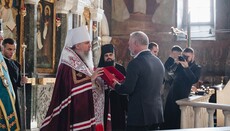
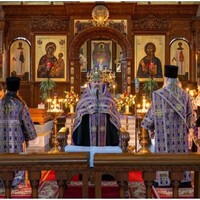
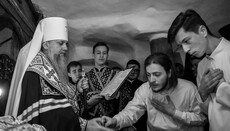
Soon after the Ministry of Culture handed over the Near Caves, along with the Exaltation of the Cross Church and the Warm Church in the Lower Lavra, to the OCU, all the media outlets of this structure triumphantly announced the “tonsure” of two monks performed by Epifaniy Dumenko. One detail, however, is telling: one of these “newly tonsured” men was already a resident of St. Michael’s Monastery, albeit in the rank of a “priest.”
The head of the OCU informed the new monastics that in the caves “rest the relics of many of our venerable fathers,” and warned them that on the monastic path “various trials” awaited them.
And, in itself, a monastic tonsure in the Church is an entirely ordinary event. Even now, during Great Lent, tonsures are taking place in the UOC every few days. That is hardly surprising: the Church has 260 monasteries and around 5,000 monks.
Why, then, are we even mentioning Dumenko’s tonsure in the Lavra?
The answer is simple: for the OCU, this was an extraordinary event. A search for the phrase “monastic tonsure” on the OCU’s official website produces only one result – the very case we are discussing here. One result in seven years of the OCU’s existence. On diocesan websites, only a handful of such cases can be found over the same period.
The total number of monastics in the OCU is carefully left unspoken. The last known figure dates back to 2021 – 233 monks. Subtract the “bishops,” and the number drops to 170. Of those, about 50 live in Kyiv. Which means that outside the capital, the OCU has roughly 120 monks. And yet it claims more than 80 monasteries. The calculation is elementary: on average, each monastery houses one and a half residents.
It is no surprise, then, that until quite recently the “OCU Lavra” consisted of just six people. There was simply nowhere to get more from. How they managed to persuade two more to join remains anyone’s guess. Perhaps those men hope to become bishops at speed, or to be placed in charge of monasteries the authorities are already threatening to confiscate from the UOC. But a different question is even more to the point: why did this tonsure happen right now given that Dumenko’s structure has been operating in the Lavra for nearly four years?
The answer, most likely, is simple – and it lies in the realm of PR tactics.
This trick has already been tested. On March 8, when Epifaniy was “celebrating” in the Lavra the transfer of the Near Caves and two churches, his people arranged for “parishioners” to be bused in from Ternopil region. The central media then showed images of a packed Refectory Church and gushed about how people were flocking to the “Ukrainian Lavra.” True, the buses drove away – and the Lavra fell silent again.
The sudden appearance of two monks immediately after the caves were handed over to the OCU looks very much like the same kind of PR maneuver.
Still, credit must be given where it is due: the number of tonsures in the OCU has risen sharply. Two people in seven years is no laughing matter – that is 200 percent growth. We now await the triumphant statistics from Dumenko’s synod and the grandiloquent reports destined for the Phanar.