Why the UOC is not Russian, and its expulsion from churches is unlawful
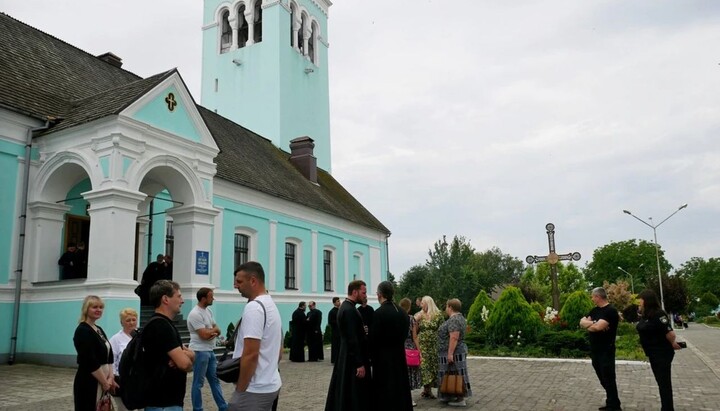
The authorities expelled the Dormition community from the cathedral in Volodymyr to hand it over to the OCU. Photo: Buh
Ukrainian authorities led by Zelensky constantly assure their Western partners that there are no violations of freedom of religion in Ukraine, and that anyone who claims otherwise is a Kremlin agent. They insist that there are no church seizures, and that all 2,000-plus transitions from the UOC to the OCU are purely voluntary.
But even if one were to believe for a moment that this is indeed the case, there still remain the actions of the state itself, even without taking into account the “exploits” of the OCU.
On January 14, MP Huz stated that the Dormition Cathedral of Volodymyr, which had been taken away from the UOC, was “transferred to the balance sheet” of the OCU by the authorities. Earlier, the authorities expelled UOC communities from two ancient cathedrals in Chernihiv. Before that, they removed the community of the St. Nicholas Cathedral and the regent school in Kremenets. Even earlier, UOC believers were expelled from the Refectory Church and the Dormition Church of the Kyiv-Pechersk Lavra, which were handed over for the OCU needs. And these are only the most vivid examples; in reality, there are a huge number of such cases.
In effect, the state is expelling some citizens holding Ukrainian passports from churches in order to let others in. But why is this happening? What makes the latter so much better than the former that constitutional norms are being trampled for their sake? The Ukrainian authorities justify this by claiming that the UOC is allegedly part of the ROC. For example, this was stated by Ambassador to the United States Stefanishyna in response to criticism from Congresswoman Anna Paulina Luna.
But where does such a claim come from? For such a large-scale and obvious violation of believers’ rights, there must be very compelling grounds. And this is where the argument falls apart. There are currently no grounds whatsoever to label the UOC as “Russian”. There is only the private opinion of five officials from the State Service of Ukraine for Ethnopolitics and Freedom of Conscience (DESS) (none of whom are theologians or scholars of religion), who, in their “study” of ROC documents, concluded that the Kyiv Metropolis (not the entire UOC!) is affiliated with Moscow. But even these arguments still have to be proven in court.
What is the result?
As of January 2026, the authorities have no legal grounds to label the UOC as “Russian”. Therefore, all expulsions of UOC believers from their churches in favor of the OCU – in Volodymyr, Chernihiv, Kyiv, or any other cities and villages – constitute a clear and obvious violation of their constitutional right to freedom of religion.
And if anyone claims otherwise, let them present at least one argument to support their position.
Read also
Lawyers in the crosshairs: How UOC is being stripped of its right to defense
Activists harass UOC lawyers outside courthouses, call them “traitors” on air, and promise them a “warm welcome” at hearings. The Church’s right to a legal defense is at stake.
How to respond to persecution: Lessons from St. Silouan the Athonite
The Church can and should be defended, but without malice. Why love for persecutors is not weakness but the only way to preserve the Spirit of Christ in the midst of the struggle.
Where the Spirit of the Lord is, there is freedom
Reflections on the controversies surrounding the creation of the OCU.
Pentarchy with Rome: A return to the roots or a new schism?
Patriarch Bartholomew wants to revive a council of five patriarchates, including Rome. What would reunion with Catholics look like, and what role would be left for the other Churches?
Concubine or daughter? On words that cannot be used about the Church
An archon of the Church of Constantinople likened the UOC to Moscow’s “concubine.” But for St. Epiphanius of Cyprus, “concubines” are heresies.
Shameful chronicle of one week: how the OCU was born
Exarchs under escort, a call from the operations room, and 36 votes for Epifaniy: what a member of the Phanar delegation revealed about the 2018 "Council".