First сosmonaut of spirit: How St. Anthony turned desert into metropolis
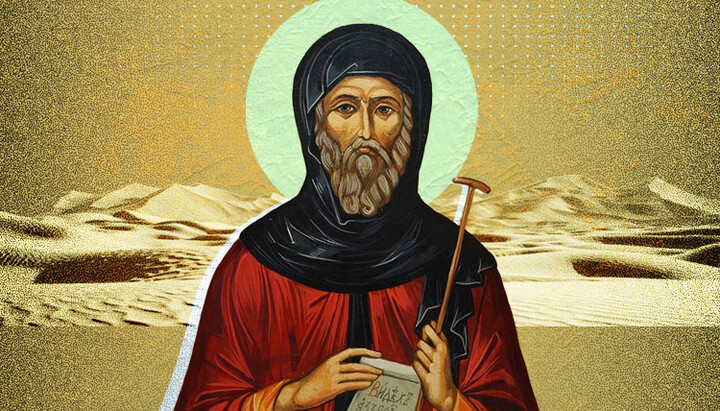
Saint Anthony the Great. Photo: UOJ
In the year 285, a young Egyptian did something his friends took for suicide. He simply left. First to the edge of the village, then to the tombs – and finally across the Nile, deep into the desert, to the ruins of an old mountain fortress at Pispir. Saint Anthony blocked the entrance with stones, leaving only a narrow slit for bread that would be brought to him twice a year.
Twenty years of seclusion. No internet. No news. Not a single living word. A modern person panics if you take their smartphone away for an hour. “Sensory hunger” sets in, withdrawal. Millennia before the age of celebrated “gadgets,” the desert-dweller was free even inside his stone sack.
What happens when you are left alone
We stare into our phones. They buzz with notifications every three minutes. We are slaves to this plastic box. And that Egyptian in the fourth century sat in darkness and silence. For twenty years.
In Holy Scripture, the desert is not a place for meditation and sunset-watching. It is the enemy’s lair, the arena of battle. When the Savior was led by the Spirit into the wilderness, He did not go there to rest but to fight (Matt. 4:1). The Egyptian ascetic took that challenge literally.
His confinement in the fortress at Pispir was like a prolonged psychedelic thriller. St. Athanasius the Great, Anthony’s biographer, describes it as a physical assault. The fortress walls were collapsing, and through the breaches came lions, wolves, snakes, and scorpions. The sounds tore at the ears. Demons took the form of women and soldiers.
These were not “images in the mind.” This was sensory deprivation pushed to the limit. When the outer world disappears, the inner world spills out – with all its monsters.
Anthony stood in the middle of that horror alone. With no therapists and no pills. The only cable supplying him “oxygen” was prayer, strengthened by humility.
Once, Abba Anthony saw all the snares of the enemy spread across the whole earth, and with a groan asked, “Who can possibly escape them?” And he heard a voice: “The humble one.” Not the strong, not the clever, not the well-read. The humble – the one who has nothing left to lose, because he has already given everything to God.
What they found when they broke down the door
After twenty years, Anthony’s friends could not bear it any longer. They came to the fortress and literally broke the entrance open. They expected to see anything: a starved skeleton, a mad old man with darting eyes, or a decomposed corpse.
To their astonishment, a man stepped out of the ruins in perfect physical and inner balance.
St. Athanasius writes that Anthony’s body had not changed – he had not grown fat from lack of movement, and he had not withered from fasting. His face shone with a strange calm. There was no fear in him, no nervous joy, no agitation.
It was like watching someone emerge from a capsule after decades in airless space. The ascetic returned from the desert and discovered within himself a point of support no crisis can shake.
It turned out that when you strip life of everything unnecessary, what remains is not emptiness but divine fullness.
The sheer physical reality of his feat is staggering. This “extreme” ascetic lived to 105. Without dentists, he kept all his teeth. Without glasses, he retained sharp sight to his last breath. He was healthier than those who stayed behind in “civilized” cities, drinking wine and discussing gossip. His body seemed to rewire itself to another source of nourishment – a spiritual one.
How the desert became a metropolis
Strangely, Anthony ran from people in order to be alone. But the opposite happened. Once he became whole, thousands began to follow.
The desert started to “bloom” with monasteries. Dead land where only scorpions had lived became a metropolis of the spirit. People abandoned homes in Alexandria and Rome just to stand near this old man from whom peace and silence seemed to flow.
The saint colonized the wilderness and made it habitable.
St. Anthony the Great proved this: solitude is terrifying only when there is nothing inside you. If you are empty, silence will crush you. If you are filled with God, silence becomes your ally.
Today we are suffocating in an informational smog. We fear that if we turn off notifications, the world will collapse – or we will vanish. Abba Anthony laughs at that fear from his fourth century. He tells us, “Try it. Enter your Pispir. Block the doorway with stones, if only for an hour. Down there, in the depths, the Creator is waiting for you. And you will be astonished at how strong you truly are.”
He was not a “gloomy monk.” He was the first cosmonaut to step into the open space of the spirit without a safety line – and return to tell us: it is not cold there. Love reigns there – the love of God.
Read also
Prayer commemorations instead of loving embraces
At every Orthodox wedding, the choir sings a hymn to the martyrs. For families separated by war, these words carry a special meaning.
Honest atheism vs. spiritual hypocrisy
The 70th anniversary of Albert Camus’s Nobel Prize recalls an uncompromising challenge to Christianity. An honest unbeliever brings theology back to the mystery of the Cross.
The valley of trouble and the gateway of hope
One soldier buried an expensive cloak and some gold beneath his tent. Because of this, all Israel lost a battle. Why did one man’s sin bring disaster upon an entire nation?
From love spells to bishop's throne
Antioch’s most powerful sorcerer sent demons against a devout young Christian woman three times – and failed every time. In the end, a demon himself revealed the truth that led to his conversion.
The Weeping Queen of Blachernae
On the night of the Feast of the Protection, only two people witnessed the miracle in the Church of Blachernae. Everyone else prayed and saw nothing. Yet they, too, received grace.
Deadly spiral of human hatred
The tragedy of Lebanon's civil war lays bare how dehumanization and fear can turn human beings into monsters.