Mirror labyrinth of righteousness
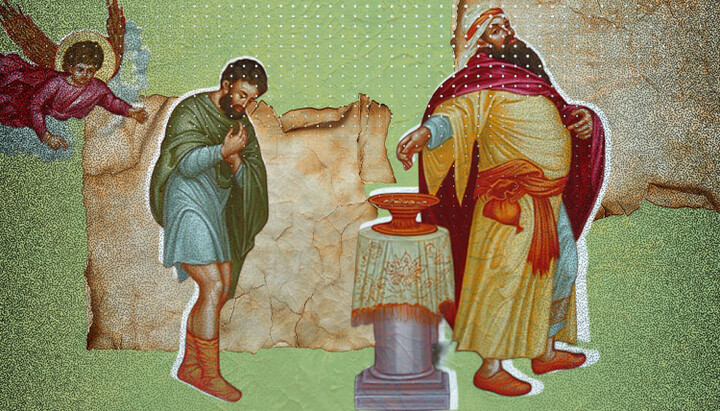
The Publican and the Pharisee. Photo: UOJ
Sunday of the Publican and the Pharisee… How many sermons and reflections on this parable have we already heard. In many of them, the Pharisee appeared as a caricatured villain. But this is unfair and wrong.
The Pharisee is an “ideal” believer. He is honest, sacrificial, he observes all the commandments, he is not just “normal”, he is – essentially, the religious elite. Most of us are very far from such a level of quality in spiritual life as the Pharisee had.
The Pharisee's problem is not that his spiritual storehouse is in order, but that its walls consist of mirrors reflecting the Pharisee himself and his perfect holiness. And God for him is merely a notary who must certify the list of his undoubted merits.
The Pharisee turned his relationship with the Creator into an accounting book. He filled the space of his soul with “correctness”, and in this impeccable purity there was no room left for the Living God.
God cannot enter where everything is already occupied by the human “ego”.
The Publican for the Pharisee is a background that clearly and beautifully sets off his own radiance. The Pharisee feels alive only when he finds someone “worse” than himself. His joy feeds on others' downfall. He lives in an icy desert of the spirit, where his “ego” swells to the size of the universe, displacing love.
Cry from hell
The Publican is a completely different matter. He has no arguments for defense. There is only sin and pain. The Publican is naked before eternity. This is a person who has neither good deeds, nor reputation, nor illusion about his significance. Strange as it may seem, but at certain moments in life this inner emptiness turns into a megaphone for a call.
“God, be merciful to me a sinner,” – this is not so much a prayer as a cry from the hell of his own abandonment and loneliness.
This is an existential cry of a soul that understood it cannot save itself. And here a miracle happens: the Publican's emptiness attracts God's fullness to itself.
The Publican does not ask for justice. Justice will destroy him. He asks for mercy. The Publican intuitively grasps that God is not an automatic judge, but Love that seeks a reason to forgive.
Christ concludes the parable with a shocking conclusion for His contemporaries: the Publican went to his house “justified rather” than the Pharisee. For Christ's listeners, these words were revolutionary. They always pictured God as a merchant, meticulously tallying everything, giving each one their just reward, and demanding payment for debts.
First hesychast
The Parable of the Publican and the Pharisee is also a textbook on prayer practice. One could say that the Publican is the first hesychast. He performs what in asceticism is called “bringing the mind into the heart”.
The fact is that the Pharisee prays “in the mind”, which wanders over the surface of his achievements. He is in a state of prelest (spiritual self-deception) and captive to his thoughts. His “ego” is a gigantic construct of thoughts, images and evaluations. The publican, however, performs an act of kenosis (self-humiliation). He cuts away everything superfluous. His prayer is like a laser beam directed at one point. He does not analyze his sin, he does not conduct a dialogue with God – he entirely becomes a call for mercy.
The Pharisee's speech in the temple is the embodiment of internal dialogue that never ceases.
In his head works a computer that keeps count of his righteousness and compares it with others. This is a state of “mental entertainment”, which is also called “monkey mind”. He cannot meet God because his mind is constantly occupied with itself.
Eye of the heart
The Publican enters a state of true hesychia. He becomes still. His refusal to lift his eyes to heaven is an act of the deepest self-restraint. He closes off his external senses so that the “eye of the heart” may open. In this emptiness, in this “nothingness” that the tax collector represents, true prayer and peace are born. The paradox of the parable is that the tax collector, being completely broken and emptied, finds the center of his life in God.
The Pharisee lives in his “head”. His religion is ideology, concept, law. He is protected by his righteousness like armor. But God cannot break through armor. The publican stands with a “broken heart”. This is a state when the hard shell of our “ego” cracks, and through this crack Divine energy (grace) begins to flow.
“Stand with your mind in your heart and cry: Lord, have mercy,” teach the Holy Fathers. The Publican does exactly this.
He does not reason about God, he stands in His presence. His consciousness of his absolute insufficiency is instantly filled with Divine presence. This is an existential “quantum leap”.
As Leonard Cohen (author of the song “Hallelujah”) said: “There is a crack in everything, that's how the light gets in”. The Publican in his simplicity reaches the “formlessness” of God. He does not imagine God, he does not envision angels. He simply knows: God exists, and I need Him.
Death of the ego
The Parable of the Publican and the Pharisee is a parable about the death of the ego. The Pharisee tries to preserve his “ego” through deeds. He wants immortality for his pride. The publican agrees to the death of his “ego”. He acknowledges: “I as a righteous person do not exist. There is only my sin and Your mercy”. At this moment spiritual resurrection occurs.
When our ego dies, Christ begins to live in a person. This is the main mystery of hesychasm: to free up space for God.
The Parable of the Publican and the Pharisee is a hymn to human freedom. We are not determined by our past. The Publican, burdened by years of sin, in one second in the temple becomes closer to God than the “holy” Pharisee in his entire life. This parable destroys all the logic of karma and cause-and-effect relationships of Eastern religious traditions. In Christianity, one moment of true repentance is worth more than tons of mechanical religiosity.
Read also
The Time of the Soul's Ripening
Modern society has turned youth into a cult and calls old age a period of "living out one's days." The Christian view reveals the deep spiritual meaning of one's later years.
Faith is not a checker piece in a spectator sport
Arguments about faith on social media increasingly resemble no-holds-barred fights. We turn to a saint who, sixteen centuries ago, knew how to speak to those interested only in turning theology into a combat arena.
The metropolitan who fought with a pen
St. Cyprian of Kyiv was robbed, expelled, and barred from his see. He answered with letters, books, and canons – and before his death, forgave everyone.
Loneliness under one roof
Spouses can share a home for years, raise children, and faithfully attend church – yet remain strangers to each other.
The cross – the deepest healing of the human soul
Emotional exhaustion and anxiety have become a way of life. Ancient Christian tradition offers an unexpected way out – embracing one's own cross.
The Prophet Elisha and the mystery of the Bethel massacre
The story of the prophet Elisha and the two bears seems to be the harshest in the Bible. But in reality, it carries a profound theological meaning.