Could the UOC have gained autocephaly 10 years ago?
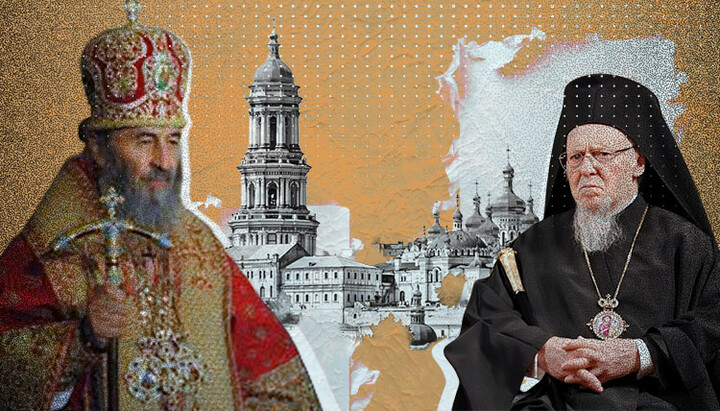
Did Patriarch Bartholomew grant the Tomos to the schismatics because he resented Metropolitan Onuphry? Photo: UOJ
The difficult situation the UOC finds itself in today is prompting discussion and a search for a way out. Most often, this way out is seen as the acquisition of autocephalous status. There is a widespread belief that if the UOC were to receive recognition as a Local Church, all of its problems would be resolved. However, at present, such a possibility (for various reasons) appears unlikely.
Recently, however, information has emerged suggesting that the UOC could have become autocephalous as far back as 10 years ago, that the Ecumenical Patriarch of Constantinople offered the status of the “Orthodox Church of Ukraine” not to Filaret and Makariy, but to His Beatitude Metropolitan Onuphry. This triggered a strong reaction across a wide range of church circles. Representatives of the “patriotic wing” of the UOC began criticizing Metropolitan Onuphry for “missed opportunities”, while critics from the north accused him of potential betrayal and of conducting secret negotiations behind the back of the Mother Church.
What is this about? The claim is based on an account by Archdeacon Andriy Palchuk of the Odesa Eparchy of the UOC, published on one of the church-related online resources.
“I will now tell you a sensation that I learned on the island of Corfu from a very serious person who communicates directly with representatives of Mount Athos and, accordingly, with the Ecumenical Patriarch. In 2016, our Primate was told that he should receive the tomos, independence. If you do not take it, we will give it to others. You must take it, because in 2018 Ukraine will in any case receive this tomos,” the deacon said, citing his source.
According to his interlocutor, after the election of the Primate of the UOC in 2014, Patriarch Bartholomew invited him to a meeting, but Metropolitan Onuphry sent another hierarch in his place.
“So that you understand, Bartholomew was deeply offended. Very deeply offended. One has to understand that there are also human factors, personality. And one has to maneuver within all this. You can’t act like that,” Fr. Andriy said indignantly.
According to the UOJ, there are no official documents confirming Phanar-UOC negotiations on granting the Tomos in 2016. There is neither official correspondence nor evidence of visits by representatives of Constantinople, nor any records of meetings. At most, what may have occurred were rumors circulating in church circles and informal attempts to “feel out” the disposition of the UOC episcopate.
But the main question, of course, is not that. Today, the Primate of the UOC is being blamed for condemning the Church to the current persecutions by the authorities and the OCU by ignoring the Phanar’s offer (if it was indeed made). Is this really the case?
Did Patriarch Bartholomew want to help the UOC but was offended?
Let’s assume that such an offer was indeed made. In Fr. Andriy’s account, the situation appears as if Patriarch Bartholomew, with good intentions, wanted to establish relations with the UOC Primate and help his Church gain autocephaly. Metropolitan Onuphry, however, for unclear reasons, rejected this “helping hand” from Constantinople.
Recall the historical church context. Neither 2018 nor 2016 can be considered a starting point in discussions about “Ukrainian autocephaly”. That point could be seen as 2008, when Patriarch Bartholomew visited Kyiv at the invitation of then-President V. Yushchenko. What prompted him to make this visit? Officially, it was to celebrate the anniversary of the Baptism of Rus’. But in reality, the reasons were far more serious: even then, there was an agreement with Yushchenko to legitimize Filaret with his “episcopate” from the UOC-KP and to integrate this structure into the Patriarchate of Constantinople. The next step was supposed to be the granting of the Tomos. The relevant letter from the Kyiv Patriarchate to Patriarch Bartholomew was published in 2020 by Oleksandr Drabinko.
It was only Filaret’s sudden “cancellation” that destroyed this plan at the last moment. The reason was simple – he suspected that he would not retain the position of Primate.
Patriarch Bartholomew was ready to grant autocephaly to the UOC-KP and UAOC even ten years before the creation of the OCU. So why, in 2016, was he willing to grant autocephaly to the UOC? Why such vacillations?
Could it be that Patriarch Bartholomew didn’t care who he granted autocephaly to — a legitimate canonical Church or people he had previously recognized as clergy without ordination? The facts suggest that this was indeed the case. But why was it so important for the Patriarch that, in order to implement his plan, he was willing to negotiate with parties from opposing camps? It seems the reason had little to do with love for Ukraine or Ukrainians. The truth is much simpler and more prosaic. For the Patriarchate of Constantinople, which considers itself “first without equal” in Orthodoxy, it was important to “put in its place” and weaken the Russian Church, which, after the collapse of the USSR, had grown in strength and become a threat to this primacy.
The first “trial run” was the establishment of a Constantinople Church structure in Estonia in 1996. And the separation and realignment of Ukraine would have been a decisive victory in the “war” with the ROC. Yes, it is strange to use militaristic terminology in the context of relations between Local Churches, but today the Phanar representatives speak openly about a “war” with the Moscow Patriarchate.
It is not surprising that, after a new Primate appeared in Ukraine, who could have helped Patriarch Bartholomew resolve the “Ukrainian question”, he tried to establish contact with him. Especially since the Euromaidan had just ended and the war in Donbas had begun with active Russian involvement. On the surface, the situation seemed favorable for breaking with the ROC and gaining autocephalous status. Metropolitan Onuphry did not go for it. And for this, according to Archdeacon Andriy, the Ecumenical Patriarch bore a grudge against him. But why did His Beatitude Onufriy act this way?
Why didn’t the UOC seek autocephaly?
In 2014, and even more so in 2016, the situation of the UOC in the country was already quite difficult. The state showed increasing hostility, media attacks in the media became more brazen, and the rhetoric of the “patriotic denominations” grew more intolerant. It would seem to be the perfect time to break from Moscow and establish contacts with Constantinople.
But let us remember that relations with the ROC were very different at that time. Patriarch Kirill refrained from political rhetoric and avoided commenting on relations between Ukraine and Russia. The eparchies in the Crimea and Donbas, despite Russia’s annexation, remained under the UOC administration.
It seems strange to recall now, but just five and a half years before the Euromaidan, Patriarch Kirill (then still Metropolitan of Smolensk and Kaliningrad) shouted from the stage on Khreshchatyk: “Russia, Ukraine, Belarus – this is Holy Rus’.” And a huge crowd greeted these words with enthusiastic cheers. Considering the historical and ecclesiastical ties between Russia and Ukraine, one can confidently say that the overwhelming majority in the UOC would not have accepted a break with the Russian Church. And such a break, in the case of defecting for Constantinople, would have been inevitable.
What would have awaited the Ukrainian Orthodox Church in that case? Almost certainly – a new schism. Part of the episcopate and the faithful would have considered such a decision a betrayal and a violation of the canons. And it would have been difficult to oppose anything to them.
Moreover, knowing Constantinople’s decisions on granting the Tomos to the OCU, one can say with certainty that in a similar scenario with the UOC, Metropolitan Onuphry would have had to accept a union with the non-ordained clergy from the UOC-KP and UAOC. There is no doubt that Patriarch Bartholomew would have implemented exactly the same plan he carried out in 2018: uniting everyone into a single structure without reordination or repentance. And even if someone from the UOC had opposed it, that would have changed nothing: recognition of the authority of the Constantinople Church would have automatically meant recognition of all its decisions.
Actually, a potential autocephaly for the UOC in 2016 would have been no different from the conditions that Patriarch Bartholomew offered to the UOC in 2018:
- recognition of the annulment of the 1686 Letter and the return under Constantinople;
- a “unifying council” of everyone with everyone;
- the Tomos bestowal.
On top of all this, there would have been a schism within the Ukrainian Orthodox Church itself. A portion (the smaller part) would have joined the new structure, while the rest would have tried to preserve the UOC structure or would have moved directly under the ROC.
Does autocephaly protect against harassment and persecution by the authorities?
We can imagine an even more fantastic scenario: Patriarch Bartholomew grants autocephaly to the UOC and “forgets” about the UOC-KP and UAOC. Let us be clear—this option is highly improbable, as it would completely undermine the carefully cultivated image of the Patriarch as a “unifier” of Ukrainian Orthodoxy. But let us still allow it: by the time of the full-scale invasion, there exists an autocephalous UOC, while the UOC-KP and UAOC continue to exist. Can we really believe that autocephaly would have protected the UOC from attacks by activists, schismatics, and at least suspicion from the state? Can we really think that no one would have called us “Moscow” and accused us of sympathizing with the Kremlin and working for Putin?
Let us give a simple example from the life of the Church of the Czech Lands and Slovakia in the Czech Republic. Today, it is called a “threat to national security.” At the end of January 2026, the authorities held a closed presentation of a report titled “Security Risks of the Orthodox Church.” Earlier, the Ministry of Culture had initiated administrative proceedings against the Church to revoke its special rights. Even earlier, the OCCLS was expelled from the Ecumenical Council of the Czech Republic due to “Russian influence.” Unofficially, the Prague hierarch is accused of ties to Moscow simply because he criticizes the OCU and studied at the seminary alongside the current Patriarch Kirill of the ROC.
And yet the Czech Republic is an EU country where there is no war. And the Czech Church is fully a Local and autocephalous Church. Moreover, its autocephaly was granted by Constantinople. And did this provide it with an “alibi”? No, it did not.
Talks suggesting that autocephalous status would have protected the UOC from accusations of being “Moscow-aligned” or having ties with the Kremlin are naive. To the “patriots,” it would have been just as much an “FSB church” as it is now.
Real alternative
Let us recall that all these considerations were made only in the context of Fr. Andriy Palchuk’s words that Patriarch Bartholomew offered His Beatitude autocephaly ten years ago. An analysis of the situation shows that even if such offers had come from Istanbul, they would have brought no benefit to the UOC.
The hypothetical “Tomos for the UOC” would have been absolutely no different from the current Tomos of the OCU: Constantinople grants autocephaly not to a specific structure, but to everyone in the country who calls themselves Orthodox.
Nevertheless, a question may arise: if not a Tomos from the Phanar, then what? What alternative does the UOC have?
The answer is to maintain the status that the UOC has now. The status of a truly independent Church that determines its internal life on its own, handles administrative matters and elects its own bishops and metropolitans.
Yes, this status is not formally recognized as autocephaly. But it gives the UOC more real freedom than the “autocephaly” of the OCU under the Phanar’s control. This was precisely confirmed by the decisions of the Council in Feofania, with reference to the Letter (the same Tomos) from the ROC in 1990. Decades of church practice have shown that the UOC is completely free in its decisions and is not dependent on external influence.
The UOC does not need a document from Constantinople to be an independent Church. It is already de facto autocephalous. Formal recognition of this status may happen at some point in the future, when the circumstances are right, and it can be done on canonically proper grounds, without yielding to those who violated church order.
The UOC leadership acts prudently, collegially, and in accordance with canonical principles. To some, this may seem insufficiently active or decisive. But it is precisely this approach that allows the Church to preserve its identity and survive the challenging conditions the UOC is facing today.
Read also
Pentarchy with Rome: A return to the roots or a new schism?
Patriarch Bartholomew wants to revive a council of five patriarchates, including Rome. What would reunion with Catholics look like, and what role would be left for the other Churches?
Concubine or daughter? On words that cannot be used about the Church
An archon of the Church of Constantinople likened the UOC to Moscow’s “concubine.” But for St. Epiphanius of Cyprus, “concubines” are heresies.
Shameful chronicle of one week: how the OCU was born
Exarchs under escort, a call from the operations room, and 36 votes for Epifaniy: what a member of the Phanar delegation revealed about the 2018 "Council".
Can UOC eparchies be dissolved before court ruling on Metropolia?
DESS is launching separate proceedings against UOC eparchies, monasteries, and institutions while the case involving the Kyiv Metropolia is still pending.
Two murders, one silence
Zelensky condemned the killing of a Catholic priest in Poland the very same day. A month earlier, a UOC monk was murdered at the Sviatohirsk Lavra – and the president has remained silent ever since.
A bow to Phanar? Why did UOC academy congratulate Constantinople’s exarch?
A delegation from the Kyiv Theological Academy congratulated the Phanar’s exarch, who has remained silent about the persecution of the UOC. Who authorized this gesture, and why did even OCU supporters fail to appreciate it?