God in bed No. 2: The last conversation with Nektarios of Aegina
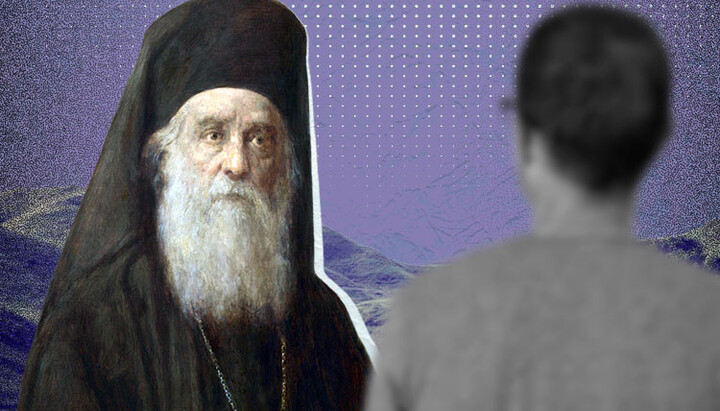
The dying saint. Photo: UOJ
The smell of carbolic acid. Metal bedpans in the corner. The squeak of springs on the neighboring bed. November 1920 – the Areteion Hospital in Athens. A ward for incurable paupers.
I am on duty in the ward. All around me – the paralyzed. The doctors promise nothing. They say, “Get used to it.”
I am on duty in the ward. All around me – the paralyzed. The doctors promise nothing. They say, “Get used to it.”
Get used to what? To the fact that you are – a vegetable? To the fact that you will not even make it to the toilet on your own?
Last night they brought in someone new. A small old man in a coarse woolen cassock. The nun Euthymia was explaining something for a long time to the director out in the corridor. I caught scraps of their conversation:
“He has no money.”
“He is a monk?”
“He is a bishop.”
The director laughed. He did not believe it. Bishops do not walk around like that.
They laid him on the bed opposite mine – bed number two.
The first night
He does not groan. That is strange. I can see his body twisting with pain – acute prostatitis, cancer, something wrong with the bladder too, I did not quite understand. The doctors were talking in the morning. They said, “Not long now.”
But he is silent. He only clenches his teeth. His lips move. He is praying, I suppose.
At night I cannot stand it any longer.
“Vladyka,” I whisper. “Does it hurt?”
He opens his eyes. Dark, deep. Tired.
“It hurts,” he says softly. “But it is nothing.”
“How can it be ‘nothing’?” I am almost angry. “You are a bishop. Why are you here? Why did they not put you in a proper ward? Why are you alone, without help?”
He is silent. Then he smiles. A strange smile – not sad, not bitter. Simply calm.
God is not closest when we are flying, he says. He is closest when we are broken.
I do not understand it all. But I do not want to argue.
Second day. A conversation about justice
In the morning an orderly brings breakfast. Thin porridge. Bread. Tea without sugar.
The old man hardly eats. He only drinks water. His lips are cracked. The skin on his hands – like parchment stretched over bones.
I look at him and think: where is justice? He served God all his life. Built a monastery. Taught nuns. Helped the poor. And now he is dying here, in this stinking ward, like a vagrant.
“Vladyka,” I say again. “Is this really just? You gave your whole life to God. And He… like this?”
He looks at me for a long time. Then he says:
Gold is purified only in fire. If God wants to make me gold, He must melt me down. Illness is fire. It burns away everything superfluous. Only what is real remains.
“But it hurts!” I almost shout. “Why is this pain needed?”
“So that I do not forget who I am,” he says quietly. “Without pain I might think I am great. That I am a bishop, a metropolitan, a teacher. Pain shows the truth: I am only an old man who cannot even get to the toilet by himself.”
I fall silent, because he is right.
Third day. About enemies
At night his condition worsens. A nurse comes. Gives an injection. Morphine, probably. He does not resist. He only whispers something.
In the morning I ask:
“Were you praying?”
“Yes,” he says.
“For yourself?”
“No. For those who betrayed me.”
I do not understand. I am indignant.
“And you have the resolve to pray for them?” I cannot believe my ears.
“Yes,” he says simply. “Because they did not know what they were doing. They were afraid. Fear makes people cruel. I cannot hate them. Hatred is poison. It kills the one who carries it.”
I look at him and think: how? How can one not hate those who ruined your life?
He seems to read my thoughts.
“If I hate them, I will become the same as they are. Fear and hatred are one and the same. They kill the soul. Forgiveness is the only thing that gives freedom. Not to them. To me.”
Fourth day. Silence
He scarcely speaks. He lies quietly. Breathes heavily. His lips move, whispering prayer.
Orderlies are talking in the corridor: “Today – tomorrow.”
In the evening the nun Euthymia comes again. She sits beside him. She is quietly crying. He strokes her hand.
“Do not cry,” he whispers. “I am going home.”
She nods. But the tears do not stop.
I look at them and think: what are we afraid of? Death? Or the fact that we never managed to become real?
The fifth night. November 8
Night. Silence. Only the old man’s heavy breathing.
Suddenly he opens his eyes. Looks somewhere upward. Smiles.
“I see,” he whispers.
“What do you see?” I ask.
He does not answer. He simply closes his eyes. And does not open them again.
His breathing stops. Silence.
The nun jumps up. Calls the nurse. They come to the bed. They pronounce him dead.
And suddenly – a fragrance. Not carbolic acid. Not pus. Not hospital.
A fragrance I have never smelled before. Sweet, but not cloying. Fresh, but not floral. Unearthly.
It fills the whole ward. It overpowers the stench of urine and medicines. I breathe it in and understand: I am sensing something I should not be sensing here. Not in this place. Not in this pain.
The nun and the nurse begin to change his body. They remove his undershirt – coarse wool, soaked in the sweat of sickness. They toss it onto the bed where a paralyzed pauper lies – simply to free their hands.
The shirt touches his legs.
The miracle
Suddenly the helpless man begins to move his fingers. Bend his knees. He rises.
The nurse turns around. Drops the sheet. Screams. The nun looks at me. Crosses herself.
He is standing on his feet. He holds onto the bedframe, because he is not used to it. But he is standing.
And I understand: Vladyka Nektarios has died, but he has not gone away forever. He left something here. Not a shirt. Not a thing. He left Light.
The body of the departed hierarch was taken away. He was buried on Aegina, in the monastery he built. The nun Euthymia took that shirt. Later I learned that dozens more were healed by it.
More than a hundred years have passed. Saint Nektarios of Aegina has been glorified. His relics stream myrrh. His icons are in churches all over the world.
But I remember him not on an icon. I remember him on a hospital bed. Small, exhausted, with cracked lips. A bishop whom no one recognized. A metropolitan who died in poverty.
And I understand: dignity is not how you look. Not whether you can get to the toilet by yourself. Not how many titles and honors you have.
Dignity is the Light of God that you carry inside a dying body.
Illness strips a person bare. It tears off ranks, status, beauty. Only what truly is remains. In Saint Nektarios there remained only Light. Cancer killed his body, but it could not destroy his spirit.
To this day I remember that bed – number two. God Himself was there with His saint. In a ward for the destitute.
Read also
The Weeping Queen of Blachernae
On the night of the Feast of the Protection, only two people witnessed the miracle in the Church of Blachernae. Everyone else prayed and saw nothing. Yet they, too, received grace.
Deadly spiral of human hatred
The tragedy of Lebanon's civil war lays bare how dehumanization and fear can turn human beings into monsters.
Woe to expectant mothers – or to those of little faith?
God commanded one prophet not to have children, yet told his people in exile to bear sons and daughters. What does this apparent contradiction tell us today?
The help God never asked for
Uzzah wanted only to keep the Ark of the Covenant from falling into the dust. Why did this well-intentioned act cost him his life, and who was really responsible for his death?
Freedom begins when there's nothing left to take
Fear of persecutors takes root in our attachment to possessions. We turn to St. Basil the Great to understand why the prefect's threats held no power over him.
The bride in the window frame
The author of the earliest account of St. Thecla’s life was defrocked. Yet it was his book that preserved the only ancient description of the Apostle Paul’s appearance.