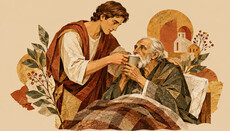

The bishop who discovered the law of the heart’s gravity

Nearly a thousand years before Newton, Blessed Augustine formulated a law of gravity – not for bodies, but for hearts. We put his theorem to the test against our own attachments.
Today we begin a series of conversations on spiritual matters with the saint who was the first to leave behind a written confession of his life.
Aurelius Augustine was born in 354 in Tagaste, a small Roman town in North Africa. The future bishop’s youth was turbulent. He built a brilliant career as a rhetorician, spent years in the Manichaean sect, which promised simple answers to the problem of evil, and endured the loss of a close friend – a tragedy he would later describe as one of the deepest wounds of his youth. He converted to Christ and was baptized in 387, and by 395–396 Augustine had become Bishop of Hippo, remaining in that office until his death.
Around 397–400, already a bishop, he wrote his Confessions – a work often described as the first attempt at written self-examination in Western literature.
Long before psychology emerged as a science, Augustine carefully examined every movement of his soul: where the impulse to steal comes from, why the heart cannot find rest, and what happens to a person who loves the wrong things or loves them in the wrong way.

He died in August 430 in Hippo, then under siege by the Vandals, during the third month of the occupation.
It is with this man – who struggled against his own weakness until the very end – that we begin our conversation today.
The invisible weight that pulls us down
– Your Grace Augustine, you lived a life filled with attachments – to success, learning, and people. Looking back, what did you come to understand about the very nature of such love?
The Blessed One does not answer at once. He reflects, as though weighing his words. At last, he begins to think aloud:
– My love is my weight; wherever I am drawn, it is my love that carries me. Fire rises upward, a stone falls downward. Everything seeks its natural place. So it is with the soul: wherever its love is directed, there it moves, whether it wishes to or not.
– That sounds almost like a law of gravity – as though it had been discovered not after your time, but during your lifetime.
– I am speaking in the language of my age – the language of natural philosophy, St Augustine replies. – More than a thousand years before scholars would describe mathematically how bodies fall, every human being already knew from experience that what pulls the heart downward is stronger than any physical gravity. The difference is that a stone does not choose its weight. It falls at the speed God has appointed for it. A human being, however, can choose what to love and how to love it.
We fall silent. It is an unsettling thought: if what he says is true, then our present and future are determined by what we truly love and become attached to – often against our own will.
Why can the heart find no rest?
– Your Grace, love as attachment can exhaust the soul. Anxiety arises at the thought that the things dear to us may one day be taken away.
– You have made us for Yourself, and our heart is restless until it rests in You, Augustine suddenly says, reciting the prayer with which he once opened his Confessions. – The anxiety you speak of is not weakness. It is a signal. The heart grows weary not from attachment itself, but from trying to assign to temporary things a weight they do not truly possess.
– So the problem is not that we are too attached to something?
– The problem is that we want to make perishable things eternal, the saint replies. – A home, a career, even someone dear to us – all these are good, and everything created by God is good. But to demand from creation what only the Creator can give is to condemn oneself to endless anxiety and exhaustion. These things are not worth the price you place upon them.
The proper hierarchy of love
– Your Grace, in your writings you speak of an order of love. What does that order mean?
– Virtue is the proper ordering of love, Bishop Augustine answers at once. – Sin is not the love of bad things. There are no bad things among those created by God. Strange as it may sound, sin is the love of good things – but understood and practiced in a distorted, disordered way.
– How can all this be applied to our ordinary lives?
– Imagine a set of scales, Bishop Augustine says. – On one side are your family, your profession, your care for those close to you, your country, and the city where you live. All of these are worthy of love. The problem begins when love for these things outweighs love for God. Not because God is jealous, but because He alone can give absolute love without being destroyed Himself and without destroying us.
We recall the confession that once burst from the depths of our interlocutor’s grieving soul:
“Late have I loved You, Beauty so ancient and so new, late have I loved You! You were with me, but I was not with You. Those things kept me far from You which would not exist unless they existed in You.”
A library is worth more than survival
– Your Grace, you were dying in a besieged city. An entire age was collapsing around you – the Roman Empire was living out its final decades. How did you feel in those days?
Blessed Augustine answers calmly:
– I was not saving the city. I was saving the books.
– Which ones?
– In my final years, I made sure that manuscripts – both my own and those of others – were copied and taken to places of safety: Italy, Gaul, and Sicily. The city in which I served could be lost. But I did not want important thoughts, written down near the end of life, to be lost with it.
– Does that not contradict your own teaching about detachment from everything earthly and temporary?
– No, Augustine replies firmly. – Giving heavenly and earthly things their proper place in the order of love does not mean indifference toward creation. One must simply know what is truly worth saving and what may be surrendered to destruction. Hippo was doomed. But thoughts about God, written on parchment, must not be allowed to die.
– And what thoughts troubled you during the final days of your life?
The saint remains silent longer than usual.
– I asked for the penitential psalms to be written on the walls of my cell. The penitential psalms in particular, he says. – Even a bishop, even an old man who has spent his whole life contemplating God, remains until his final hour a human being who still has much for which to repent before Him.
We end this conversation with the feeling that someone has finally spoken aloud what we have always sensed but could never put into words. The anxiety caused by attachment to material things is not necessarily a reason to reject them at once. It is a signal from above – an invitation to discern where the gravity of our heart is truly pulling us and Whom we must place at the center of our lives.