Estonian Council of Churches opposes ban on EOCC over ties to Moscow
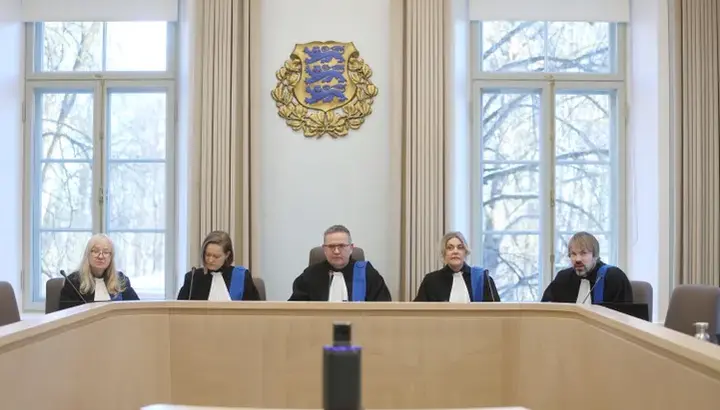
Panel of the Supreme Court that heard the Estonian President’s petition regarding the Churches and Congregations Act. Photo: SILLE ANNUK/Tartu PM/Scanpix Baltics
On February 3, 2026, Estonia’s Supreme Court, in an open hearing, began considering a petition by President Alar Karis to declare unconstitutional amendments to the Churches and Congregations Act that would prohibit religious organizations from maintaining ties with foreign spiritual centers, Postimees reports.
The hearing took place in Tartu with the participation of representatives of the President, the Riigikogu, the Ministry of the Interior, and the Ministry of Justice, as well as delegations from the Estonian Orthodox Christian Church (EOCC), the Pühtitsa Stavropegial Convent, and the Council of Churches of Estonia.
The government and parliament insist the amendments are necessary to protect national security. In their view, the potential threat comes not from religious communities in Estonia, but from foreign centers of influence.
The Council of Churches of Estonia expressed serious concern that, by changing the legislation, the state is intervening in the self-determination of one specific church. In the Council’s view, this approach creates a dangerous precedent of pressure on religious freedom and could affect more than just the EOCC.
The Pühtitsa Stavropegial Convent and the EOCC took a position similar to the President’s. Their representatives stated that the proposed norms are, in fact, directed precisely at the EOCC because of its canonical link to the Moscow Patriarchate and do not have a general, neutral character. The Church emphasizes that the demand to change its subordination violates the principle of legal predictability.
In addition, representatives of the EOCC and the monastery said the law places responsibility on the local church for the actions and statements of foreign clerics who are beyond its control. In their view, this creates the risk of arbitrary enforcement, increases the sense of discrimination, and undermines believers’ trust in the state.
Earlier, the UOJ reported that Estonian authorities had adopted a law mandating the severance of canonical ties between the Estonian Christian Orthodox Church and the Moscow Patriarchate.
Read also
Zhytomyr court gives pastor suspended sentence for refusing mobilization
A court handed a pastor a three-year suspended prison sentence for refusing military service on religious grounds.
UOC bishop: Church is not holy water and prosphora but a bridge to Eternity
Metropolitan Boholep of Oleksandriia said that Christians must go beyond simply believing to embracing faith and being born again. Otherwise, they remain mere consumers of “church services.”
KDAiS rector responds to critics of delegation’s visit to Phanar exarch
Archbishop Sylvester said that congratulating the Phanar exarch on his anniversary was part of the Church’s diplomatic life.
OCU cleric joins UOC-KP along with his congregation
UOC-KP head Nikodym has signed a decree accepting another OCU cleric into his organization.
OCU-affiliated platform posts mock murder video
Supporters of the Dumenko structure have once again posted a video depicting a killing.
Dumenko: Churches not recognizing OCU do not deny its autocephaly
Dumenko claimed that Local Orthodox Churches have not established full relations with the OCU because of the Russian Orthodox Church’s influence over the Orthodox world.