The Father’s embrace: Why God has two different hands in Rembrandt’s painting
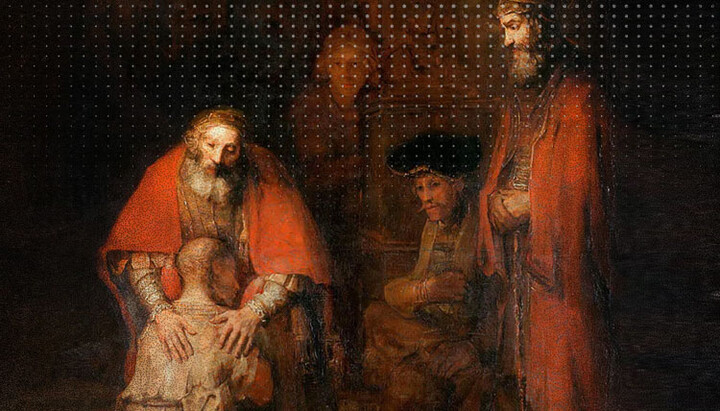
Rembrandt. The painting The Return of the Prodigal Son. Photo: UOJ
Standing before a two-by-two-meter canvas, you cannot tear your eyes away from a heel. A dirty, scraped, callused heel – the heel of a man who has just collapsed to his knees. Rembrandt painted it so you can see the cracks in the skin, the dust ground into the creases. Nearby lies a sandal – worn through, with a hole in the sole. The other is still on his foot, but it is barely holding together. This man has walked hundreds of miles. For the last weeks – perhaps months – he has been barefoot. He made it. But what his feet have become is its own separate story of pain.
The painting is called The Return of the Prodigal Son. Everyone knows the plot: the younger son demands his inheritance, squanders it, comes back in rags, and the father forgives him. A school lesson. But when you stand before this canvas, the school lesson evaporates. Only the heel remains – and the question: how far do you have to go for your feet to be rubbed raw, to the blood?
Rembrandt painted this work in 1668–1669, a few months before his death. He was sixty-three. He lived in poverty in a poor quarter of Amsterdam, after bankruptcy and the sale of everything he owned. He had buried his wife, three children, his beloved. He knew what it was to lose everything – and to have no strength left for the road back. When he painted this canvas, he was not illustrating a parable.
He was writing a testament. He was painting his hope that beyond the threshold of death there is Someone who will receive him as he is – scraped, ruined, with heels full of scars.
Frame one: a shaved crown
Lift your eyes higher, to the son’s back. He is on his knees, his face pressed into his father’s chest. We do not see his eyes. We see only the back of his head – shaved bare. It is a strange detail, easy to miss, but it is the key.
Why is his head shaved? Art historians argue. Some say it is the mark of a convict or a slave – in antiquity, slaves and criminals had their heads shaved. He has lost the status of a free man. Others say it is the sign of illness – typhus, which cut through the poor in the slums. A third view sees a symbol of being reset to zero: he has returned as an infant. A bare head, like a newborn’s. Life begins again.
Most likely, Rembrandt meant all three at once. The son truly was a slave – he tended swine, and for a Jew that was rock-bottom. He truly was sick – poverty always drags disease behind it. But above all, he truly returned as an infant. He cannot speak. He can only fall to his knees and allow himself to be embraced.
Rembrandt worked in a technique called impasto. He laid paint on so thickly that it rose above the surface of the canvas. He molded light with his fingers, smeared it with his palms. You want to touch this painting – to run your hand over the son’s shaved head, to feel the roughness of the paint. Rembrandt painted as though he knew this: sight can deceive, but touch does not. You have to touch in order to believe.
Frame two: hands that cannot belong to one person
Now look at the father’s hands. The father embraces the son with two hands. The left rests on the son’s right shoulder. The right rests on the left. But these hands cannot belong to a single man.
The left hand is broad, muscular, with thick fingers splayed wide. It lies heavy. It holds. It braces. It is the hand of someone who has worked with his hands all his life. The hand of a man who can lift a log or catch someone as he falls. The fingers spread as if the father fears the son will collapse again – and he must keep him from going down.
The right hand is refined, with long, slender fingers that rest softly, almost without pressure. The fingers draw close together. They do not grip – they soothe. It is the hand of a woman comforting a child after a nightmare. The hand of a mother who knows that a touch can be stronger than any words.
Henri Nouwen, a Catholic priest and theologian who wrote an entire book about this painting, spent several days in front of it at the Hermitage in 1986.
He noticed this asymmetry and understood: Rembrandt portrayed God not as Father or Mother, but as Father and Mother at once.
In Hebrew, the word for “mercy” – rachamim – comes from rechem, meaning “womb.” God’s mercy is not the stern justice of a patriarch. It is maternal tenderness – the tenderness that carried you for nine months and is ready to carry you again, no matter how many times you leave and return.
Rembrandt, a Protestant raised in a tradition where God is a strict Judge, instinctively touched what mystics in every age have known: God is larger than our categories. He is the Father who protects and the Mother who comforts. The left hand says, “I will not let you go.” The right says, “I will console you.” And both hands say, “You are home.”
Frame three: a blindness that sees more than sight
Look at the father’s face. His eyes are half-closed. He does not stare at the son. He does not measure the rags, the shaved head, the filthy feet. He is feeling him.
This is the image of a blind father recognizing his son by touch. It echoes the biblical story of the blind Isaac, who felt Jacob to know whether it was truly his son. But in Rembrandt, the father’s blindness is not a physical ailment. It is a theological metaphor.
Vision judges. Eyes see dirt, a beggar’s garment, worn sandals. Eyes draw conclusions: he is lost, he disgraced the family, he is unworthy. But touch loves. Hands feel the warmth of a living body, the beating heart, the shiver of cold and fear. Hands say: he is alive, he is here, he has come back.
God does not look at us. He touches us.
He is no respecter of faces, as Scripture says, because faces lie. A beautiful face may conceal a dead soul. A ravaged face may conceal holiness. God feels the heart. He recognizes us not by what we look like, but by what we are within.
Rembrandt painted a “blind” God in an age when the Church taught that God sees every sin and records it for the Last Judgment. He painted a God who closes His eyes to sins because His hands have already embraced the sinner. It was a radical gesture in the seventeenth century. It is a radical gesture in the twenty-first.
Frame four: the shadow of the righteous
To the right of the father and son stands another figure – the elder brother. He wears a red cloak, holds a staff, and his face resembles the father’s. But his hands are locked together. He does not embrace. He does not touch his younger brother. He stands upright and looks down.
He is the most frightening figure in the painting. Because he believes he is right. He truly stayed at home. He truly worked, did not rebel, did not demand his inheritance. He is the “good” son. But his hands are closed.
The father bends over the sinner. The righteous man stands straight. The father embraces. The righteous man grips his staff. The father is blind to sins. The righteous man sees every detail of disgrace.
Rembrandt shows the tragedy of righteousness without mercy. You can stand next to God – within arm’s reach – and be infinitely far from Him. You can live your whole life without sin and never once love. You can be right – and dead at the same time.
In Christ’s parable, the elder brother does not enter the house for the feast. He stays outside, in his righteousness and resentment. In Rembrandt’s painting, he stands on the threshold. He can still go in. But to do that, he must unclench his hands. He must bend. He must stop judging and begin embracing.
Where am I in this painting?
In truth, all of us are in this painting. The only question is who we are right now.
The younger son on his knees – with scraped heels and a shaved head? The one who went so far that the road back feels impossible? The one who fears he will not be received because he is too dirty, too broken, too guilty?
Or the elder brother standing aside with a staff in his hand – the one who never left, but never returned either? The one who sees other people’s sins more sharply than his own deafness of heart?
Rembrandt died in October 1669, a few months after finishing this painting. He died in poverty, alone, in a rented room. He was buried in an unmarked grave. But he left these hands behind – one masculine, that holds; the other feminine, that soothes.
He left an image of God who does not judge by appearances, but embraces blindly, without calculation.
Now, when the world once again feels like a place you want to flee, those hands say what they said in 1669: there is a home. You can come there scraped and barefoot, with a shaved head and empty pockets. You will be received – not because you deserve it, but because God has two hands. And both are turned toward you.
The only question is whether you are ready to fall to your knees and allow yourself to be embraced.
Or whether you will stand off to the side with a staff in your hand, counting how many times your brother sinned – and how many times you were right.
Read also
Stories of the Early Church. Level of governance: patriarch
How did several episcopal sees rise above the rest, why did the Church’s administrative map come to mirror that of the empire, and is the patriarchate a sacred form of Church governance?
A Chronicle without an author
We are accustomed to calling The Tale of Bygone Years the work of St. Nestor. Yet another monk left his signature on it, while the chronicle itself passed from one generation of scribes to the next.
How a wedding stopped a war
The young princess of Slutsk was married off to keep two powerful noble families from drowning the city in blood. Soon afterward, a Uniate metropolitan complained that Orthodoxy had been reborn in Slutsk.
Man before the forces of nature
A solitary figure on the shore seems insignificant before the immense power of the sea, yet it is he who stands before the Creator.
The mysteries of Golgotha in the light of archaeology
The veil of centuries obscures what really happened in the fourth century. Archaeology and ancient texts shed light on the true history of one of Christianity’s greatest sacred sites.
Zaporozhian Cossacks defend the persecuted faith
The story of how Cossacks drew their sabers to defend abused priests – while sometimes causing violent disturbances inside churches themselves.