A lock before the deep: How not to turn cheesefare week into a carnival
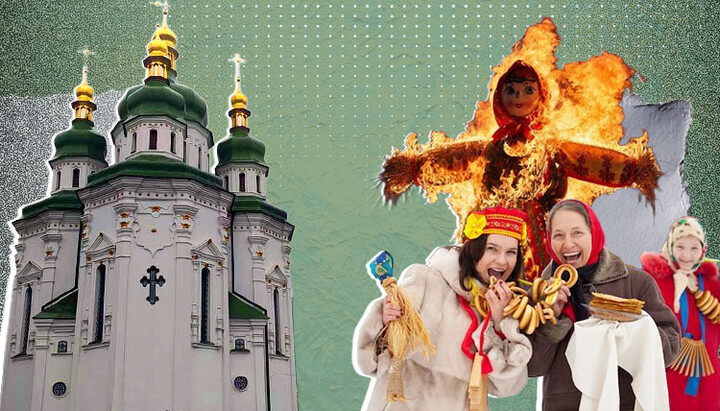
Maslenytsia: Pagan and Christian. Photo: Union of Orthodox Journalists
We are standing at that line again. Ahead is Great Lent – forty days of descent into silence and strictness. And right now comes a strange, noisy, muddled week that we habitually call Maslenytsia. In the Church calendar it is Cheesefare Week. And here we often fall into a trap. On the one hand – “let the soul run wild,” mountains of pancakes and the intoxication of a fairground. On the other – penitential prostrations in church on Wednesday and Friday. We dart between the frying pan and the Prayer of St Ephraim the Syrian, trying to weld together what cannot be welded. But perhaps this is precisely where the Church’s deep care for our psyche and spirit is hidden.
The bends of the soul
Ask a professional diver what is most dangerous in his work and he will not say “sharks” or “darkness.” He will say decompression sickness. It happens when you rise too quickly from great depth, and nitrogen bubbles in the blood begin to tear the body apart. In the spiritual life it works the same way – only in reverse. We cannot “jump” into the Fast at a sprint.
We are creatures of habit. We are accustomed to a certain rhythm of eating, socializing, consuming information.
A sudden shift from “everything goes” to strict abstinence and silence almost always triggers a spiritual case of the bends.
Those are the familiar breakdowns in the first week of Lent, the sudden flare of aggression and irritability. Perhaps this is not so much “demonic temptations” as the body and psyche rebelling against violence done to them.
Cheesefare Week is an adaptation шлюз – an airlock, a decompression chamber where the pressure is equalized gradually. Meat has already left our diet – we bid it farewell last Sunday. But dairy, eggs, and fish remain. The holy fathers taught that preparation for the fast must be gradual – like warming up before a long road. We loosen the muscles. We tune the instrument.
On Wednesday and Friday of this week, the Divine Liturgy is not celebrated. It is a striking moment. In the middle of this half-fast, when homes smell of fried batter, a hush settles in the churches. We make our first prostrations to the ground.
These “flashes” of the coming Lent remind us: the pancake on the plate is not the goal – it is only strength for the road.
Remembering the dead in the smoke of kitchens
Most of us are sure that the pancake is a symbol of the sun. We were taught that in school; glossy magazines repeat it. Yet this “solar” theory is quite recent – it appeared in the nineteenth century. It was invented by romantic scholars who saw echoes of sun cults everywhere.
In reality, for our ancestors the pancake was a memorial food, in the first place.
The first pancake at Maslenytsia was never intended for the eater. It was placed on the window “for the parents” – that is, for departed ancestors. Or it was given to a beggar at the gate, so he would commemorate the dead. Ethnographers record this among the Eastern Slavs as a stable practice of remembrance.
Maslenytsia does not begin right after Meatfare Saturday by accident. It is a meal in the presence of the whole family – the living, and those already with God. We are not celebrating the sun. We are affirming the unity of generations before the face of eternity. We sit at table with the whole Church – visible and invisible – asking for strength for the road ahead.
Burning the ego instead of straw
Every year we see the footage: cheerful crowds burning a straw effigy. In the logic of ancient magic it made sense – people tried to “kill” winter and cold physically, to force spring to come more quickly. Responsibility for everything bad was shifted onto straw. Burn the doll – and you feel cleansed.
Christianity offers a completely different mechanism.
We do not need to burn straw. We need to burn our own egoism.
Preparing for Forgiveness Sunday is hard labor: cleansing the space of your life, not merely the contents of your refrigerator. You can clear every dairy product from the house, but if the “corpse” of an old grievance against your brother or your mother is still lying in the heart, your fast will be nothing more than a diet.
St Tikhon of Zadonsk saw how preparation for Lent in Voronezh could turn into ordinary frenzy. He wrote that “whoever spends Maslenytsia in disorderly excess becomes a clear disobedient of the Church and shows himself unworthy of the very name of Christian.” He reminded people that this week is given for contemplating God, not for contemplating the bottom of an empty plate. We often fear being “too strict” with ourselves, but at times we lack precisely this sobriety. Maslenytsia is a time to gather strength for good – not to lose one’s human face.
The pancake as a white flag
The tradition of going “to the mother-in-law for pancakes,” or inviting guests during Cheesefare Week, is not really about cuisine. It is about diplomacy. Family is always a complex system of hurts, half-spoken words, and long-standing quarrels. Sometimes people do not speak for years, living on neighboring streets.
And here the pancake becomes a “white flag.” Maslenytsia gives us a legal, universally understood reason to enter a house you have been afraid to enter for a year. It is social grease that helps rusted mechanisms of human relationships move again.
We bake pancakes so that, at a warm table, it becomes easier to say the words that matter: “Forgive me.”
St John Chrysostom reminded us: “Not only the mouth must fast – no, let the eye fast, and the ear, and the hands, and all our body.” This applies fully to the threshold of Lent as well. If we feast, but our table has no place for the one who cannot repay us – the poor man, the lonely neighbor, the wanderer – then our hospitality is worth little. A true feast is justified only when it enlarges the circle of our love.
The smell of home in the fog of anxiety
We live in a strange time. When it is February outside, and in the news there are reports of destruction and death, Maslenytsia can feel like a feast during a plague. It is easy to slide into escapism – to try to forget ourselves in food and empty merriment, just so we do not think about what is happening. But that is a false path.
We do not need to hide. We need to strengthen our bonds with one another. In conditions of war and crisis, Cheesefare Week becomes a time to build a warm circle.
We bake pancakes not because we are unbearably cheerful, but because we desperately need to feel the smell of home and the warmth of the hand beside us.
This is our quiet way of telling death and ruin: “We are still a family. We are alive, and we are holding on to one another.”
We do not know what this Lent will be for each of us. We do not know whether we will have the strength to finish it. But today we have this week – a week of quiet evenings, the smell of warm batter, and the chance to call the person with whom we are at odds.
Do not miss this time. Let it be for us not a carnival, but a door we open to one another, so that together we may enter the silence of the fast.
Read also
Brother of tax collector and brother of Lord
The Gospel is silent about the son of Alphaeus, and commentators have argued for centuries over who he was. And the Church commemorates two apostles named James in close proximity.
Prayer commemorations instead of loving embraces
At every Orthodox wedding, the choir sings a hymn to the martyrs. For families separated by war, these words carry a special meaning.
Honest atheism vs. spiritual hypocrisy
The 70th anniversary of Albert Camus’s Nobel Prize recalls an uncompromising challenge to Christianity. An honest unbeliever brings theology back to the mystery of the Cross.
The valley of trouble and the gateway of hope
One soldier buried an expensive cloak and some gold beneath his tent. Because of this, all Israel lost a battle. Why did one man’s sin bring disaster upon an entire nation?
From love spells to bishop's throne
Antioch’s most powerful sorcerer sent demons against a devout young Christian woman three times – and failed every time. In the end, a demon himself revealed the truth that led to his conversion.
The Weeping Queen of Blachernae
On the night of the Feast of the Protection, only two people witnessed the miracle in the Church of Blachernae. Everyone else prayed and saw nothing. Yet they, too, received grace.