Lot’s wife syndrome: Why repentance cannot look back
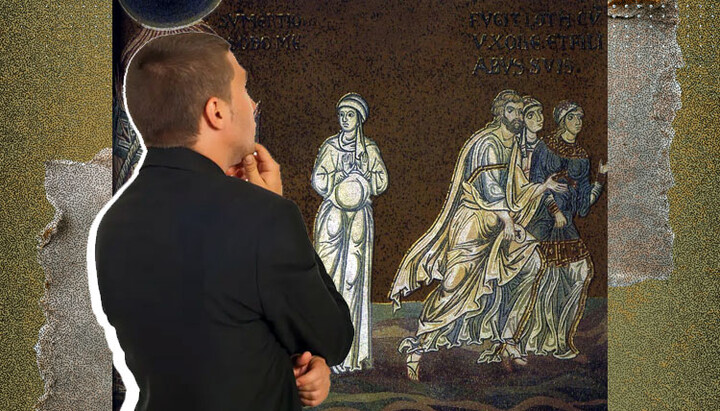
Reflection on the deed of Lot's wife. Photo: UOJ
This evening in the churches, the second part of St. Andrew of Crete’s Great Penitential Canon was read. In the third ode there are lines that are easy to let slip past your ears. But if you stop and weigh their meaning, it turns chilling: “Do not become a pillar of salt, O soul, by turning back – let the image of Sodom strike you with fear; flee to Zoar.”
If you look back, you will become a pillar of salt. This is not a metaphor for punishment. It is a description of what happens to a person who walks out of one life while his heart stays in the old one.
Three words from Christ
In the seventeenth chapter of Luke there is a phrase where Christ speaks of the last times. The Kingdom of God will come suddenly – as the flood came in Noah’s day and as fire fell on Sodom. And in the middle of that conversation there is a very brief remark: “Remember Lot’s wife” (Lk. 17:32).
Three words – and no explanation of what exactly to remember, or why. Simply: do not forget her.
That alone says something important. Christ did not explain the obvious. If He considered it necessary to recall her precisely in a conversation about Judgment, then her story has something to do with us.
What the righteous man’s wife did
It is easy to read this story as a parable about simple curiosity: she was told not to look back – she looked back. She disobeyed – and punishment followed.
St. John Chrysostom, in his homilies on Genesis, sees something else here. “She was punished not merely for turning her head,” the saint wrote, “but because in her heart she remained in Sodom. She loved what God had cursed.”
That is the core of it. Her body was moving forward, but her heart stood still and stared backward. The turn of the head was only an honest confession of what had already happened inside.
Sodom in this story is not necessarily a monstrous place. It is simply her home. The square where she sang. The yard where she spun. The tall house where she gave birth to her children. Anna Akhmatova wrote about this in 1924 with such accuracy that the poem is still alive – precisely because there is no condemnation in it, only a quiet understanding: “Only my heart will never forget the one who gave her life for a single glance.”
Akhmatova pities her. But God is silent in this story – He already said everything earlier: do not look back.
Warm Sodom
Why is it so hard not to look back? What we leave behind was, most often, warm, familiar, ours. Not necessarily terrible sins – simply habits that fed us, relationships that held us, a way of life in which we knew every corner.
St. Cyril of Alexandria called this double-mindedness: a person goes toward God, but misses his sin. He is not rushing back – he is simply homesick for what is gone. And that quiet, almost harmless longing for the former life makes him, in the saint’s words, “barren.” Not evil, not an apostate – just frozen, a monument to himself.
We all know this state. You come to confession, name your sin, receive absolution – and then, leaving the church, you begin to remember it again. Not to repeat it – just to remember, the way one sorts through old letters. St. John Climacus called such a condition “captivity by a thought.” A person has already walked out of Sodom, but continues to live in it – inside his own memory.
What a pillar of salt smells like
Salt is a preservative. It keeps the shape, but kills life. A pillar of salt is a body that has not decayed, but has not been reborn either. It has simply stiffened at one point.
Psychology has a word, “rumination” – the obsessive return, in the mind, to the same events. A person rewinds the past again and again, and each new circle brings neither comfort nor peace – only strengthens the feeling that life had to be lived then, not now. Life “before” becomes the real life, and everything after is only its shadow.
Today this is felt especially sharply. Many of us live in the mode of “before the war”: before the war there was a normal job, before the war you could plan, before the war the future was predictable. That is understandable – and humanly honest.
But if “before the war” becomes the only place where we truly live, we turn into that pillar. We stand, looking back into the past, and our feet have already grown into the ground.
Little Zoar
In Lot’s story there is a detail that is easy to miss. God told him to flee to the mountains. Lot was afraid of the mountains and asked permission to take refuge in a small town nearby – Zoar. And God agreed.
We are not being asked to accomplish the feat of the mountains – we are asked for just one thing: to run. Even if it is only to your own Zoar, farther from the fire. St. Andrew of Crete wrote his canon not for monks who have reached dispassion, but for us – ordinary people, afraid, stumbling. “Flee from the flame of every senseless desire.” Do not soar – just run.
Lent is Zoar. When we pass through it, we give a small consent to step a little away from the fire of passions. To stop savoring a sinful life. To give ourselves at least a little quiet.
We do not know whether Lot’s wife thought she was looking back toward her home for the last time. Most likely – no. Most likely she thought: I will take one look, just one, and then I will go on.
Maybe that is why Christ spoke of her so briefly – without explanations, without moralizing. Simply: remember. One glance backward is also our choice. And sometimes that choice is the last one.
Read also
Honest atheism vs. spiritual hypocrisy
The 70th anniversary of Albert Camus’s Nobel Prize recalls an uncompromising challenge to Christianity. An honest unbeliever brings theology back to the mystery of the Cross.
The valley of trouble and the gateway of hope
One soldier buried an expensive cloak and some gold beneath his tent. Because of this, all Israel lost a battle. Why did one man’s sin bring disaster upon an entire nation?
From love spells to bishop's throne
Antioch’s most powerful sorcerer sent demons against a devout young Christian woman three times – and failed every time. In the end, a demon himself revealed the truth that led to his conversion.
The Weeping Queen of Blachernae
On the night of the Feast of the Protection, only two people witnessed the miracle in the Church of Blachernae. Everyone else prayed and saw nothing. Yet they, too, received grace.
Deadly spiral of human hatred
The tragedy of Lebanon's civil war lays bare how dehumanization and fear can turn human beings into monsters.
Woe to expectant mothers – or to those of little faith?
God commanded one prophet not to have children, yet told his people in exile to bear sons and daughters. What does this apparent contradiction tell us today?