Why are the authorities and the OCU “reopening” Kyiv-Pechersk Lavra?
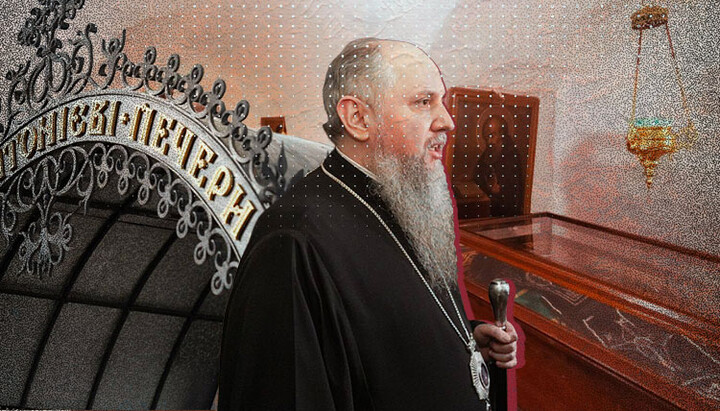
Dumenko says the reopening of the Near Caves is a step toward victory over Russia. Photo: UOJ
On February 17, 2026, at the Kyiv-Pechersk Lavra, employees of the National Preserve cut the locks off two churches in the Lower Lavra – the Exaltation of the Cross Church and the Church of All Venerable Fathers of the Caves (the “Warm Church”). UOC monks can no longer serve there. According to plans voiced by Ministry of Culture officials, the brotherhood is to be blocked from accessing all Lavra churches. In the longer term, everything is to be handed over for OCU use.
On February 2, 2026, the Ministry of Culture already transferred two buildings of the Lower Lavra to the OCU – Building No. 70, formerly Metropolitan Onufriy’s residence, and Building No. 49, which housed the Chancellery of the UOC Kyiv Metropolis.
And all of this is happening while the UOC monastic brotherhood in the Lavra numbers around 150 monks. Meanwhile, the structure calling itself the OCU “community of the Kyiv-Pechersk Monastery” consists of just six people – and even they are formally registered as employees of the secular preserve and receive salaries there. So why do they need the Lavra’s churches and buildings?
Here is the answer. “The purpose of transferring the buildings of the Lower Lavra is to create proper conditions for the full implementation of the religious and monastic practices of the OCU community and to continue the process of legally securing its ministry in the Kyiv-Pechersk Lavra,” a Ministry of Culture document states. A “monastic community” of six preserve employees. It would be funny – if it were not so grim.
“We’re opening” the Caves
On February 24, Culture Minister Tetiana Berezhna, Preserve Director Maksym Ostapenko, and Head of the Institute of National Memory Oleksandr Alferov led a ceremonial “reopening” of the Near Caves for believers. The quotation marks are for two reasons.
First, it has never been clearly explained why the Ministry of Culture closed the caves (and, in fact, the entire territory of the Lower Lavra) back in August 2023. So the state first blocks access to holy sites – and then “lifts the blockade,” presenting it as a grand achievement.
Second, the caves were truly open when, at the end of the Soviet era, the Lavra was returned to the UOC. What the Ministry and the OCU are staging now looks like a parody. Previously, anyone could enter the caves freely and at any time (until 5:00 p.m.). Now it will be “in a controlled mode.”
Access to the Near Caves (the Far Caves remain closed) is to be allowed from Wednesday through Sunday only, by prior registration, in groups from 9:00 a.m. to 11:00 a.m. Each group may include no more than ten people, with thirty minutes allotted for pilgrimage along a so-called “tourist route.” In other words, a maximum of forty people a day, about two hundred a week. The rest of the day – from 12:00 p.m. to 4:00 p.m. – is slated for paid sightseeing tours.
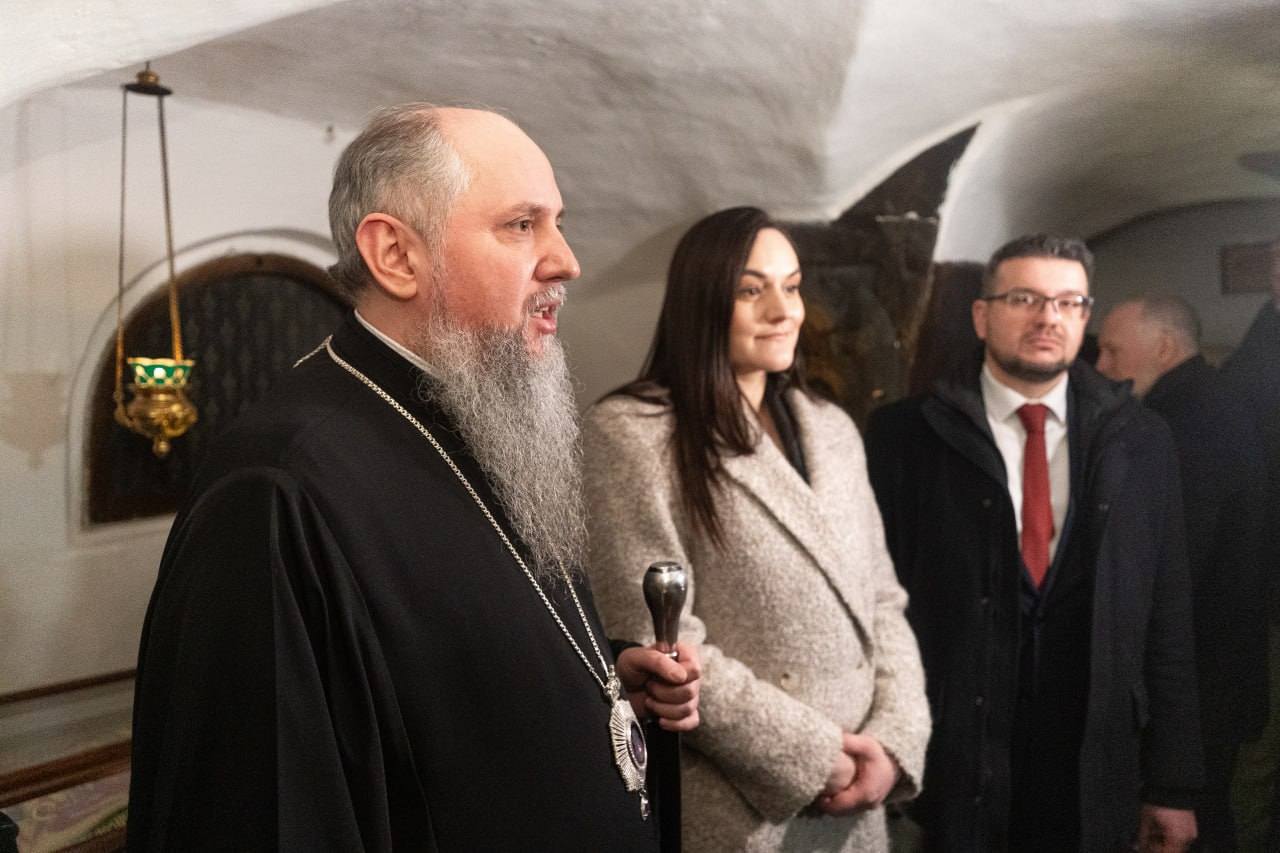
Announcing this “reopening,” Deputy Prime Minister and Culture Minister Tetiana Berezhna declared: “The reopening of the Near Caves is a continuation of cooperation between the Ministry of Culture of Ukraine, the Preserve, and the OCU. We are reviving the cave route as it was under Petro Mohyla and Ivan Mazepa, restoring the tradition of Ukrainian pilgrimage.”
Officials always need lofty phrases when their actions clash with logic, history, and plain common sense. But it is hard not to notice that nearly everything in this statement is a bundle of absurdities.
First: before the authorities drove the UOC monastic community out, the caves were open without any “cooperation” between the Preserve and the OCU. People came from all over the world to venerate the relics of the Venerable Fathers. Now the Ministry is congratulating itself for “opening” the caves for a couple of hours – and not even every day.
Second: Petro Mohyla and Ivan Mazepa are the seventeenth century and a bit of the eighteenth. To “restore” the caves as they were then, the Ministry would have to do the opposite of what it is doing now. It would have to:
– fill in the entrance to the Near Caves from the Exaltation of the Cross Church;
– remove the cast-iron floor plates;
– dismantle the brickwork reinforcing the cave vaults;
– reopen access to sections currently closed due to risk of collapse.
In fact, the Near Caves acquired their current appearance largely in the period that today’s rhetoric brands as “spiritual occupation.”
And third: pilgrimage to the Lavra was never a narrowly “Ukrainian tradition.” It is an all-Christian tradition. Pilgrims came to the Lavra from the lands of historical Rus’, from the Polish-Lithuanian Commonwealth, from Greece, and from across Europe.
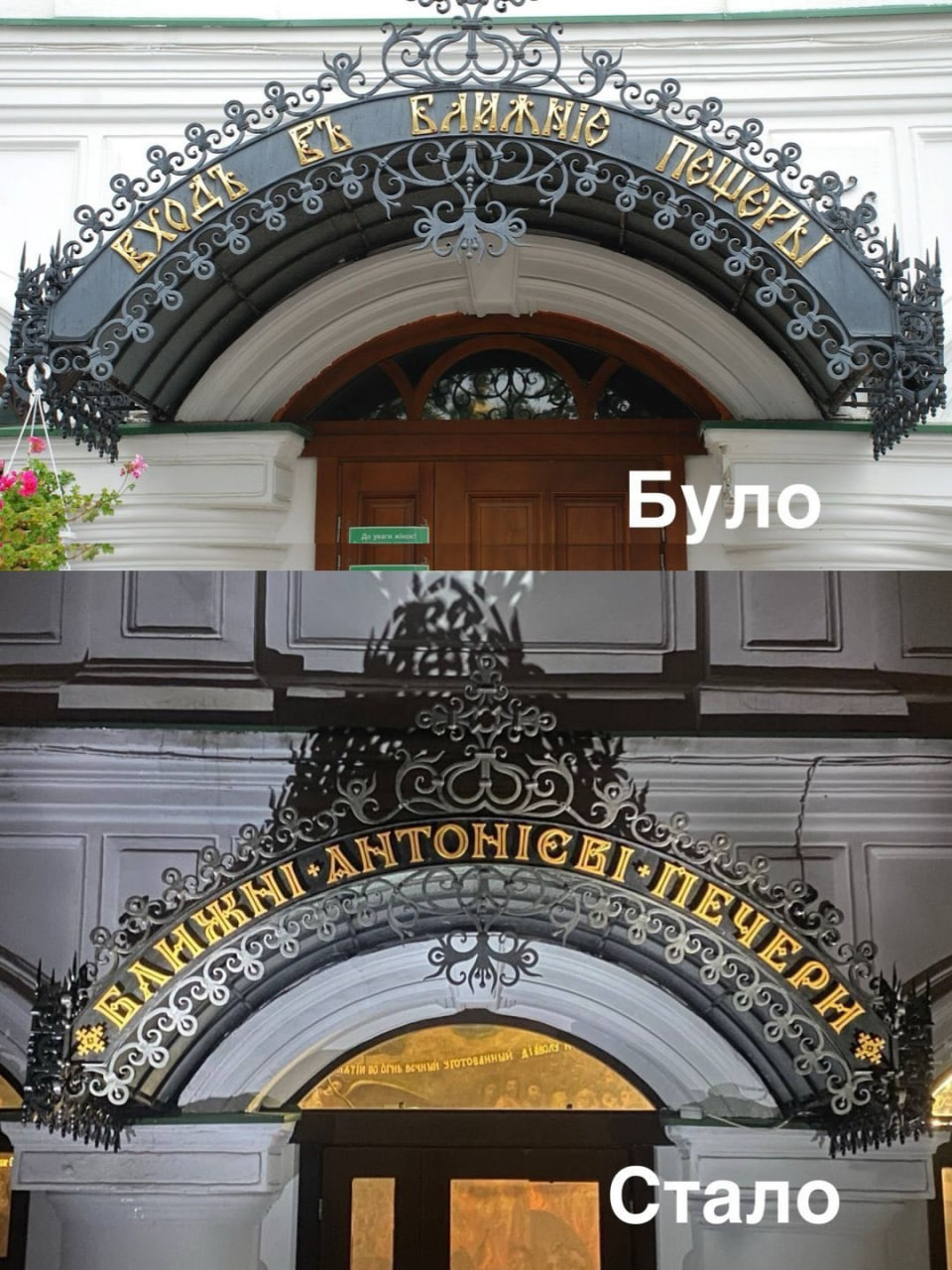
They also replaced the plaques above the reliquaries of the saints: Church Slavonic was swapped for modern Ukrainian; the old style for the new – the very “new style” that Orthodox Christians in Mohyla’s era regarded as a betrayal of the faith. This is the kind of “seventeenth-century revival” in which Mohyla himself would not recognize a single line.
Yet the head of the OCU, Serhiy (Epifaniy) Dumenko, called this spectacle a meaningful victory on the road to Ukraine’s “main victory” over Russia. “These small victories add up to our great Ukrainian victory, because it consists of small victories, forged not only at the front but also in the rear. Every small step makes us stronger,” he said.
But what is the victory? That where the caves used to be open to everyone, they are now open only by appointment? That where people could venerate the saints for most of the day, they are now allotted two hours, Wednesday through Sunday? Is the “victory” that the state has organized something that looks increasingly like persecution of the Church of Christ?
Another jarring statement came from officials at the “reopening” ceremony. The head of the Institute of National Memory, Oleksandr Alferov, called the Lavra a common shrine for Catholics, Protestants, and Orthodox. Yet his own thesis was immediately undercut by Minister Berezhna herself – a Catholic of the Byzantine rite – who admitted that she was visiting the Lavra for the first time in her life. What kind of “sacred center” is it, if a Greek Catholic minister has ignored it all her life? And to claim that relics are “a shrine” for Protestants is not ecumenism – it is basic religious illiteracy.
Which Church is “returning” to the Lavra?
But the most contradictory statement came from Serhiy Dumenko himself – contradictory to the point of tragicomic. On February 24, 2026, speaking in the Exaltation of the Cross Church, he declared that the transfer of Lavra churches to OCU use testifies to the “liberation of the Lavra from the yoke of the ‘Russian world’” – and in the same breath compared it to the “return of the Church to its shrine in 1988,” during the millennium celebrations of the Baptism of Rus’-Ukraine.
It sounds smooth – until you remember one stubborn fact: in 1988, it was the Russian Church, in the person of its Ukrainian Exarchate, that returned to the Lavra. In other words, precisely the very “Russian world” from whose “yoke” Dumenko now claims to be “liberating” the Lavra.
Yet this collision with reality does not trouble him. “Gradually and patiently, but confidently, we are moving toward the full restoration of this sacred place precisely as a spiritual cell of the Orthodox Ukrainian Church,” Dumenko insists.
But the Lavra was restored by the faithful and monastic community of the UOC – both materially and spiritually. The UOC rebuilt churches and buildings from ruins. Dumenko’s structure did not lift a finger for the shrine’s restoration, did not spend a kopeck. Under the UOC, services in the Lavra were crowded. Under the OCU, the Lavra churches are largely empty. What appears instead are concerts, songs, dances, and culinary shows. Is expelling 150 monks a “restoration”? Is replacing them with six preserve employees who call themselves OCU monks a “revival of the monastery”?
Why this performance with the Ministry, the OCU, and the “opening” of the Caves?
The Preserve Director, Maksym Ostapenko, all but said it outright. In an interview with Hlavkom, he expressed hope that UOC monks would transfer into subordination to Serhiy Dumenko and to Dumenko’s representative in the Lavra, Avraamiy Lotysh:
“A contract is being prepared with the Orthodox Church of Ukraine for the permanent presence of OCU representatives here. Before that, they were already effectively here, but it was not legally fixed. There were only temporary agreements. I hope this will allow us, as a preserve, to cooperate more effectively with the monastery community of the Orthodox Church of Ukraine headed by Bishop Avraamiy. I believe that all monks who are in the UOC MP and understand their responsibility before the people will carry out their mission under Bishop Avraamiy.”
In plain terms: the authorities, together with the OCU, want to create a pretty picture in the Lavra – caves supposedly open, people supposedly coming, services supposedly being held. The Lavra supposedly “lives.” It works for an external audience: look, they say, everything is thriving under the OCU. And it is a message to the UOC monks as well: why are you cramped in the Church of Agapitus of the Caves outside the Lavra walls? Come to us – here everything is “like the good old days.”
Conclusions
This entire story is not about “reviving routes” or “restoring pilgrimage traditions.” It is about building a glossy display window. On the one hand, real monks are stripped of churches and buildings, and real monastic life is forced out of the Lavra. On the other, officials solemnly announce the “reopening” of the caves – for a couple of hours a day, under a pass-and-permit regime. This is not the revival of a monastery. It is the conversion of a shrine into a checkpoint – and into a paid sightseeing product.
Read also
A political commissar’s vocabulary: Three interviews with Epifaniy Dumenko
In just six days, the OCU leader managed to call an end to church seizures “capitulation,” describe Lavra monks as “hired hands,” and portray the U.S. vice president as a victim of propaganda.
The Council of Crete: a decade of unity in name only
Constantinople marked the anniversary of the Council of Crete with a theological conference in France. They spoke about the unity of Orthodoxy, although over the past years there has noticeably been less of it.
Yelensky’s plan: Why is DESS demanding what the UOC has already done?
DESS is demanding that the UOC take steps it has already taken, while offering no assurance that further demands will not follow. What is behind Yelensky’s ultimatum?
Why OCU hierarchy lacks canonical ordination: what Local Churches say
The OCU head refuses to address invalidity of his ordinations. But almost all Local Churches speak of it – even those that recognized the OCU.
Why nation-first advocates do not call for peace
Ukraine’s population is declining by nearly one million people a year, and experts are warning of the nation’s demographic extinction. Yet the leaders of the Orthodox Church of Ukraine (OCU) and the Ukrainian Greek Catholic Church (UGCC) continue to call for war and mobilization.
The deception that decided the fate of the Tomos
In 2008, the "Filaret problem" derailed Yushchenko's plan. In 2018, Poroshenko solved it in just one hour – with a police escort for the Greeks and verbal promises to Filaret.