1946 revisited: The UGCC’s suppression anniversary and today's UOC crisis
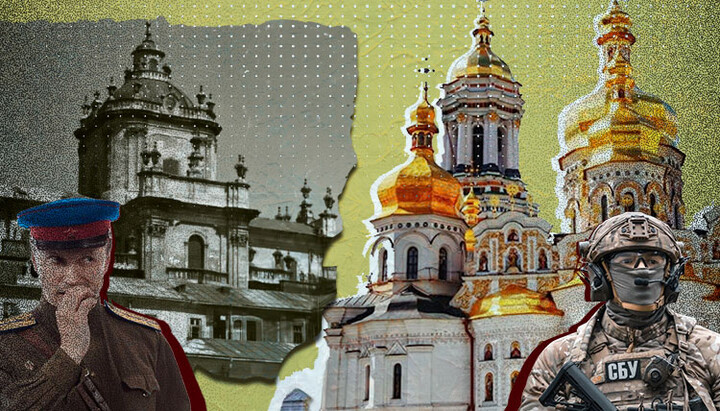
There are parallels between the current persecution of the UOC and the liquidation of the UGCC in 1946. Photo: UOJ
Today, Ukraine is officially marking the 80th anniversary of the Lviv Council of the UGCC, which resolved to abolish union with Catholicism and return to Orthodoxy. On Kontraktova Square in Kyiv, UGCC head Sviatoslav Shevchuk and DESS head Viktor Yelensky opened a documentary exhibition, the Foreign Intelligence Service declassified part of its archives, and the Institute of National Memory organized a round table.
At all of these events, the Lviv Council of 1946 was invariably described as a “pseudo-council” inspired by the Soviet authorities. That assessment is quite substantiated – but, as usual, there is a flip-side to the story.
Historical background: the Union of Brest in 1596
The structure now called the “Ukrainian Greek Catholic Church” emerged in 1596 as a result of the Union of Brest. In 1595, the then-Orthodox bishops Ipatii Potii and Kyrylo Terletskyi swore allegiance to Pope Clement VIII, accepted all Catholic dogmas, and received permission to retain Orthodox rites wherever this did not conflict with Catholic interests. After that, in 1596, a council was convened in Brest with the backing of the authorities of the Polish-Lithuanian Commonwealth to legitimize the betrayal of Potii and Terletskyi. But instead of one council, there were two. One categorically rejected the union, while the other accepted it.
King Sigismund III of Poland thereafter recognized only those bishops who had accepted the union. The Orthodox, meanwhile, were stripped of rights, deprived of their churches and property, subjected to pogroms, and at times even killed.
It is important to understand that the Orthodox rejected the union not because they were drawn toward Moscow or sought unity with the Russian Church – as some try to present it today. At that time, the Kyivan Metropolia was under the jurisdiction not of the Russian Orthodox Church but of the Patriarchate of Constantinople – and would remain so for another hundred years. The reasons for rejecting the union were not political but doctrinal: Orthodox Ukrainians did not want to betray their faith and accept Catholic dogmas.
For more on the Union of Brest, see the article “The OCU Project and the Union of Brest: What Has Been Will Be Again.”
Historical background: the Council of 1946
The Lviv Council, too, was convened under pressure from the authorities, and those who refused to take part paid for it with repression. But the nature of that repression was fundamentally different: the issue was not apostasy – the authorities made no such demand – but refusal to assist in the disarmament of OUN-UPA formations. The persecution was political, not dogmatic.
After the Red Army liberated Western Ukraine, the UGCC leadership tried to ingratiate itself with the Soviet authorities and remain legal in the USSR. In October 1944, UGCC head Andriy Sheptytsky wrote a servile letter of greeting to “the great marshal of the invincible Red Army, Joseph Vissarionovich Stalin”:
“After your victorious march from the Volga to the San and beyond, you have once again united the western Ukrainian lands with great Ukraine. For the fulfillment of the cherished desires and aspirations of Ukrainians, who for centuries regarded themselves as one people and wished to be united in one state, the Ukrainian people offer you their sincere gratitude. These bright events, and the tolerance you show toward our church, have also aroused in our church the hope that, like the whole people, it will find in the USSR under your leadership full freedom to work and develop in well-being and happiness. For all this, supreme leader, you deserve the deep gratitude of us all.”
A few weeks after writing this letter, Sheptytsky died, on November 1, 1944, and the Soviet authorities allowed his solemn funeral to be held in Lviv. Then, on December 21, 1944, a UGCC delegation headed by Sheptytsky’s successor, Josyp Slipyi, arrived in Moscow. The delegation brought a substantial monetary offering of 100,000 rubles and handed it over “for the Red Cross.” Slipyi also wrote his own letter to Stalin, which said: “I join in the expressions of joy over the victories won by you, after which our universal Greek Catholic Church, we hope, will also be guaranteed freedom of religion and the means necessary for its confession.”
But neither generous donations nor praise-filled letters to Stalin changed the authorities’ attitude toward the Church. In the eyes of the Soviet leadership, the UGCC remained – not without reason – a pillar of the Ukrainian national movement and the anti-Soviet underground, the armed resistance that continued in Western Ukraine for many years after the war.
In Moscow, the delegation was told quite plainly that the fate of the Church depended on its willingness to help disarm the OUN-UPA. Its refusal to meet that condition became the starting point for all the repressions that followed against the UGCC.
The Greek Catholics tried to portray their refusal as an unwillingness to take part in political matters. Ivan Hryniokh, chaplain of the Nazi “Nachtigall” battalion, later wrote: “The delegation was required to join the struggle against the Ukrainian insurgents. Explanations that the Church could not directly and actively involve itself in an entirely politicized internal struggle were of no help.”
That is more than debatable. For many years, the UGCC had been a real pillar of the Ukrainian liberation movement. And for some reason, it did not then regard that as an “entirely politicized internal struggle.”
The crux of the matter lies elsewhere: the Greek Catholics were banned not for loyalty to the Pope of Rome, not for their Catholic confession, and not for refusing to merge into the Russian Orthodox Church, but solely for refusing to help the Soviet authorities solve their political problems in Western Ukraine.
After that, events followed a pattern familiar to any totalitarian regime, one already tested on the Russian Orthodox Church. In April 1945, Josyp Slipyi and virtually the entire episcopate of the UGCC were arrested. They were convicted on charges of “treasonous activity” and “collaboration with the occupiers.” The authorities did not allow the consecration of new bishops or the restoration of UGCC governance. Instead, they backed an “Initiative Group” led by Havriil Kostelnyk, Mykhailo Melnyk, and Antonii Pelvetskyi. Anyone unwilling to support this group’s agenda was arrested and sent to prison or exile. As a result, from March 8 to 10, 1946, a council was assembled in Lviv, in St. George’s Cathedral, and it voted to abolish the Union of Brest of 1596, break with Rome, and “return” to the ROC.
For more on these events, see the article “Lviv Council: Uniates' Return to the Church or Stalin’s Destruction of UGCC?”
And if we call the council that abolished the union a “pseudo-council,” then by the same logic the Brest Council of 1596, which ratified the union, must also be called a pseudo-council. On exactly the same grounds.
How do the Uniates and the Ukrainian authorities assess these events today?
Needless to say, negatively. Attempts to curry favor with Stalin and assurances of loyal devotion are things people today prefer not to remember. They also discreetly gloss over the main reason for the destruction of the UGCC. But the repressions themselves, as well as the fact that the UGCC later revived and significantly expanded its influence in Ukraine, are painted in vivid colors.
For example, Taras Pshenychnyi, acting dean of the History Faculty at Taras Shevchenko National University of Kyiv, speaking at an event organized by the Ukrainian Institute of National Memory and the Institute of Church History of the Ukrainian Catholic University, said: “History has not yet known an institution capable of breaking the Church, beginning from antiquity. … The Church is people. The Church is tradition, mentality, and worldview. It is very difficult to break that. And the Soviet system, although it knew history very well … did not have enough of that knowledge to break the Church.”
UGCC head S. Shevchuk said at the opening of the outdoor exhibition on Kontraktova Square in Kyiv: “Despite the peak of that Stalinist machine’s power after the Second World War, the plan to liquidate our Church did not succeed. That machine failed, because we are standing here today.”
And at the same event, the head of the Ukrainian Institute of National Memory, Oleksandr Alferov, said that the UGCC had proved to be “an element of the body of the Ukrainian people” that cannot be torn away.
Parallels with the present-day destruction of the UOC
There are indeed parallels between 1946 and the current situation surrounding the UOC. Above all, they lie in the logic and methods of state action. Those who agree to follow the religious policy of the authorities receive every possible support. Those who refuse are persecuted. And to dress this up in something resembling legitimacy, the authorities organize a kind of council.
Today, the council of 1946 is called a pseudo-council because it was organized with state backing and was expected not to make an independent decision, but merely to legalize a decision already made by the authorities. But if that is so, then the council in Brest in 1596 was also a pseudo-council. And the council in Kyiv in December 2018 was likewise a pseudo-council.
Because in 2018 the same thing happened. The Ukrainian authorities organized the so-called “Unification Council,” whose key figure was then-President Petro Poroshenko. The council was meant to legitimize the creation of the OCU, and anyone who might disagree was immediately outlawed. Today the same thing is happening as under Stalin: the activity of the UOC has effectively been banned by Law No. 3894-IX, and court proceedings to implement that ban are continuing. Criminal cases have been opened against a number of bishops, while today the functions of the Gulag are quite successfully performed by the illegal mobilization of priests.
At the same time, the President of Ukraine says that in this way Ukraine is taking a step toward liberation from “Moscow demons.” And DESS head V. Yelensky says that the state is merely demanding a “break with Moscow.” But the problem is that such demands are no longer relevant. The UOC broke its “ties with Moscow” back in May 2022, when at the Council of the UOC in Feofania it declared its “full independence and autonomy.” Metropolitan Onuphry officially emphasized: “After May 27, 2022, we are no longer part of the Moscow Patriarchate.”
Which means the issue is not really a break with “Moscow ties” at all – the reasons are different, specifically, union with the “state church.” The parallel with 1946 is obvious: then the UGCC was destroyed for refusing to submit to the will of the authorities – today, by the same logic, the UOC is being destroyed.
There is, however, one fundamental difference here. The Soviet authorities did not demand that the UGCC renounce its doctrine – they demanded only political submission. Today, by contrast, the UOC is being required to recognize an organization that lacks apostolic succession and the grace of episcopal ordinations – in other words, to violate Orthodox teaching on the Church and to step over its own faith and conscience. Then they were dismantling a church structure – today they are attacking the very ecclesiological foundation of church life. And history bears unmistakable witness: violence against religious convictions never achieves its goal.
Read also
Pentarchy with Rome: A return to the roots or a new schism?
Patriarch Bartholomew wants to revive a council of five patriarchates, including Rome. What would reunion with Catholics look like, and what role would be left for the other Churches?
Concubine or daughter? On words that cannot be used about the Church
An archon of the Church of Constantinople likened the UOC to Moscow’s “concubine.” But for St. Epiphanius of Cyprus, “concubines” are heresies.
Shameful chronicle of one week: how the OCU was born
Exarchs under escort, a call from the operations room, and 36 votes for Epifaniy: what a member of the Phanar delegation revealed about the 2018 "Council".
Can UOC eparchies be dissolved before court ruling on Metropolia?
DESS is launching separate proceedings against UOC eparchies, monasteries, and institutions while the case involving the Kyiv Metropolia is still pending.
Two murders, one silence
Zelensky condemned the killing of a Catholic priest in Poland the very same day. A month earlier, a UOC monk was murdered at the Sviatohirsk Lavra – and the president has remained silent ever since.
A bow to Phanar? Why did UOC academy congratulate Constantinople’s exarch?
A delegation from the Kyiv Theological Academy congratulated the Phanar’s exarch, who has remained silent about the persecution of the UOC. Who authorized this gesture, and why did even OCU supporters fail to appreciate it?