Why is the Great Canon read when there is no strength left?
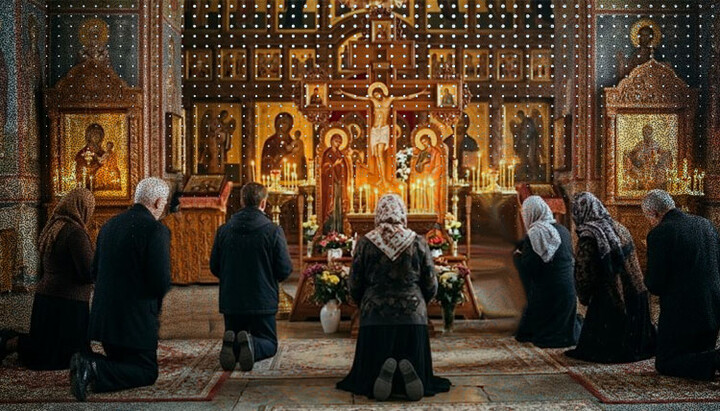
St. Mary's Standing. Photo: UOJ
On Wednesday evening, in the fifth week of Great Lent, the church no longer resembles a place where people come "for an hour". It stands dark, filled with people. At the beginning of Lent, we thought that all this would be almost easy: the first services, prostrations, familiar words of the Penitential Canon. But then the fifth week comes, and it turns out that a person can barely stand on their feet anymore. Not out of laziness. The body simply signals: we are not made of iron.
And it is precisely then that the reading of the Great Canon begins in its entirety. Not "for beauty" and not "for the sake of completing the rule". It is read when we already want to lean our forehead against the church wall and not pull away from it. The choir intones: "O my soul, arise," but inside there is a completely different impulse – to get down, to sit, and escape this stifling closeness. And here the service penetrates into the muscles, into the lower back, into heavy feet. We stand and suddenly remember the words of the Apostle Paul: «Most gladly therefore will I rather glory in my infirmities, that the power of Christ may rest upon me... For when I am weak, then am I strong» (2 Cor. 12:9–10). Here it is – our weakness: in heavy knees, in a parched throat, in irritability.
Everything is clear, but nothing is clear
There is something almost humiliating in this for our usual self-respect. We already understood all the content of the canon in March. We read it, heard it, lit a candle, endured the first week. But the Church places us in the same semi-dark cramped space and again, line by line, leads us through the entire canon. And not because it loves to torment. Rather because it knows how to bring a person to that line where they have nothing left to cover their inner emptiness.
Saint Isaac the Syrian spoke of this with rare directness in his "Ascetical Homilies": "A person who has come to know the measure of their own weakness has attained the perfection of humility." In the church, this thesis is always confirmed with particular clarity.
A worshipper is irritated, tired, and cramped; he can no longer pray "as he should". And it is precisely in this brokenness that his faith in his own self-sufficiency begins to crack, along with the confidence that he is his own master, that he can manage on his own, without God.
But the body exposes him before the mind can object.
Transfiguration of the body
The Great Canon does not leave us only on this heavy note. Into the most exhausting service bursts the life of Saint Mary of Egypt, and here everything changes its weight. The Life, handed down to us by Saint Sophronius of Jerusalem, tells us not a beautiful legend but an almost tangible episode: Mary comes to Jerusalem and cannot enter the Church of the Holy Sepulchre. An invisible force does not let her in. Not the thought of sin, not pangs of conscience, but precisely a force so that her sin suddenly becomes heavy, like a stone, firmly embedded in the threshold.
And then forty-seven years of desert pass. Exactly that many, according to the saint's own words, "have passed since I left the Holy City" – this is recorded in the Life directly, in conversation with Elder Zosimas. Almost half a century she spent in solitude, heat and waterlessness. And after this the elder sees the saint rising above the ground by a cubit during prayer, and then crosses the Jordan on water, as on dry land.
This is already a completely different state of the body, unfamiliar to us, tired from the many-day fast. Although, let us admit, we are very far from that measure of self-limitation which Saint Mary took upon herself while in the desert.
Vladimir Lossky, reflecting on the deification of human nature, wrote that it is like red-hot iron that has become fire, yet does not cease to be iron by nature. Mary became a living witness to this thought: her body was spiritually transformed by many years of feats of prayer and fasting.
Humility after the service
And so we stand in the church with numb legs and understand: the fifth week of Lent does not spare us by chance. It brings us to exhaustion so that there is nowhere to hide self-satisfaction – that confidence in oneself which makes repentance impossible. And into this weariness from our own weakness, the living power of Christ, which Paul spoke in his epistle, can already enter.
By the end of the service the church slowly releases people. The doors open into the March night, and the air sharply strikes the face with cold. Feet step onto the asphalt reluctantly, like cast iron blocks. The back aches. But in the ears the chant still holds: «O my soul, arise...» We take the first step almost by touch, feeling every joint, and understand that the body will not heal itself. Only He Who knows how to raise the dead will heal our weakness.
Read also
Honest atheism vs. spiritual hypocrisy
The 70th anniversary of Albert Camus’s Nobel Prize recalls an uncompromising challenge to Christianity. An honest unbeliever brings theology back to the mystery of the Cross.
The valley of trouble and the gateway of hope
One soldier buried an expensive cloak and some gold beneath his tent. Because of this, all Israel lost a battle. Why did one man’s sin bring disaster upon an entire nation?
From love spells to bishop's throne
Antioch’s most powerful sorcerer sent demons against a devout young Christian woman three times – and failed every time. In the end, a demon himself revealed the truth that led to his conversion.
The Weeping Queen of Blachernae
On the night of the Feast of the Protection, only two people witnessed the miracle in the Church of Blachernae. Everyone else prayed and saw nothing. Yet they, too, received grace.
Deadly spiral of human hatred
The tragedy of Lebanon's civil war lays bare how dehumanization and fear can turn human beings into monsters.
Woe to expectant mothers – or to those of little faith?
God commanded one prophet not to have children, yet told his people in exile to bear sons and daughters. What does this apparent contradiction tell us today?