A telegram from exile: how Bishop Luke set conditions for Soviet authorities
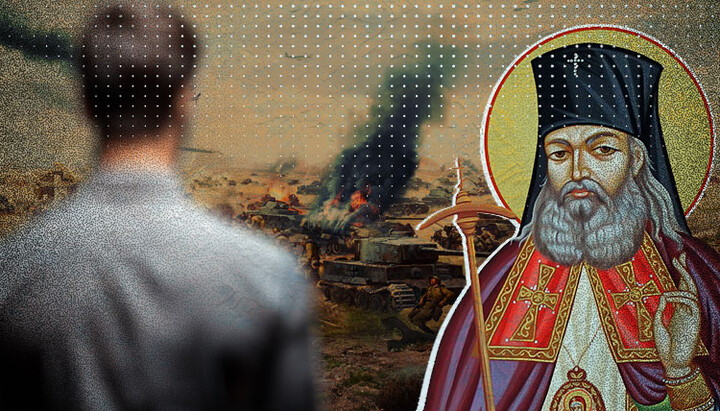
Ministry of the confessor during wartime. Photo: UOJ
In the freezing post office, on cheap paper, a 64-year-old exile dictates the text of a telegram to the Chairman of the Presidium of the Supreme Soviet of the USSR. Behind him, there were three exiles, two prison terms, and years of scientific research. Ahead, if they refuse, there is the same Siberian cold and the same obscurity.
The text is short: "I, Bishop Luke, Professor Voyno-Yasenetsky, am serving a sentence in exile in the village of Bolshaya Murta, Krasnoyarsk Territory. Being a specialist in purulent surgery, I can provide assistance to warriors on the front or in the rear, wherever I may be entrusted. I request that my exile be interrupted and that I be sent to a hospital. Upon the end of the war, I am ready to return to exile. Bishop Luke."
Reading these lines, one's gaze stops at one phrase: «Upon the end of the war, I am ready to return to exile." The saint does not bargain for rehabilitation. He asks only for an operating table – and himself, voluntarily, promises to return to exile afterward. Why?
Why Bishop Luke asked to be sent to war
– Your Grace, you had the legal right to remain silent. The state broke your life. Why did you write this telegram at all?
– Pity, compassion – these are the fundamental qualities of love, – the confessor answers.
– In whom there is love, there is pity and compassion, for one cannot love and not have compassion. Our mercy arises from pure love; from pure love we fulfill the commandments of Christ.
The state that had arrested him three times remained for him a persecuting state – this opinion he never reconsidered. But the soldier in the train from near Vyazma was not the state. This was a dying neighbor with a shattered joint who needed emergency care.
– But didn't this seem like a concession to those who persecuted you?
– Deprived of the possibility of priestly service, I devoted myself entirely to scientific work and perform it as a form of service to God, Saint Luke said.
– The striking and entirely evident help of God in this work strengthens me in the conviction that this is truly a task pleasing to God. The book I am preparing will save hundreds of thousands of patients from suffering, injury and death, for through it thousands of physicians will study purulent surgery.
He wrote this letter back in 1937, at the height of the third investigation, working on the second edition of "Essays on Purulent Surgery." The scalpel and episcopal staff were for him not a contradiction but two forms of one service. The state, which deprived him now of one, now of the other, could never deprive him of both services simultaneously.
Purulent surgery: a job many avoid
The telegram lay on the regional committee desk for a long time before they decided to send it. It lay on First Secretary Golubev's desk, was discussed with NKVD workers. But in October 1941, the exiled professor was transferred to Krasnoyarsk as chief surgeon of evacuation hospital No. 1515 and consultant to all hospitals in the region. At the same time, the saint formally remained a political exile and was obliged to report to the police twice a week. He lived in a damp, cold room. According to instructions, he was not supposed to be fed in the hospital kitchen, but caring orderlies secretly left porridge for him.
The most hopeless patients were brought to Siberian hospitals: trains from the front traveled for weeks, and wounds had time to become deeply infected during such time. Advanced osteomyelitis, rotting frostbite, open fractures with necrosis – the holy doctor had to face all this at the front.
Purulent surgery has a special smell – of decomposing flesh and bones, and this smell cannot be overcome by any antiseptics. Therefore, many surgeons left this field for other specializations. Voyno-Yasenetsky chose it voluntarily even before the revolution. In Krasnoyarsk, he himself asked to have the most severely ill patients brought to him from the station.
– How did you endure operating eight to nine hours in a row? That's an inhuman pace.
– When beginning an operation, one must remember not only the abdominal cavity but the entire sick person, who, unfortunately, is so often called a "case" by doctors, Saint Luke instructs.
In the second half of 1943, his hands performed three hundred fifty-six operations: on joints, skull, nerve trunks, vessels, thirty-one plastic operations, and sixteen major amputations. Young surgeons from Voronezh and Leningrad, evacuated to Krasnoyarsk, learned from him right in the hospital corridors. Professor Priorov, who came on inspection, wrote in his report: nowhere had he seen such results in treating infected joint wounds.
The cassock in surgery: NKVD reaction
The operating room nurses of the Krasnoyarsk hospital remembered one thing: before the first incision, the chief surgeon would stop, turn to the icon painted on cardboard – it stood in the corner of the operating room – cross himself and pray. Then he would take the scalpel. He worked in a cassock, with a panagia over his surgical gown. NKVD officers assigned to the political exile watched this in silence.
– Your Grace, didn't this silence bother you? They tolerated you only as long as they needed you.
– To me, a priest, defending Christ's flock with bare hands from a whole pack of wolves and weakened in unequal struggle, at the moment of greatest danger and exhaustion, the Lord gave an iron rod, an episcopal staff, and with great episcopal grace mightily strengthened me for further struggle, the confessor calmly answers.
He said these words back in 1923, after his first arrest, in his first episcopal sermon. But the logic contained in them is the same as in the Krasnoyarsk operating room. The authorities thought they were using the surgeon. The surgeon knew that now he was using the authorities – as an instrument for fulfilling his medical duty.
– Go through the narrow gates, by the stony and thorny path, not fearing suffering, for it gives birth to good. The one who suffers is freed from evil, the holy surgeon instructs.
He wrote this in a sermon, based on his own experience. The saint's exile was ended back in 1942, but he continued working in Krasnoyarsk until February 1944. In 1946, he was awarded the First-Class Stalin Prize of 200,000 rubles—for Essays on Purulent Surgery, written and revised in the Krasnoyarsk hospitals. Of this, he immediately donated 130,000 to children left without parents.
The confessor's signature
In that fateful telegram, he signed thus: first "Bishop Luke" – and only then "Professor Voyno-Yasenetsky." In the Soviet context, the professorial title weighed incomparably more.
The church title in 1941 was rather an aggravating circumstance. But the saint put it first – knowing what he was doing.
In this act – all of him, Saint Confessor Luka (Voyno-Yasenetsky). He was not a legendary hero with ready answers to all questions. He was a man who had a completely clear understanding of who he was and why he stood at the operating table during the war years. And this unshakeable strength of human dignity proved much stronger than the power of that authority which tried to destroy him.
Read also
A lesson from a speechless donkey
The famous seer struck his donkey three times for refusing to go forward. All the while, she was saving his life – and seeing what he could not.
The time when the soul ripens
Modern society has turned youth into a cult and old age into a period of merely “living out one’s days.” The Christian perspective reveals the profound spiritual meaning of our later years.
Faith is not a checker piece in a spectator sport
Arguments about faith on social media increasingly resemble no-holds-barred fights. We turn to a saint who, sixteen centuries ago, knew how to speak to those interested only in turning theology into a combat arena.
The metropolitan who fought with a pen
St. Cyprian of Kyiv was robbed, expelled, and barred from his see. He answered with letters, books, and canons – and before his death, forgave everyone.
Loneliness under one roof
Spouses can share a home for years, raise children, and faithfully attend church – yet remain strangers to each other.
The cross – the deepest healing of the human soul
Emotional exhaustion and anxiety have become a way of life. Ancient Christian tradition offers an unexpected way out – embracing one's own cross.