Elder Arkhip’s notes: How a village priest acquired the gifts of the Spirit
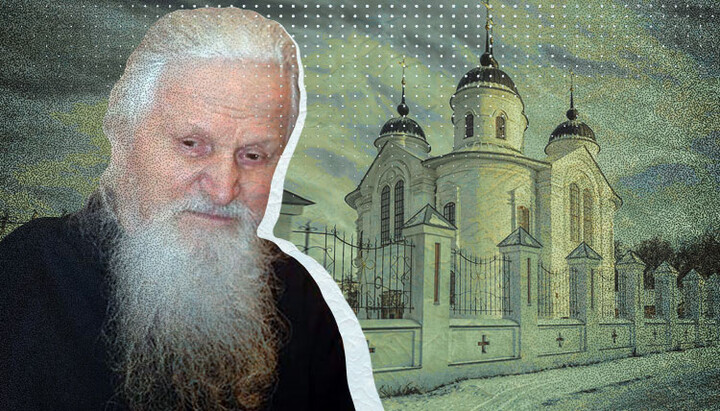
Elder Arkhip (Kolodiy). Photo: author, UOJ
“Be wise as serpents and innocent as doves” (Matt. 10:16), said the Lord – and these words could well be applied to Schema-Archimandrite Arkhip (Kolodiy, †2016), an extraordinary priest who revealed to the world true gifts of spiritual courage, clairvoyance, and childlike meekness. For more than half a century, he bore the labor of priesthood. During the years of Khrushchev’s persecutions and under Brezhnev’s rule, he repaired and painted 32 ancient churches in the Chernihiv region. To the author of these lines, he seemed marked by an almost unearthly grace – as though one of those tender-hearted ascetics known only from patericons and the hagiographic literature of Holy Rus had suddenly stepped into our own time.
First meeting with the elder
I remember our first meeting vividly, in the village of Khotynivka in the Nizhyn district of the Chernihiv region in the late 1990s. We saw him beside a poor whitewashed clay hut where he lived, in a thin, patched cassock, chopping and stacking firewood for the winter, with his unfailing warmth and a face shining with love, as though he had long been awaiting dear and long-expected guests. Inside his little cottage, in the tiny cell where only a narrow passage remained between the whitewashed stove and the bed, and even on the elder’s own sleeping place, the windowsill, and the small table beneath the icons, there were piles of commemoration slips.
As the priest himself soon explained, his chief obedience was prayer for people – the living and the departed.
So, in the course of our conversations – and not in a single visit to the elder, but over several journeys – the astonishing path of this man’s life gradually unfolded. I remember that on that first trip to Khotynivka, the elder offered us lodging, saying that he had built a small brick house with heating for guests, where on Sundays he held tea gatherings with parishioners and spiritual talks. There he also painted icons unlike any we had seen – icons that recalled the style of the Egyptian Coptic Church, marked by a childlike simplicity, clarity, and a kind of holiness one might expect only from the brush of an innocent child.
When we had settled into the Sunday school building, and the village world had sunk into complete stillness and peace, while autumn stars shone overhead and a moonbeam fell across the elder’s unfinished icon of the Savior Not-Made-by-Hands, he brought us a crock of fresh milk and loaves of wheat bread and handed us a stack of school notebooks, saying, “Here, take a look at my notes, which I’ve been writing little by little for a long time now. I myself do not know why – only that certain thoughts about our faith come to mind, or I feel the desire to tell of the wondrous things the Lord shows to me, a sinner and unworthy man…”
Reading through those notebooks one after another late into the night – written in a language so simple, yet plainly so spiritually deep, with astonishing directness and faith – I kept trying to remember where I had encountered something similar before. Then I recalled it: this was how Saint Silouan the Athonite wrote about faith in the well-known book by Fr. Sophrony Sakharov, who had been the saint’s disciple on Mount Athos.
I would not dare say that Fr. Arkhip’s notes – for then he was still the celibate Archpriest Anatoliy Kolodiy – were exactly like the great revelations of Saint Silouan. Yet there was in them a certain likeness, and the same daring with which Fr. Anatoliy spoke of receiving the gifts of the Holy Spirit was also present in the writings of the future schema-monk Arkhip (Kolodiy).
Some time later, a small book of Fr. Arkhip’s revelations was published. Given the format of this site, we can offer only brief excerpts from it here.
Childhood
“One day my mother said to me, ‘Pick some sour cherries – we’ll make dumplings with sugar.’ I went into the orchard, climbed the tree, and began picking them. Then I looked at the trunk and thought: this cherry tree is like the Orthodox faith. From one trunk come three branches: one God in Trinity – God the Father, God the Son, and God the Holy Spirit. And I thought then about that bitter tree with its three trunks, so like the Orthodox faith: if the Orthodox faith is the true faith – and by then I had begun to doubt because the Stundists-Baptists had come among us – then God could make this cherry tree sweet. (Editor’s note: Notice that Saint Silouan also had a similar childhood experience, when his father brought a postman into the house – supposedly an educated man – for a spiritual discussion, but the man turned out to be an atheist and insisted that there was no God, thereby sowing great confusion in the soul of the child who would become Elder Silouan.)
“The next year I went into the orchard and remembered my conclusion – by then the cherries had ripened. I ran up to the three-trunked cherry tree with the bitter berries, the one that reminded me of the Orthodox faith. I tasted fruit from one trunk – sweet! From another – sweet! From the third – sweet! Then I cried out: ‘The Orthodox faith is the true faith!’”
Army service
“In 1952 I went into the army. I served near Lviv, in Sambir… A barracks was being built. I often had to cross the bridge over the Dniester River and go to a village smithy to make iron brackets for construction. I had to walk across the fields to the village. I was deeply grieved, thinking about certain priests who serve only before men, not before God, and I thought about the perdition of souls. Those thoughts weighed heavily on me. And suddenly my lips began to sing, without my knowing it: ‘Rejoice, O our joy, cover us from every evil and soothe our sorrows…’ Only later, when I returned home and went to church, did I hear that very refrain in the Akathist to the Mother of God, ‘Assuage My Sorrows,’ which I had never heard before. And I glorified the Mother of God.
“One day I was resting after duty, took a mug, and went to the well to wash. My soul was heavy again. As I was returning from the well to the barracks, I stopped at the corner. And suddenly I became as though outside myself: I found myself, as it were, at the bottom of the sea in a cave. I looked upward, and there the sun was breaking through the thickness of the water. And I was overcome by an unspeakable fear and loneliness. And bitterly I thought: now, on earth, people are living – some are working, others are celebrating weddings, singing, rejoicing. And no one among the living knows that I am here, and no one will come and help me, and there is no hope in any human being, no help to be expected from anyone. Only the Lord alone can help me! And I cried out to the Lord. Then I came to myself, and I remained standing there for a long while with the mug still in my hand, not understanding what had happened to me. But after some time I understood: one must place no hope in man, only in God.”
A call to the priesthood
“At first, after the army, I thought I would be a church janitor and live in such a way that people would not even know I existed. But Archimandrite Antoniy called me into the altar and предложил мне стать пономарем.” Need fix accidental Russian. Continue translation carefully.
“On the next day I hid myself in the choir loft and was afraid to enter the altar, thinking this: that is a place for angels, while I am a sinful man. And I sat there in the loft by the wall, praying to God to take this cup away from me. And I fell asleep. And I dreamed that I had a knife in my hand and was about to take my own life. I awoke in terror and understood the dream as an image of disobedience. And I resolved to remain a church server until death. So I served as an altar attendant for two years.
“In 1957, Fr. Antoniy was transferred to Chernihiv, and I was left alone by the church. In a dream I saw this: in the village where we lived, in a house, I was putting on white clothes and shoes, and I knew it was night. But the house was very bright – brighter than day. I thought: I shall get dressed, go out into the yard, and see why it is so light. I went out and saw, in the sky above the horizon to the east, where the sun rises, the Holy Spirit in the form of a dove made of stars – one star next to another.
“I looked to the side and saw a church, and above the church stood Saint Theodosiy of Chernihiv with dikerion and trikerion in his hands, just as on an icon. And I decided to go to Chernihiv to serve Fr. Antoniy as an altar attendant. When I arrived in Chernihiv, it was the Church of the Transfiguration of the Lord – exactly as it had been shown to me in the dream – and there repose the relics of Theodosiy of Chernihiv.
“Later, Archimandrite Antoniy blessed me to go to the bishop so that I might be ordained a deacon. I thought that a deacon stands in obedience to priests and does whatever is necessary during the services. And I decided to remain a deacon until death. On February 18, 1959, Bishop Andriy ordained me to the diaconate.
“Nine months passed. Fr. Antoniy was placed out of штат, and I was assigned to his place – as a priest. I had neither expected it nor prepared for it; I wanted to remain all my life in obedience under a priest. But on November 21, the feast of the Archangel Michael, Bishop Andriy ordained me to the priesthood.
“The next day the bishop blessed me to serve the early liturgy in the cathedral. I stood before the altar and said: ‘Lord, You know that I know nothing; teach me and help me.’
“With God’s help I served the liturgy without faltering, and afterward the choir said they had thought, during the service, that I was an experienced priest. Thus the Lord helped me – glory to God.
“After that I was sent to a rural parish, where I served for fifteen years. The enemy, both directly and through people, did his work by God’s permission, while we, with God, did ours.”
A warning about the planned burning of a church
“One day I was walking to church. The Holy Spirit said: ‘In the village of Khotynivka a church has been prepared for burning.’ I asked, ‘In honor of what is the church consecrated?’ The answer came: ‘In honor of the Exaltation of the Cross of the Lord.’ My prayer was: ‘Mother of God, entreat the Lord that for the sake of His sufferings on the Cross He may preserve this church.’ The answer came: ‘The Lord will preserve it, and you yourself will see with your own eyes that the church had been prepared for burning.’
“Several years later, the bishop assigned me to Khotynivka as rector. When I arrived, I began inspecting the wooden church. I climbed into the attic and saw that large metal tins – the kind used for halva or jam – had been nailed to the beams. Inside them was blackened tow; the kerosene or gasoline had apparently evaporated by then, and the arsonist had not been able to come for some reason, so the church remained intact. If the beams had been set alight, they would have burned through, the ceiling would have collapsed, and the church would have gone up in flames. But the Lord preserved it.”
Spiritual counsels
“I have noticed this in myself: when I become more sinful, worse in my heart and soul, then it seems to me that all people are bad, sinful. But when I become better in my heart and soul, it seems to me that all people are good, kind, like angels. Therefore, if you want people to be good, be good yourself.”
“When a person is born, he is first nourished with his mother’s milk, and only later is gradually accustomed to solid food and grows.
“Through the Sacrament of Baptism, a person is born spiritually and is first fed with spiritual milk, then with solid food – in the struggle against passions and lusts – and grows into the measure of Christ, as the Apostle Paul says.
“If a person’s body does not grow, he is called a dwarf. I once heard a servant of God say that nowadays people are like spiritual dwarfs, because after Baptism – after spiritual birth – they do not nourish themselves with the word of God and the holy mysteries.”
On Filaret, the author of the schism
“When Filaret began the schism, I was deeply distressed. I loved Filaret as our exarch and bishop and always prayed for him. And I thought: I will go to Filaret and speak with him about the schism, about the danger facing the Church, about how the schism will bring much sorrow to Ukraine. I had already resolved to go to Kyiv. But in a dream I saw Filaret standing without clothes, completely naked, in an empty well from which the water had gone.
“In the dream I cried out to the Lord and awoke. And I interpreted my dream thus: Filaret naked – deprived of episcopal grace; and the well – the Living Water – the Holy Spirit had departed from him. And I changed my mind about going to him.”
Conclusion
“I wondered whether I should write or not write of the things the Lord revealed to me over the course of my life. And I thought: Jesus Christ did not hide His tears. The Apostle said that he taught with tears. The apostles gathered together and told how the Lord worked wonders through their hands. And elsewhere it is written – in the life of Mary of Egypt – that the king’s secret should be kept, but the works of God proclaimed. Good people asked me to tell something of my life, of how the Lord had mercy on me and preserved me.
“I have only reminded people of God’s love, of God’s mercy toward the whole world and toward me personally, a sinner, of God’s longsuffering.
“After reading what is written here, there will be some who revile me – and I deserve it. But there may also be those who think more highly of me than they should. Yet nowhere is the donkey praised on whose back, by God’s power, the icon of the Mother of God was set. The donkey came to the gates of an Athonite monastery with the icon on its back and stopped. The monks took the icon and glorified the Queen of Heaven. But as for the donkey – total silence.
“To You belongs glory, O Lord our God, and to You we send up glory – to the Father and to the Son and to the Holy Spirit, now and ever and unto the ages of ages. Amen.”
The elder reposed on July 29, 2016, at the Annunciation Monastery in Nizhyn, where the ruling bishop had invited him to serve as spiritual father and elder confessor to the monastics, clergy, and laity. There he received monastic tonsure with the name Antoniy, in honor of Saint Antoniy of the Kyiv Caves, and later the Great Schema with the name Arkhip, in honor of Saint Archippus of Chonae. The blessed elder reposed in that monastery and was buried there as well. Great numbers of people hasten to his grave and receive what they ask for. Pray to God for us, Father Arkhip, and eternal memory to you.
Read also
A lesson from a speechless donkey
The famous seer struck his donkey three times for refusing to go forward. All the while, she was saving his life – and seeing what he could not.
The time when the soul ripens
Modern society has turned youth into a cult and old age into a period of merely “living out one’s days.” The Christian perspective reveals the profound spiritual meaning of our later years.
Faith is not a checker piece in a spectator sport
Arguments about faith on social media increasingly resemble no-holds-barred fights. We turn to a saint who, sixteen centuries ago, knew how to speak to those interested only in turning theology into a combat arena.
The metropolitan who fought with a pen
St. Cyprian of Kyiv was robbed, expelled, and barred from his see. He answered with letters, books, and canons – and before his death, forgave everyone.
Loneliness under one roof
Spouses can share a home for years, raise children, and faithfully attend church – yet remain strangers to each other.
The cross – the deepest healing of the human soul
Emotional exhaustion and anxiety have become a way of life. Ancient Christian tradition offers an unexpected way out – embracing one's own cross.