The Lord's Entry into Jerusalem: between miracle expectation and Golgotha
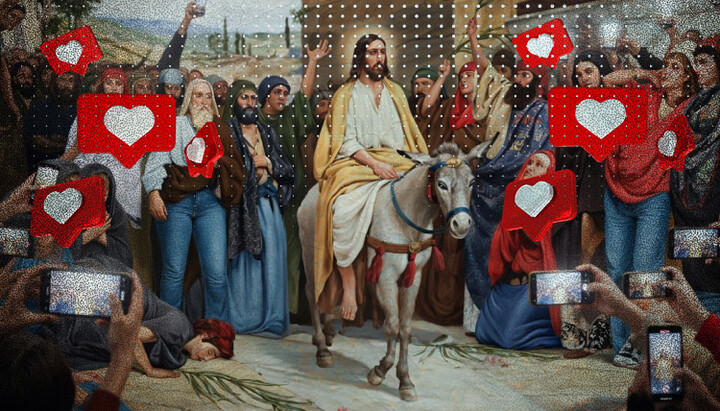
The Lord's Entry into Jerusalem and modern ostentatious religiosity. Photo: UOJ
The events described in the New Testament possess a unique ontological multi-layeredness. They are not limited by the framework of chronology or the geographical coordinates of ancient Judea. These are events beyond time, eternally relevant constants of being that invisibly permeate every historical moment. Christ did not simply once walk along the dusty streets of Jerusalem; He is at this very second making His procession along the hidden paths of human souls.
The Savior shed tears over the inhabitants of Jerusalem – people who today enthusiastically exclaimed "Hosanna!" but a few days later furiously demanded His execution. He sheds tears even today as He looks upon our lack of faith. The threshold of Holy Week is a moment of truth, when the Lord reveals to the faithful the tragic prospect of what awaits a civilization that has proved unable to recognize the presence of the Creator.
Unrecognized God and consumerist faith
How can one speak of "unrecognition" when jubilant crowds spread palm branches along Jesus’ path and filled the surroundings with cries of welcome? The reason lies in the profound distortion of popular expectations. The excited crowd was not meeting God, who had come to redeem humanity from the bonds of death and the power of the devil at the price of His Sacrifice. They did not need a teacher or prophet proclaiming the will of the Most High.
In the person of Christ, the people wished to see a kind of "sacred instrument," a magical means for solving material problems.
Their imagined the Messiah as a giver of endless goods: one who would provide the people with "free bread" and abundance, who would perform mass resurrection of ancestors for earthly comfort, who would turn political opponents and foreigners to dust, establishing national and social dominance.
When Christ's true sacrificial teaching became evident, fury replaced excitement. Calls to love enemies, to serve one's neighbor, and forgive all seemed offensive to the crowd. Such an "inconvenient" God, not fitting into the framework of consumer egoism, was doomed to rejection.
Unfortunately, modern humanity has not strayed far from the Jerusalem crowd. Religiosity often boils down to utilitarian demands: prayers for everyday well-being, health, and the resolution of life’s troubles prevail over the search for Truth. We forget that Christ did not promise His followers freedom from earthly suffering. On the contrary, the path to the Kingdom of God, according to the Apostle Paul, runs through the crucible of trials.
The illusion of "earthly paradise" and the little flock
The main tragedy of the "man of the crowd" lies in seeing the root of all misfortune in external circumstances, while his goals are directed solely at satisfying the needs of his own "self". For this "good", people are willing to commit murder and violence. The ideological motif of "destroy everything to the ground in order to build paradise on earth" is the eternal refrain of all social cataclysms, from the Babylonian confusion of tongues to the present day.
This global project of "homemade paradise" without God inevitably moves toward its finale – the establishment of a new world order.
Today we see the foundation being laid for a system in which, instead of the transformation of the spirit, total control and an external, surrogate unity under the rule of a coming false messiah are offered.
Against the backdrop of this global construction, another reality exists – the "little flock" of Christ's followers. Away from the informational noise, in silence and often in material scarcity, these people build the Kingdom of God within themselves. It is precisely their invisible prayer that is the spiritual restraining principle thanks to which the world still exists.
Life in God requires extreme asceticism of spirit. Any manifestation of malice, judgment, or lust instantly destroys the delicate fabric of Divine grace in the heart.
True Christians flee from the spiritual corruption of the world, while the majority of "believing people" seek only their own interests, indulging pride and sensual desires.
The power of prudent silence
In discussions with the world, logic and common sense are often powerless – this is an important lesson of the Gospel history. Look at the reaction of the Jewish elders to the resurrection of Lazarus: instead of bowing before the obvious miracle, they decided to kill both Christ and Lazarus. When hatred clouds reason, any arguments become useless.
This is precisely why Christ kept silence before the high priests, responding only to Pilate, who maintained at least a shadow of formal justice. For us, Christ's silence is a call to the same silence in the face of aggressive ignorance. The external triumph of evil and the trampling of Truth is only a temporary illusion. God, our hope, glory to You.
The tragedy of the "new world order" lies in the attempt to build an ideal society through external coercion and technological surrogate of well-being. While Christ offers transformation of personality through inner freedom and repentance, the worldly project strives for unification of humanity for the sake of security and consumption.
The ancient temptation of "bread," rejected by the Savior in the desert, becomes the foundation of modern civilization.
Man either agrees to the role of a cog in an efficiently tuned system of "earthly paradise," where the measure of success is social status and comfort, or chooses the thorny path of the "little flock," preserving purity of heart and faithfulness to Truth, even if this path leads to Golgotha.
The mirror of the Lord's Entry
The true strength of believers lies not in political struggle or attempts to convince those who seek only "bread and circuses," but in keeping the Divine presence within themselves. Quiet prayer is the highest form of responsibility for the world. The inner light of those who pray restrains humanity from final immersion into the chaos of self-destruction.
When the twilight of the "new order" thickens around us, where truth is declared relative and vice becomes the norm, the Christian is called to become a living witness of another existence.
Our prudent silence in the face of a furious crowd and our faithfulness to the commandments in the small details of everyday life are the very building of God’s world, which is beyond time and does not fear earthly upheavals.
The celebration of the Lord's Entry into Jerusalem annually places us before the mirror of eternity: who are we in that multitudes-strong crowd? Do we seek a "magic wand" to solve our problems, or are we ready to follow the humble King ascending to the Cross?
The historical process moves toward its inevitable conclusion, but this should not plunge us into despair. On the contrary, it is a call to utmost sobriety and spiritual vigilance. For after the darkness of Holy Week inevitably comes the radiance of Easter, and those who have preserved Christ in their hearts amid the storms of this world will be the first to witness the dawn of His eternal Kingdom.
Read also
A lesson from a speechless donkey
The famous seer struck his donkey three times for refusing to go forward. All the while, she was saving his life – and seeing what he could not.
The time when the soul ripens
Modern society has turned youth into a cult and old age into a period of merely “living out one’s days.” The Christian perspective reveals the profound spiritual meaning of our later years.
Faith is not a checker piece in a spectator sport
Arguments about faith on social media increasingly resemble no-holds-barred fights. We turn to a saint who, sixteen centuries ago, knew how to speak to those interested only in turning theology into a combat arena.
The metropolitan who fought with a pen
St. Cyprian of Kyiv was robbed, expelled, and barred from his see. He answered with letters, books, and canons – and before his death, forgave everyone.
Loneliness under one roof
Spouses can share a home for years, raise children, and faithfully attend church – yet remain strangers to each other.
The cross – the deepest healing of the human soul
Emotional exhaustion and anxiety have become a way of life. Ancient Christian tradition offers an unexpected way out – embracing one's own cross.