Filaret's death as a signal for Epifaniy to dismantle the Kyiv Patriarchate
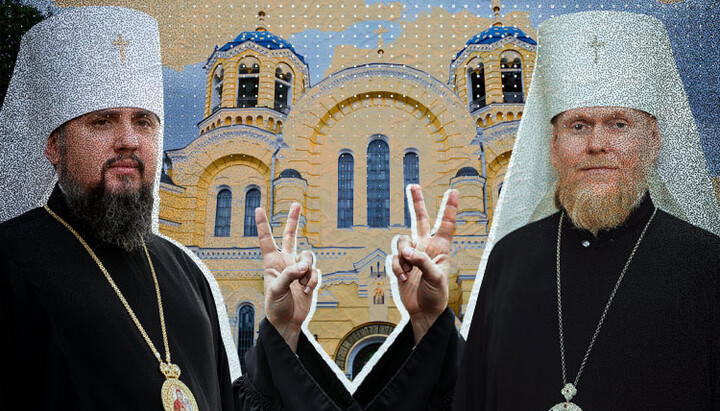
Dumenko and Zoria believe they have defeated the UOC-KP. Photo: UOJ
Immediately after Filaret's death, "hostilities" against his Kyiv Patriarchate began in the OCU. In the shortest time, Dumenko took control of St. Volodymyr's Cathedral and the building of the Kyiv Patriarchate on Pushkinska (now – Chykalenko), Kyiv. Such a scenario was anticipated, but few expected it to be implemented so swiftly. Despite the fact that since 2019 Filaret repeatedly declared his withdrawal from the OCU and the absence of any ties with this organization, Dumenko's people, thanks to contacts with Denysenko's relatives, gained access to his body immediately after death. The pompous funeral of the "honorary patriarch" became the beginning of an information campaign against Filaret's associates in the UOC-KP, who by that time had already elected a new "patriarch" – Nikodim.
Having lost the main spiritual center – St. Volodymyr's Cathedral – the Kyiv Patriarchate received a serious blow, however this organization still exists, albeit without state registration. Therefore, the OCU launched a coordinated attack on the UOC-KP, seeking to destroy it in a single powerful assault.
First, Dumenko held a Synod that announced control over St. Volodymyr's Cathedral and the residence on Pushkinska, and also condemned "the anticanonical activity of a group of persons who groundlessly and arbitrarily appropriate the name of the UOC-KP".
Second, the OCU published a statement on its website titled “Events in Ukrainian Orthodoxy after the Repose of His Holiness Patriarch Filaret: Facts and Assessments.”
Third, OCU spokesperson Yevstratiy Zoria held a press conference with a similar title on the Ukrinform Press Center platform.
We offer a brief analysis of the main theses of the OCU.
Brand seizure
The OCU declared that the UOC-KP and UAOC are additional official names of its structure.
Is this so? No. In the Tomos, the OCU is called the "Holy Church of Ukraine," and its head is not a patriarch (as should be in a patriarchate), but "Metropolitan of Kyiv and All Ukraine." In the state registry, the OCU is registered as "Kyiv Metropolis of the UOC (OCU)".
The only basis for the OCU’s claim to the “UOC-KP” brand is clause 5 of the OCU Statute, where it is indeed stated that the OCU “reserves the right to use” the names of the UOC-KP and the UAOC. However, this was linked to the assumption that the UOC-KP had ceased to exist. But in 2019, Filaret Denysenko stated that the UOC-KP had not been dissolved at all, and in the subsequent years until his death he was engaged in its restoration.
Why does the OCU now need the Kyiv Patriarchate brand? There is one reason – destroying a competitor.
Property seizure
Dumenko's circle assures that St. Volodymyr's Cathedral and the residence on Pushkinska have always belonged to the OCU, and Filaret used them because he was granted a "lifetime right" to do so as a "retired hierarch of the OCU." Consequently, after his death, all this returned to the OCU.
But documents and Filaret's own words tell a very different story. Between him and the OCU leadership there was a desperate struggle for Kyiv parishes, St. Volodymyr's Cathedral and other property. On June 20, 2019, Filaret convened a "Local Council of the Kyiv Patriarchate," at which he declared: "We as the Ukrainian Orthodox Church of the Kyiv Patriarchate continue to exist and withdraw from the OCU. We distance ourselves from the so-called OCU – this is not our Church."
In response, the OCU Synod on June 24, 2019 subordinated to Dumenko all Kyiv parishes and monasteries that before December 15, 2018 were part of the UOC-KP. Filaret called this decision a raider attack and declared: "Now a seizure of St. Volodymyr's Cathedral is planned." In September 2019, Filaret achieved that the District Administrative Court of Kyiv (OASK) suspended the liquidation of the Kyiv Patriarchate and imposed a ban on actions with its property.
On December 18, 2019, Filaret published "Patriarch Filaret's Response to the words and deeds of Metropolitan Epifaniy," in which he accused the head of the OCU of achieving the removal of the Kyiv Patriarchate from state registration, closing UOC-KP bank accounts, and refusal of utility services to conclude contracts for electricity, water and heat supply. There Filaret sarcastically noted that Epifaniy "boasts that he allowed the patriarch to live in the premises" that he himself built. And in an interview from January 31, 2023, Filaret directly stated that Epifaniy and Poroshenko wanted to "liquidate the Kyiv Patriarchate and seize its property."
So there were no peaceful “lifetime arrangements” granting St. Volodymyr’s Cathedral and the residence to Filaret. Instead, there was a fierce struggle involving raiding, court battles, and utility blockades.
Seizure of "unity"
Today the OCU is trying to present the situation as if Filaret always strived for unity with the OCU, and therefore the very existence of the UOC-KP contradicts his will.
One may have different views on Filaret, but this is a clear misrepresentation of his position. Yes, he always declared a desire for the unity of all Orthodox Christians in Ukraine – but a unity based on the UOC-KP and with himself at its head. He, in turn, accused the OCU of undermining this unity. Now Zoria and the OCU claim that Filaret allegedly meant unity specifically within the OCU. At a press conference, Zoria presented it as follows: “The Patriarch consistently emphasized that church unity is necessary in Ukraine, and by his personal example demonstrated that he wished Orthodox Ukrainians to live in peace and love with one another. If Patriarch Filaret had a different opinion and a different vision, over these seven years he had every opportunity to attest to this in his documents and to make it public."
Let us turn to these documents and see what Filaret truly desired. The OCU likes to refer to the meeting between Filaret and Dumenko in November 2025 – first at Filaret’s residence, and then at the St. Michael’s Golden-Domed Monastery. However, first of all, the reports about this meeting contain no indication that Filaret gave up his negative attitude toward the OCU or took any steps toward reconciliation.
And second, turning a single late-life episode into proof that Filaret allegedly returned to supporting the OCU means disregarding the entire body of his own statements. Here are just a few examples.
On June 25, 2019, after leaving the OCU and restoring the UOC-KP, Filaret declared: "We had a council on June 20, and we declared there that we do not belong to this so-called OCU. Their resolutions and punishments do not concern us. '…' We distance ourselves from this so-called OCU, this is not our Church."
Filaret's statement of September 28, 2019: "We did receive the Tomos of autocephaly of the Ukrainian Orthodox Church, but not the Tomos we had expected. […] It turned out that we had left one dependence – on Moscow – only to fall into a second dependence – on Constantinople.”
Official "Address to media representatives" of September 22, 2021: "His Holiness Filaret is not any 'honorary patriarch of the Orthodox Church of Ukraine.' '…' This is an outright fake and lie, designed to hide the betrayal and genuine immoral attitude of Metropolitan Epifaniy toward his spiritual father Patriarch Filaret. '…' Patriarch Filaret is not part of the episcopate of the Orthodox Church of Ukraine, but is the Head of a separate denomination – the Ukrainian Orthodox Church of the Kyiv Patriarchate (the main temple of the UOC-KP is St. Volodymyr's Patriarchal Cathedral in Kyiv). The Kyiv Patriarchate is a fully autocephalous Orthodox Church, independent of either Moscow or Constantinople, with a real, not honorary Patriarch at its head."
In the same appeal, Filaret denied that Dumenko is the head of the OCU: "Incidentally, I inform that Metropolitan Epifaniy (Dumenko) is not the Primate of the Orthodox Church of Ukraine, since he was not elected at a Local Council of the Orthodox Church of Ukraine, as Orthodox tradition requires…" And formally Filaret is right: the event commonly called the Unification Council of December 15, 2018, based on decisions of the Constantinople Patriarchate, was a council of the Kyiv Metropolis within that patriarchate.
"Exposing" Filaret's testament
It is now commonly said in the OCU that Filaret allegedly almost bequeathed to his followers that after his death they should join the OCU.
But everyone knows that in his testament Filaret said the direct opposite. He actually forbade OCU hierarchs from participating in his own funeral service: "I bequeath that the rite of funeral service and burial be performed in St. Volodymyr's Patriarchal Cathedral of Kyiv by the clergy and hierarchs of the UOC-KP, and not the OCU."
Zoria declared at the press conference that the testament "is not the Patriarch's will," that other people wrote it, and this is "a piece of paper that entails no consequences." Zoria provided no evidence except his own impression.
The matter is not even about the “piece of paper,” but about the fact that the content of the will fully corresponds to Filaret’s long-standing public position. For many years he referred to the OCU as “so-called,” said “this is not our Church,” rejected the Tomos as dependence on Constantinople, insisted on the continued existence of the UOC-KP, and officially stated that he did not belong to the episcopate of the OCU. Regarding Dumenko, Filaret said: “I did not know what was in Metropolitan Epifaniy’s soul. […] And now he has revealed his true nature, like that Maximus the Cynic” (a well-known 4th-century impostor – Ed.).
And now, completely without evidence, Filaret is being portrayed as someone who allegedly wanted the OCU to appropriate his spiritual legacy.
Denial of UOC-KP "ordinations"
Both in the OCU Synod statement and at Zoria's press conference, the claim was made that ordinations in the current UOC-KP are uncanonical.
After falling into schism in 1992, being defrocked and excommunicated from the Church, recognized by all Local Churches without exception, Filaret carried out numerous “ordinations,” including those of Epifaniy Dumenko and Yevstratiy Zoria. Moreover, these are not questioned by anyone in the OCU. However, when the “legitimized” Filaret left the new structure and began performing ordinations of the same supposed “validity” within the Kyiv Patriarchate, the OCU for some reason refused to recognize them.
At the press conference on April 1, 2026, Zoria stated that "from the very beginning, from 2019, the OCU has not recognized, does not recognize, and will not recognize any proclamations of anyone as hierarchs” if they became such outside the OCU jurisdiction.
However, first of all, these "ordinations" were performed by the same Filaret. If before his legalization by the Patriarchate of Constantinople his non-graced status was recognized by all Local Churches without exception, then after 2019 Filaret was recognized by only four Local Churches.
Second, after leaving the OCU, Filaret was not suspended from ministry either by the OCU itself or by the Patriarchate of Constantinople. On what basis, then, does the OCU not recognize his "ordinations" after 2019? And if they are invalid, then the ordinations of Dumenko, Zoria, and others are even more so invalid.
Question of jurisdiction
In addition, Zoria and the leadership of the OCU make decisions regarding the "canonical" status of people who are not under their jurisdiction. In 2019–2020, several "bishops" of the OCU, in particular Ioasaf Shibaev and Filaret Panku, returned to Denysenko in the UOC-KP. How did the OCU respond? Did it ban them from the priesthood? Did it defrock them? No – they were excluded from the OCU “episcopate.” A quote from the Synod documents: “His Eminence Ioasaf (Shibaev) […] was excluded from 24 June 2019 from the episcopate” of the OCU. In the same way, Filaret Panku “from 9 July 2020 was excluded from” the OCU. On what basis, then, were they later tried and defrocked if they no longer belonged to the OCU jurisdiction?
On top of that, neither Shibaev nor Panku are Ukrainian citizens and live in other countries: Shibaev – in Russia, Panku – in Moldova. And according to the Tomos, OCU jurisdiction extends only to Ukrainian territory. This discrepancy was noted at the press conference itself: one of the journalists asked Zoria: "How could they be defrocked if OCU jurisdiction extends to Ukrainian territory, and they were representatives of the UOC-KP in other countries?" Zoria calmly replied that everything is contained in official OCU documents and decisions.
The point is that even these decisions contain absurdity. A quote: “Although Metropolitan Ioasaf, since June 24, 2019, does not belong to the episcopate of the OCU and permanently resides and serves in the Russian Federation, through his activity he unlawfully, grossly, and systematically interferes in the life of the OCU.” How can he interfere in the life of the OCU while being in Russia? According to the Tomos, the OCU cannot have parishes abroad, all the more so in the Russian Federation. Or do they, in fact, operate there?
Dissenters labeled “Kremlin agents”
When legal and church arguments begin to falter, a universal formula comes into play: "This is the Kremlin's work." The fact that the UOC-KP "episcopate" did not want to self-liquidate and merge with the OCU, but instead elected Nikodim Kobzar as the new "patriarch," according to Zoria, is "an informational special church operation developed and coordinated by Russian special services."
The official OCU release states that Shibaev and Moskalev (another figure of the UOC-KP – Ed.), while in Russia, “are quite obviously under the control of Russian special services,” and that all the activity of UOC-KP members provides “solid grounds to consider” it a special operation of the Russian special services. Note the wording: “quite obviously,” “provides grounds to consider,” and the like. Neither facts, nor evidence, nor court rulings, nor materials from law enforcement agencies — but value judgments. In essence, these are the same well-worn accusations previously directed at the UOC: if you are in any way undesirable to us, you are a Kremlin agent. And “quite obviously,” at that.
Conclusion
In the end, both the wording of the OCU Synod, the publications on its website, and Zoria’s press conference turned out to be a media attack on a competing structure aimed at its complete destruction. The audience is meant to be left with the impression that Filaret, toward the end of his life, effectively returned to the OCU, that all controversial actions of his circle are canonically null, and that any dissent is dictated by Moscow.
However, documents, Denysenko’s statements, and even materials from the OCU itself show a different picture: behind the fine words about love and unity lies an ordinary struggle for name, property, symbols, and power. And in this struggle, the OCU leadership is using the same weapons once employed against Filaret — manipulation, half-truths, and in some cases outright falsehoods.
However, this entire arsenal is the main legacy of the "honorary patriarch." Today some of his students wage battle against others. They wage it using the entire arsenal their pastor taught them. And here it is not so important who wins. The very fact of this "spiritual war" speaks louder than any declarations: the schism sown by Filaret in 1992 continues to bear fruit – only now the harvest is being reaped within his own legacy.
Read also
The Council of Crete: a decade of unity in name only
Constantinople marked the anniversary of the Council of Crete with a theological conference in France. They spoke about the unity of Orthodoxy, although over the past years there has noticeably been less of it.
Yelensky’s plan: Why is DESS demanding what the UOC has already done?
DESS is demanding that the UOC take steps it has already taken, while offering no assurance that further demands will not follow. What is behind Yelensky’s ultimatum?
Why OCU hierarchy lacks canonical ordination: what Local Churches say
The OCU head refuses to address invalidity of his ordinations. But almost all Local Churches speak of it – even those that recognized the OCU.
Why nation-first advocates do not call for peace
Ukraine’s population is declining by nearly one million people a year, and experts are warning of the nation’s demographic extinction. Yet the leaders of the Orthodox Church of Ukraine (OCU) and the Ukrainian Greek Catholic Church (UGCC) continue to call for war and mobilization.
The deception that decided the fate of the Tomos
In 2008, the "Filaret problem" derailed Yushchenko's plan. In 2018, Poroshenko solved it in just one hour – with a police escort for the Greeks and verbal promises to Filaret.
Lawyers in the crosshairs: How UOC is being stripped of its right to defense
Activists harass UOC lawyers outside courthouses, call them “traitors” on air, and promise them a “warm welcome” at hearings. The Church’s right to a legal defense is at stake.