Zymne: the monastery dug out with shovels
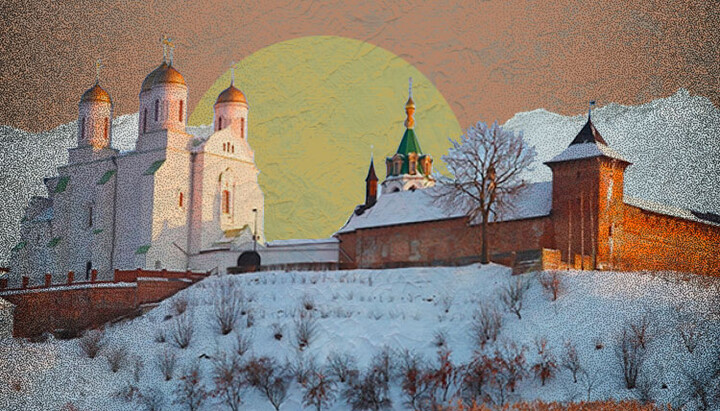
The Zymne Monastery. Photo: UOJ
The cave corridor, just a few steps from the entrance, becomes so narrow that your shoulders involuntarily brush against the walls. Here, beneath a high hill above the winding floodplain of the Luha River, the first monks of Zymne prayed. There is no exact date for when people began to burrow into this white stone. The caves seem older than any surviving records of this place. They are a living foundation that reaches far deeper into history than the walls of the above-ground churches.
During the Soviet decades, the entrances to these caves were buried with particular thoroughness. Everything that came to hand was used: construction debris, broken brick, tons of soil, etc. The idea was clear – to erase the very possibility of going down so that the prayer that had sounded there for centuries would suffocate underground. When the first nuns returned here in June 1991, the cave complex existed only in legends. On the surface, there were only hills and piles of garbage.
All of this was excavated by hand. Without excavators and heavy machinery, with ordinary buckets and shovels, over several years. This was exhausting labor, where every centimeter of freed space was won back from oblivion.
Walls to protect life
The monastery stands on an elevation that local residents have called Holy Hill for centuries. From here opens a panoramic view of the Volhynian expanses, of water meadows and dense forests on the other bank of the Luha River. The construction site was chosen with expertise. Volhynia had always been a land through which foreign armies marched, so the monastery was built as a real fortress.
Massive walls with corner towers, the Dormition Cathedral in the form of a basilica, resembling an elongated rectangle with thick masonry – all this was built for survival. The strength of the walls was more important than any decoration, since Tatar raids occurred here regularly.
The monastery had to protect people's lives as reliably as their faith.
According to church tradition, the monastery was founded at the end of the tenth century by Prince Vladimir the Great. Zymne was his winter residence, hence the name that preserved the spirit of those times. It was from these places that the prince went to the Dnieper, to that moment of baptism that changed the entire course of our history. The history of the Zymne Icon of the Mother of God is also connected with this hill. It was brought from Constantinople. Old stories connect the image with the restoration of Prince Vladimir's sight before his baptism. This tradition emphasizes the main thing: Holy Mountain always helped people see the eternal in moments when the world around was plunged into complete darkness.
Sleeping death and poisonous altar
By 1915, the war had come close to Volhynia. Artillery fire broke through the vaults of the Dormition Cathedral, destroying the roof. The monastic community was evacuated, and Abbess Ariadna took with her the main shrine – the miraculous icon. The image left the monastery with the last sisters, and this saved it from destruction in the following decades.
Soviet power finally closed the monastery in 1946. The territory was given over to the needs of a tractor station. In the altar of the Holy Trinity Church, a warehouse for chemical fertilizers was set up. For decades, the brick masonry absorbed poisonous compounds. The walls that had heard only prayers for centuries now exuded the acrid smell of industrial chemicals. The cells collapsed, the monastery courtyard became overgrown with weeds and filled with rusty metal.
When restorers came here in the early nineties, dangerous work awaited them. Sappers removed unexploded artillery shells from World War I from the walls of the Dormition Cathedral. Sleeping death had lain in the masonry for more than seventy years, becoming part of the walls. Such a situation was systemic for hundreds of monasteries. The authorities methodically destroyed buildings to break the thread of memory and make new generations forget what actually stood on these hills.
Two nuns and shovels
In June 1991, two women came to these ruins: the future abbess, nun Stefana, and nun Halyna. They saw a cathedral without a roof, inside which, right in the altar, tall trees had grown. Everywhere there were ruins of buildings and spontaneous dumps. The caves remained so densely blocked that only old legends reminded of them.
The biblical book of Ezra describes the moment when people returned from captivity to the ruins of the Jerusalem temple. The old men who remembered the former glory wept with grief. The young ones, seeing the beginning of new construction, rejoiced loudly.
In Zymne in 1991, these feelings were complex: grief at the sight of desecrated shrines mixed with joy at the possibility of starting all over again.
The restoration of the monastery became years of hard, almost penal labor. Sisters and pilgrims carried garbage out of deep caves in buckets, manually reinforced cracked walls and cleaned altars of poisonous salts. In 1995, the icon finally returned home. It was carried in a religious procession from the Korets Monastery, where it had been secretly kept in the post-war years. Dozens of kilometers were covered on dusty roads, with singing and prayer. When the image was brought through the gates of the restored monastery, the shrine had already ceased to be a construction site. Life had returned to it.
The law of life in ancient stones
Christ once said words that many understood too literally: "Destroy this temple, and I will raise it again in three days." His listeners thought about stone walls, but He was speaking about the very nature of the Church. It lives by laws that are not subject to state systems or ideologies. Ideologies die forever, turning into boring paragraphs in textbooks. The Church, however, possesses the ability to return from oblivion.
The Zymno Monastery was buried several times – truly, down to its very foundations. Its caves were filled in, its altars were poisoned, it was left to the ravages of time and the fragments of shells. But time passed, and above the Holy Hill the angelic singing was heard once again. In the excavated caves, lamps flickered back to life, and the chalk walls once again absorbed the scent of incense, driving out the chemical stench.
Today, early in the morning, the nuns walk to the service across the very courtyard where machinery once lay rotting. Above the winding Luha River and the timeless Volhynian landscape there rests a silence in which there is no longer any place for death.
Resurrection cannot be buried in the ground. If stones hold the memory of Eternity, they will always sprout through any garbage and oblivion. Now everyone who descends into the narrow chalk corridors of Zymne knows this.
Read also
Trial of a dead pope
Once in Rome, the body of a deceased pope was seated on the throne and put on trial. The accusation relied on a church canon that had once saved his see.
Monastery built in defiance of king
When Orthodox believers in Minsk were left with just one church, townspeople decided to build another – and even a royal decree did not stop them.
Young Mother and Sleeping Christ
Michelangelo carved a Virgin Mary who looks younger than her Son – and signed his name in marble for the only time in his life. Neither of these peculiarities was accidental.
Orthodox books from a Uniate printing press
In the 18th century, Uniate monks at Pochaiv printed books used in prayer by Orthodox Christians and Old Believers alike.
The story of the honey brotherhood
The Mogilev Brotherhood began with members pooling money to brew honey drinks for feast days – and eventually grew to have its own printing press.
Golgotha in the midst of a pogrom
In the autumn of 1938, the Jewish artist Marc Chagall painted the crucified Christ. Synagogues burn and refugees flee around the cross, while the Crucified One Himself is wrapped in a prayer shawl.