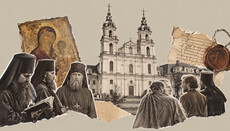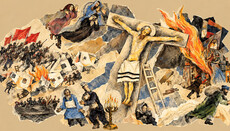

How Glinsk Hermitage went to the mountains
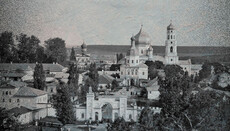
July 1961. Officials hang a heavy lock on the hinges, while the elders walked away down the dusty road with small suitcases.
In the summer of 1961, there were unusually many cars at the gates of the Glinsk Hermitage – official "Volgas" and police "gaziks." People in gray suits emerged from the vehicles. They had folders, seals, and a clear assignment: the monastery should no longer exist here. It was decided to open a psychoneurological boarding house in its place. The plans included bed spaces, rounds schedules, and economic reports. Everything was extremely rational and clear.
At that time, silence reigned in the monastery courtyard. The monks did not organize rallies or block the road for machinery. They simply carried out their belongings. Each had one small suitcase or old traveling bag. Inside was a pair of spare underwear, a prayer book, a spoon, perhaps a couple of books. All the belongings gathered over decades weighed no more than ten kilograms.
Officials busily inspected the buildings, estimating where it would be better to place beds for patients and where to set up a dining hall. From the outside, it looked like the usual liquidation of an outdated institution. The boarding house manager was already trying keys to the refectory doors. At some point, a heavy barn lock clicked behind the backs of the departing elders. That afternoon, in official records, the Glinsk Hermitage ceased to exist.
Clay, brick, and typhus barracks
To understand why these people were so calm, one must look back forty years earlier. In 1922, the monastery was closed for the first time, and then everything was much harder. The monastery was not simply sealed – it was dismantled. There are accounts of how bricks from the monastery walls, still retaining the warmth of the hands of 18th-century craftsmen, were methodically pried out and hauled away on carts. They were used to pave rutted roads and to build foundations for collective farm pigsties.
This was a symbolic act of erasing memory: turning sanctified stone into support for a barn.
The elders then faced a long journey. Kolyma, Siberian logging camps, and dry steppes of Kazakhstan. The investigators processing documents for the transports were certain that this would be the end. That a man in a padded jacket, after ten years of cleaning cesspits or working in a typhus barrack, would simply dissolve into camp dust. The spiritual tradition was supposed to break.
Schema-archimandrite Andronik (Lukash) worked as a medic in one such camp. He was sent where even guards did not venture – to the barrack for those dying of typhus. He washed their underwear, changed bandages, and carried out buckets. He lived in the constant presence of death, in the heavy smell of disease. It was there, in this ultimate abandonment, that what pilgrims would later call the "Glinsk spirit" was forged. When in 1942 – more out of military pragmatism by the authorities – the monastery was allowed to reopen, these people returned. They came to their native monastery as people who had seen the bottom of life and had not lost peace in their souls there. Those nineteen years that the monastery stood open until the Khrushchev thaw, it was a place where people came from all over the country seeking answers to spiritual questions.
The Caucasian route and whispers in the dark
When in 1961 the lock on the gates of the Glinsk Hermitage clicked shut again, this did not become a catastrophe for the brotherhood. Some of the monks were accepted by the Georgian Orthodox Church. Patriarch Ephrem II, himself having gone through Stalin's prisons, understood the value of these holy people.
Schema-archimandrite Zinovy (Mazhuga) settled in Tbilisi. Over time, he became Metropolitan of Tetrisqaro. Part of the Glinsk monks went high into the mountains of Abkhazia. They did not retreat to well-equipped sketes, but to caves, dugouts, and abandoned huts in areas so remote that patrols rarely reached them.
There, in the dampness of the Caucasian Mountains, under the whistle of wind, the strict Glinsk rule continued to live. They had no liturgical books – they knew all the services by heart. In complete darkness or by the light of a candle stub, they performed the daily cycle of prayer, not missing a single exclamation. They were hunted as "parasites" and violators of passport regulations, they were caught in forests, but they continued their work. The tradition was passed literally from mouth to mouth, through living communication between elders and their disciples.
These disciples – often secret monks working as doctors, engineers, or teachers – preserved the same manner of speech, the same depth of attention to their interlocutor. This was true spiritual succession.
Glinsk elders' legacy
Today the Glinsk Hermitage again receives pilgrims. In the 1990s the monastery was returned to the Church, the walls were whitewashed, the domes were re-gilded. But when you are standing in the monastery courtyard, what comes to mind is not its present splendor but those very suitcases from 1961.
The true value of the Glinsk story lies in the dignity with which those elders went into the unknown.
They did not look back at the slammed gates. They knew what we today often miss in the pursuit of external recognition: the life of the spirit begins where guarantees of safety end.
There are preserved memories of how the Glinsk monks behaved in the camps. They say they often wept at night. And most surprisingly – they did not weep for their own liberation. They wept for their guards, for the convoy, for those very investigators who signed their sentences. They saw in them not enemies but endlessly unfortunate, lost people who were destroying their souls right then. This compassion for the executioner was the resource that allowed them to survive decades of persecution.
The Glinsk Hermitage is a living reminder that man's true support lies beyond this world.
When it seems today that everything familiar is falling apart, that the world is becoming more aggressive, one should simply remember that road in the Sumy region and the monks walking off into the unknown.
Coals under ashes do not go out as long as there is at least one person ready to keep the fire in his heart. And this fire fears neither locks on gates nor bulldozers. Because a true monastery is an invisible space that a person builds within himself, and in this construction he has no and cannot have competitors. The main legacy of the Glinsk elders lies in this ability to remain free even when the door closes behind you.