True Pascha: from biology to spirit and the birth of personality
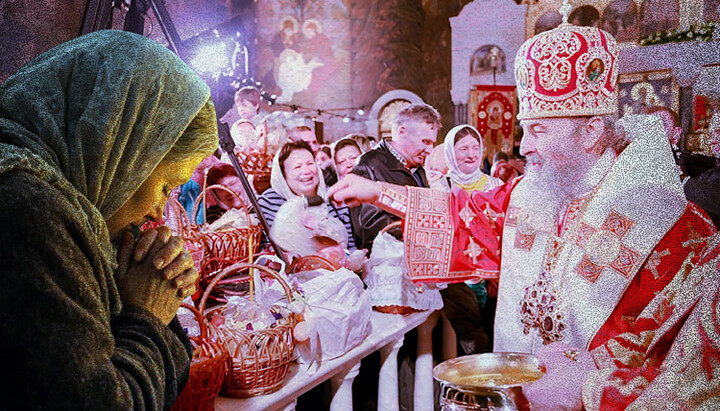
Human experience of Pascha. Photo: UOJ
Every year the world resounds with the triumphant cry: "Christ is risen! Truly He is risen!" But for most of us, this joy is like a bright, short-lived dopamine surge. The festive euphoria smolders for a week or two, then inevitably dissolves into the gray routine of everyday life. We face a bitter paradox: an event that changed the course of history does not change the structure of our daily existence.
A fundamental question arises: is the Resurrection for me a living reality or a beautiful archetypal decoration? The Lord makes it clear that participation in His victory over death is not an automatic bonus for faith, but the result of a willful ascent along the "narrow path." The joy of Divine sonship is the fruit of synergy between God and man, requiring utmost honesty and colossal effort.
Metamorphosis of personality
The Apostle Paul offers us a radically new anthropology. He introduces markers that divide two types of existence: "If anyone is in Christ, he is a new creation" (2 Cor 5:17). This is not a metaphor. To become a "new creation" means to pass through an anthropological catastrophe of the old "self." For this to happen, it is necessary to "put off the old man with his deeds, and put on the new man who is renewed in knowledge according to the image of Him who created him" (Col. 3:9–10).
Without "shedding the old skin," the Paschal greeting becomes a slogan, a religious simulacrum. For Pascha to become our personal victory, the spirit must pass through two critical stages.
Many mistakenly believe that the goal of spirituality is to "be a good person." However, cleansing the mind and heart from sinful layers is merely clearing the construction site. This is a necessary but insufficient condition.
We cleanse the vessel not for the sake of purity itself, but for what it will be filled with. Nothing damaged or impure can be placed on the altar of Divine love; the sacrifice must be whole.
Sacrifice as self-offering
At this stage, grace leads us to the blessedness promised to the pure in heart: "Blessed are the pure in heart, for they shall see God" (Mt. 5:8). Purity is achieved through the dying of our ego. Here we enter the realm of deification. As Saint Justin Popović noted, the meaning of human existence is in "co-incarnation" with Christ, in fusing one's will with the Creator's will. This is the realization of the formula of the holy fathers (Irenaeus of Lyon, Athanasius the Great): "God became man so that man might become God."
Only in the process of deification does man acquire the status of a person. Outside this vector, we remain highly developed biological specimens, but without metaphysical foundation.
Deification is not intellectual assimilation of dogmas but a new birth in the Spirit, of which Christ spoke to Nicodemus.
In this state, our natural energies enter into symbiosis with uncreated energies: man by grace acquires those properties which God has by His nature. The pinnacle of this union is love. If the transcendent leap does not occur, man risks degrading to a state "below the animal." Deprived of a spiritual vector, he becomes a hostage to passions, turning his soul into a chaotic conglomerate of egocentrism and lust, acquiring demonic traits of selfhood.
The final act of Divine sonship is entrusting one's entire life into the hands of Providence. Christ, as the Great High Priest, leads every soul ready for co-crucifixion to Golgotha. And this is not necessarily external martyrdom. This is the daily cutting off of one's selfhood: "Not my will, but Yours be done."
At this stage, we nail to the cross our ambitions, fears, and personal opinions, entrusting God with the script of our life. This is the path to genuine, unending Pascha. Those who managed to "die before death" acquire a state of continuous rejoicing, which we saw in Saint Seraphim of Sarov, for whom every day was Bright Sunday.
Two paths: depth or facade?
Before each of us lie two roads. The first is the path of the holy fathers, the difficult process of self-offering leading to real change in human nature. The second is the path of worldly tradition: reducing Pascha to external attributes (Easter breads, eggs, rituals). This is a dead end, creating an illusion of participation in God while completely lacking inner transformation. It is sad to realize that many choose the facade instead of the temple. But the choice always remains ours: to remain captive to the "old man" or risk everything to become a "new creation" and enter into the joy of the Lord.
From the plane of religious tradition, the discussion moves to the plane of metaphysics.
One is not born human in the final sense but becomes human through self-overcoming.
Without spiritual effort, man remains within the framework of "fallen nature," where his will is dictated by instincts, passions, and egocentrism. This is existence in the mode of a "biological machine." The status of person in the Christian understanding is not self-expression of ego, but the ability to go beyond one's nature for the sake of another (God and neighbor).
Man finds his true form only when "Christ is formed" in him. Worldly freedom is often understood as the absence of restrictions on "I want." The theological conclusion states: true freedom is freedom from slavery to one's own damaged nature. The death of the "old man" is not the destruction of individuality but its purification from the "noise" of sin. Offering oneself as a sacrifice to God is an act of supreme trust, where man gives his finite will to receive in return the infinite Divine will.
The two stages, purification and sacrifice, are a fact of cooperation between Divine grace and human will. Christ's Resurrection changed the nature of the cosmos, but its fruits are not assimilated by man "magically" through rituals. Deification is achieved by uniting human energies with the uncreated energies of God.
The joy of Seraphim of Sarov is an example of breakthrough from linear, devouring time into the graceful time of Eternity. A feast limited by the calendar is only a shadow of truth. True Resurrection is an eschatological event that must occur within a specific biography "here and now."
Christianity is utterly realistic. It requires not sensual raptures but radical reconstruction of consciousness.
The path from "Christ is risen" to "I am risen in Christ" lies through the cross, the point where human suffering (cutting off the ego) and Divine love intersect. True Pascha is an exit into a completely different dimension of being, where death no longer has power over the person.
Read also
The valley of trouble and the gateway of hope
One soldier buried an expensive cloak and some gold beneath his tent. Because of this, all Israel lost a battle. Why did one man’s sin bring disaster upon an entire nation?
From love spells to bishop's throne
Antioch’s most powerful sorcerer sent demons against a devout young Christian woman three times – and failed every time. In the end, a demon himself revealed the truth that led to his conversion.
The Weeping Queen of Blachernae
On the night of the Feast of the Protection, only two people witnessed the miracle in the Church of Blachernae. Everyone else prayed and saw nothing. Yet they, too, received grace.
Deadly spiral of human hatred
The tragedy of Lebanon's civil war lays bare how dehumanization and fear can turn human beings into monsters.
Woe to expectant mothers – or to those of little faith?
God commanded one prophet not to have children, yet told his people in exile to bear sons and daughters. What does this apparent contradiction tell us today?
The help God never asked for
Uzzah wanted only to keep the Ark of the Covenant from falling into the dust. Why did this well-intentioned act cost him his life, and who was really responsible for his death?