The broken door: why we still die after Easter
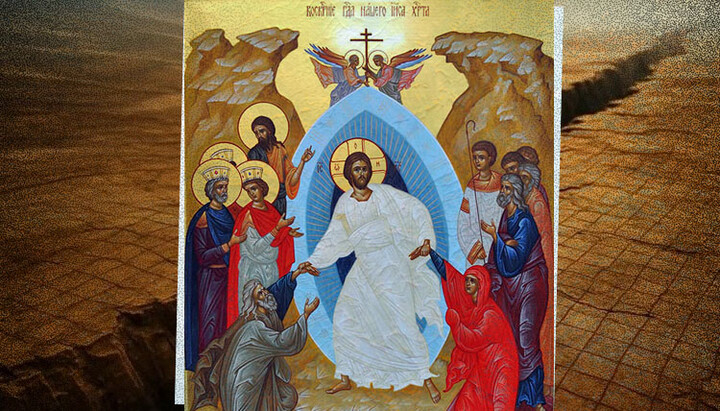
A tectonic shift in history after the Resurrection of Christ. Photo: UOJ
Jerusalem woke that Sunday with a yawn, ordinary and unhurried. The markets were already alive with quarrels over the price of oil, and legionaries on the walls blinked in the harsh morning sun, stifling their boredom. A routine provincial day on the edge of a vast empire.
The high priest Caiaphas was likely at breakfast, quietly pleased with himself – the troublesome agitator had been executed, order restored. Prefect Pilate, in his residence, dictated reports back to the capital; in those documents, the Galilean Preacher was reduced to a single line under “incidents.” Case closed. Tied off and buried. The world rolled on along its tracks, unaware that a few hours earlier, in a quiet garden beyond the city, reality itself had cracked.
In this story, it is always the silence that unsettles. We expect great upheavals to arrive with thunder, with collapsing stones, at the very least with the cry of heralds. But the Resurrection of Christ took place almost unnoticed by humanity. No temples crumbled. No stars fell. Most people simply went about their business that day. Death did not disappear. Illness did not vanish. The emperor still ruled, and people still prepared for their own funerals.
Outwardly, nothing changed at all.
And yet, within this familiar stage, something appeared that had never existed before.
A windowless house
Imagine living your entire life in a cramped room with no windows. Thick walls, a low ceiling, and a single flickering candle for light. You have grown used to it. You do not even know what dawn is, or what a horizon might be. You simply live in that gray half-darkness and call it natural. You hear footsteps beyond the walls, the wind passing outside – but to you they are only distant sounds, unreachable.
And then, one night, there is a blow – and a hole breaks open in the wall. A small, jagged gap. The house itself has not changed: the same worn corners, the same old furniture, the same stale air. But now, through that fracture, real sunlight pours in. And suddenly you know for certain: beyond these stones there is a vast world – grass, sky, an ocean without end. The house is no longer your prison. It has become a temporary place, where you wait for morning.
This is what happened at Easter. Death, as a biological process, remained exactly where it was. Our cells still age. The heart will still one day stop.
We will all die. That knowledge has not gone anywhere. But in the wall that once seemed a blind dead end, a door has appeared. Not gently opened – torn out from within, hinges ripped loose along with the stone.
The Apostle Paul once wrote words that sound almost strange: “O death, where is your sting? O hell, where is your victory?” He does not say that death no longer exists. He asks where its power has gone. The bite remains; separation still hurts. But the poison can no longer kill us forever. Death has become a pause in the middle of a long story – and after it, there will be a continuation.
Why a cemetery is a bedroom
This new sense of life revealed itself in the simplest things. Consider how the first Christians began to speak of those who had died. Before them, the world lived among necropolises – cities of the dead. Final stations. Terminals with no return journeys. Territories of absolute silence and non-being, where stones preserved only the memory of what was no more.
But Christians coined another word – koimeterion. From it comes our word “cemetery,” and its root means “to sleep.” Literally: a cemetery is a bedroom. A place where a person has lain down to rest after a day full of labor. In our own language, this lingers in the word “the departed” – those who have fallen asleep.
Christians changed these words because they saw light beyond the wall. They no longer buried forever; they laid their loved ones down to sleep until dawn.
This is a profound shift in the very foundation of how we see the world. Paul urged his friends: “Do not grieve as others do who have no hope.” He did not forbid tears. The sorrow of separation is human, and it remains. When we lose those we love, it hurts – and that pain does not vanish. But there is an abyss between the tears of someone saying farewell on a platform, knowing they will meet again, and the scream of one who falls into a void. Easter removed despair from our grief.
Fishermen who stopped hiding
The most convincing proof that something happened in that burial garden in Jerusalem is not the empty tomb, but what happened to the people.
On Friday evening, Christ’s disciples were like frightened sparrows. They locked themselves inside, extinguished the lamps, and flinched at every knock on the door. Their Teacher was dead. Their hopes were shattered. They were terrified for their lives. The instinct for survival whispered: stay quiet, stay hidden, pretend you are not here. They were ready to flee, to vanish, to gain a few more days of fragile existence.
And yet, very soon, those same fishermen step into the city squares. They speak openly. They do not hide from the guards. They do not recant under threat of torture. The instinct to survive at any cost no longer rules them.
They had seen: death is not what it appears to be.
If you have seen your Teacher alive after His body lay three days in a stone cave, you no longer tremble for your temporary shell. The deepest human terror – the fear of annihilation – simply dissolves. After that morning, dying became less frightening, because the road beyond it had already been opened.
Silence and light
That morning, the world woke and went about its business. Legionaries polished armor. Officials received petitioners. Merchants laid out their goods. And in that noise, unnoticed by all, the answer to the greatest question was given – the one we ask in the night, or at the bedside of someone we love: is there anything beyond that gray wall of death?
The wall still stands. We still lose those we love. We still fear illness. But now there is a breach in that wall, and through it we can see the dawn.
We go on living in our house – arguing over prices, making plans, raising children. But the knowledge that there is a way out changes the taste of every moment.
Easter is not about sweet bread or bright cards. It is about the fact that non-being has lost.
And now, even on the bleakest day, we know: morning will come.
It has already happened once.
The door has been torn open. The hinges are gone. Light is pouring in.
Death is no longer a dead end.
It is a threshold – beyond which eternity begins.
Read also
Honest atheism vs. spiritual hypocrisy
The 70th anniversary of Albert Camus’s Nobel Prize recalls an uncompromising challenge to Christianity. An honest unbeliever brings theology back to the mystery of the Cross.
The valley of trouble and the gateway of hope
One soldier buried an expensive cloak and some gold beneath his tent. Because of this, all Israel lost a battle. Why did one man’s sin bring disaster upon an entire nation?
From love spells to bishop's throne
Antioch’s most powerful sorcerer sent demons against a devout young Christian woman three times – and failed every time. In the end, a demon himself revealed the truth that led to his conversion.
The Weeping Queen of Blachernae
On the night of the Feast of the Protection, only two people witnessed the miracle in the Church of Blachernae. Everyone else prayed and saw nothing. Yet they, too, received grace.
Deadly spiral of human hatred
The tragedy of Lebanon's civil war lays bare how dehumanization and fear can turn human beings into monsters.
Woe to expectant mothers – or to those of little faith?
God commanded one prophet not to have children, yet told his people in exile to bear sons and daughters. What does this apparent contradiction tell us today?