Church, TRC, and war: Why "patriotic" confessions sidestep the core issue
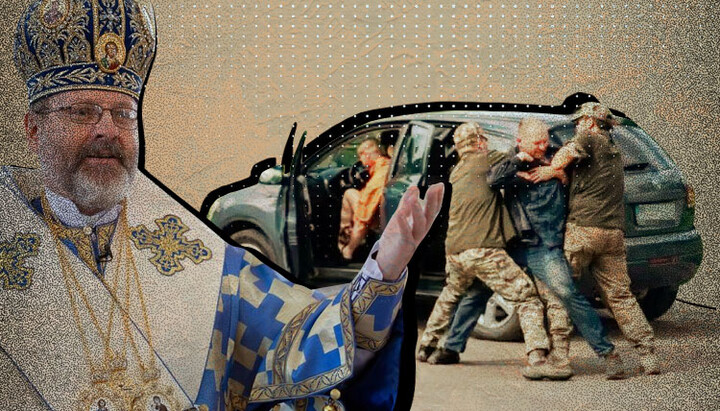
In the UGCC, criticism of recruitment centers on social media is said to come only from bots. Photo: UOJ
At the beginning of April, a recruitment officer, Oleh Avdeiev, was killed in Lviv. A loud, high-profile event. And perhaps the most shocking part is this: on social media, many Ukrainians reacted with open satisfaction. That reaction is a serious signal – public attitudes toward the war in general, and toward the recruitment centers in particular, are deeply ambiguous.
The UGCC does not see that ambivalence and treats it as Russian IPSO. For example, the Lviv-based cleric and media figure Yustyn Boiko says that violence against recruitment centers has been provoked by an artificial campaign of “bots” on social media, and that anyone who supports it is stirring up hatred toward servicemen and “is likewise committing a grave sin.” He says that violence against recruitment officers in Ukraine has already become widespread, and stresses that murder in itself is a grave sin – but the murder of a recruitment center employee is an “especially grave sin.”
It is hard to disagree with the moral assessment of murder as such – it is indeed a mortal sin. And the outpouring of hatred on social media is also sinful. But the problem is that the situation surrounding the recruitment centers is far more complex and many-sided than Boiko presents it. He presents Avdeiev, as well as his injured colleagues, as unambiguous victims. And violence against them, in his view, is a threat to the country, because it could, “God forbid, lead to some kind of civil conflict.”
Yet the Church is called to summon all sides of a conflict to repentance. And the recruitment centers often do not appear as victims – quite the opposite.
Recruitment centers: defending the homeland or abducting people?
Boiko modestly notes that in the actions of recruitment officers “there are various abuses.” But it is no secret to anyone that the word “abuses” is far too soft for what is actually happening.
Every day, the media publish dozens of videos showing brutal detentions and beatings, which people now commonly call “busification.” Over recent months and years, many serious injuries and deaths have been recorded as a result of such detentions. For a time, the authorities tried to portray these cases as the work of IPSO – as Boiko is doing now – but the public did not accept that explanation: practically every Ukrainian has relatives or acquaintances who have encountered the recruitment centers. Social media is regularly filled with stories of people who stepped out for bread or medicine, only to find themselves, a short time later, at the zero line – and soon after that, in a cemetery.
What especially outrages people is that recruitment officers often seize men only to then offer them freedom in exchange for money. This information is so widespread that it is being discussed openly at the highest level. MP Heorhii Mazurashu said on television that, according to the average going rates, a man kidnapped by recruitment officers is offered the chance to get out of the van for $5,000, out of the recruitment office for $10,000, and to leave the training center for even larger sums. According to Mazurashu, in some cases people are forced to sell apartments and other property in order to buy themselves out from the recruiters.
Journalists from Ukrainska Pravda analyzed the register of criminal cases connected with recruitment centers and published the sums recruitment officers demand from the Ukrainians they catch. The amounts range from $2,000 to $50,000.
In effect, all of this resembles not the defense of the homeland, but the actions of people who kidnap citizens for ransom.
At the same time, we hear neither from Boiko nor from other representatives of the “patriotic” confessions that the actions of the recruitment centers are an “especially grave sin.” Yet God said to Moses: “He who kidnaps a man and sells him, or if he is found in his hand, shall surely be put to death” (Ex. 21:16).
Yes, today we live in the New Testament era. But those words of the Lord have lost none of their force. And yet neither the UGCC nor the other “patriotic” confessions seem to notice this.
Why Ukrainians no longer want to fight
And here, perhaps, we should ask the main questions: why is force being used by the recruitment centers at all? Why are Ukrainians paying such enormous sums for release? Why do they resist these man-hunters so desperately? Why do they themselves no longer want to go to the front the way they did in 2022?
The longer the war goes on, the wider the gulf becomes between the pompous rhetoric of the authorities about fighting “to the bitter end” or achieving a “just peace,” and the reality in which the overwhelming majority of people no longer want to fight. Ukrainians are ready to sell their apartments, go to prison for resisting recruitment officers, and risk their lives in secret border crossings – but they are not ready to give their lives for the defense of the homeland.
We will not go into the possible reasons for this state of affairs – mass corruption, the absence of the elite’s children at the front, and so on. Our question is simpler: why do the “patriotic” confessions support the government’s position when it comes to violence against its own citizens?
Exemption in exchange for loyalty
The most obvious answer is that all of them have exemptions and will not be sent to the zero line. More than that, they obtain much of this exemption precisely in return for supporting the authorities’ mobilization policy. Boiko says that faith in God turns draft dodgers and deserters into “very good warriors.” OCU cleric Oleksii Filiuk assures us that there is nothing sinful in “catching people in the streets.” OCU “Metropolitan” Klyment Kushch urges Ukrainians not to “put on a show at recruitment centers,” but to go to the front.
Interestingly, despite all this outward militancy, the “patriotic” confessions quietly hide from recruitment officers their own staff members who do not have exemptions. Here one may recall Sviatoslav Shevchuk’s accidental admission on television that UGCC employees are being hidden from mobilization. And Metropolitan Oleksandr (Drabynko) responded that the same thing is being done in the OCU.
But why, according to the rhetoric of these “patriotic” hierarchs, should ordinary Ukrainians fight while the privileged should not?
Probably because they are guided by the principle that one’s point of view depends on where one is sitting.
For example, a large portion of the UGCC’s own structures are located abroad. Naturally, there is no question of mobilization there. Indeed, it seems that the farther a person is from the combat zone, the higher his “martial spirit.” Absurd as it sounds, this is precisely the principle that many Ukrainians use in their rhetoric, including the leaders of religious organizations.
Who is really suffering
And this concerns not only the activity of the recruitment centers and mobilization, but the broader attitude toward the war. Of all the Ukrainian jurisdictions, it is the clergy and faithful of the UOC who suffer from it incomparably more than anyone else. More than 350 UOC churches have been completely or partially destroyed. Dozens of clergy have been killed or wounded. Its priests, deacons, monks, and even bishops are being hunted down en masse and sent to the front. The count has long since gone into the hundreds. People who have dedicated their lives to God and do not have the right to touch weapons are being sent to the front line, practically being doomed to death. More than that, the war has become a pretext for open persecution of clergy and faithful alike by both the state and society.
In the “patriotic” jurisdictions, the situation is different: the number of damaged churches is incomparably smaller, the clergy are safe, and they enjoy the unqualified support of the state. Perhaps that is precisely why the position of these confessions on mobilization and the war fully coincides with that of the state leadership. And those leaders, as we know, remain in power without alternative until elections are held. Elections, meanwhile, are not held while the war continues. A vicious circle.
Something else should also be noted: the “patriotic” jurisdictions build their authority not on Christian values, but on militaristic rhetoric and hatred of the enemy. In other words, on the very rhetoric that today dominates Ukrainian society, social media, and the media at large. It is hardly surprising that these jurisdictions feel perfectly comfortable; they have no incentive to end the war or bring peace closer.
That is why there is nothing surprising in the fact that both the UGCC and the OCU oppose U.S. peace initiatives, insisting on the need to continue the war until a “just peace” is achieved. For example, Sviatoslav Shevchuk, speaking in Poland in the autumn of 2025, declared that “true peace has nothing in common with pacifism,” and also criticized the idea of “peace at any price.” Speaking in Australia, he came out against ending the war if that would involve territorial compromises. “Ukraine is much more than land resources or mineral wealth; it is a holy place where God is with His people,” Shevchuk said. In another speech, he called Trump’s peace plan a “so-called” peace plan.
Very well, let us say you are against ending the war on such terms. But every new day of fighting demands ever more human resources. Who is supposed to replenish them? Thousands upon thousands of representatives of that very Ukrainian nation which the “patriots” glorify so loftily in words.
How the war is eroding the Ukrainian nation
Religious leaders, in their rhetoric about the need to continue the war, constantly appeal to the good of the Ukrainian people. But what exactly they see as that good remains a mystery.
Over the years of the full-scale war, Ukraine’s population has been cut almost in half. If in 2021, according to Cabinet minister Dmytro Dubilet, 37.2 million people lived in the government-controlled territory, now, according to British intelligence, the figure is around 20 million. Deaths outnumber births by a factor of three. From “natural” causes alone – the gap between mortality and fertility – the country loses each year a number of Ukrainians comparable to the population of Vinnytsia or Zhytomyr. And together with emigration, that number, according to A. Hladun, head of the Institute of Demography, reaches 1.15 million per year. More than 11 million people have left the country in four years, and that number continues to grow.
With each passing day, the number of those who want to return from abroad decreases. If one compares statistics on the attitudes of Ukrainian migrants in 2022 and in 2026, the difference is dramatic. And that is natural: people find jobs, improve their language skills, build social ties, and become more and more rooted in their new place.
The head of military intelligence, Kyrylo Budanov, has expressed doubt that Ukrainians are ready to return from abroad. In his words, one day “the time will come when a large percentage will return,” but for now the statistics say the opposite.
In other words, every new month of war – every week, even every day – means a catastrophic loss of population. And above all of its youngest, most able-bodied, and most promising part.
The head of the Office for Migration Policy, Vasyl Voskoboinyk, states bluntly that the Ukrainian people are “physically dying out.” Former MP Olha Bohomolets has issued the same warning: according to her, the Ukrainian nation could disappear within just a few generations.
Even Ukrainian Catholics acknowledge the catastrophic nature of the situation. Roman Catholic Bishop Vitalii Kryvytskyi said that he raised the issue of demographic catastrophe in meetings with the president and the prime minister: “What is the point of this war if in fifteen years there will be no one left to pay pension taxes, if we have no people left? Today we do not have a crisis; we have a catastrophe.”
Thus a paradoxical situation arises: the authorities and the “patriots” keep repeating that we are fighting for the Ukrainian people, for their future – while at the same time that very future is melting away before our eyes. Melting away together with the Ukrainian people, with every day of war.
Migrants instead of Ukrainians
And what comes next? What comes next is the replacement of those who have left or died with migrants. This has already been openly discussed at the highest levels. Voskoboinyk said the country already needs 8.6 million workers. Former economy minister Tymofii Mylovanov warned that as a result of the war, Ukraine may be left with catastrophically few people, and that for the economy to function it would need to attract around 10 million labor migrants.
Ukraine risks becoming a multiethnic state in which Ukrainians will hold only a slight majority. Olha Bohomolets says this plainly: “The territory will remain, someone will sow grain on it, someone will be there – but they will no longer be Ukrainians.”
And this is not emotional exaggeration, but plain calculation. Ukraine’s business ombudsman Roman Vashchuk said that every Ukrainian who dies or leaves frees up a place for a migrant.
“There is a large part of the world for whom life in Ukraine would be an incredible upgrade. With every Ukrainian who leaves, with every Ukrainian who, tragically, dies, a workplace is created for a person from abroad,” Washchuk said when asked about a possible influx of labor migrants.
Mylovanov predicts a scenario in which, in postwar Ukraine, the ratio of Ukrainians to migrants could become 1:1.
With every new day of war, the Ukrainian nation moves closer to its sunset – that very nation which, according to patriotic slogans, is “above all.”
Do the leaders of the OCU, the UGCC, and other jurisdictions that proclaim an extraordinary love for the Ukrainian people understand all this? One would think so. But their own interests are so much “closer to the body” that they do not want to change anything. Recruitment centers abduct Ukrainians? – IPSO. The war is destroying the nation? – Russian propaganda. Beyond slogans of the “forward to victory” type, they offer nothing.
What the Church ought to say
The Church is called to be the voice of conscience, not the mouthpiece of mobilization. Its task is to lead man to Eternity, not to sing backup for one or another policy of the state. To call the killing of a recruitment center employee a sin, while remaining silent about man-hunting, corruption, and the effective destruction of the nation, is to replace Christian morality with political loyalty.
We do not know what a peace agreement should look like, what compromises may prove inevitable, or what path will lead to a just end of this war. But we do know that every new day of combat takes lives and empties the country. And if the Church truly loves its people, it is obliged to say this aloud, even if that puts it at odds with the authorities. Because in the end the Church answers not to the state, but to God. And to those people whose numbers grow smaller with every passing day.
Read also
Concubine or daughter? On words that cannot be used about the Church
An archon of the Church of Constantinople likened the UOC to Moscow’s “concubine.” But for St. Epiphanius of Cyprus, “concubines” are heresies.
Shameful chronicle of one week: how the OCU was born
Exarchs under escort, a call from the operations room, and 36 votes for Epifaniy: what a member of the Phanar delegation revealed about the 2018 "Council".
Can UOC eparchies be dissolved before court ruling on Metropolia?
DESS is launching separate proceedings against UOC eparchies, monasteries, and institutions while the case involving the Kyiv Metropolia is still pending.
Two murders, one silence
Zelensky condemned the killing of a Catholic priest in Poland the very same day. A month earlier, a UOC monk was murdered at the Sviatohirsk Lavra – and the president has remained silent ever since.
A bow to Phanar? Why did UOC academy congratulate Constantinople’s exarch?
A delegation from the Kyiv Theological Academy congratulated the Phanar’s exarch, who has remained silent about the persecution of the UOC. Who authorized this gesture, and why did even OCU supporters fail to appreciate it?
“De-Moscowize” for unity: Shevchuk’s recipe for bringing Ukrainians together
The head of the UGCC assures that internal division threatens the country's existence, while simultaneously calling to fight against the "wrong" ones. Is this cognitive dissonance or something more?