UOC and "MP": Which is telling the truth – Zelensky or Budanov?
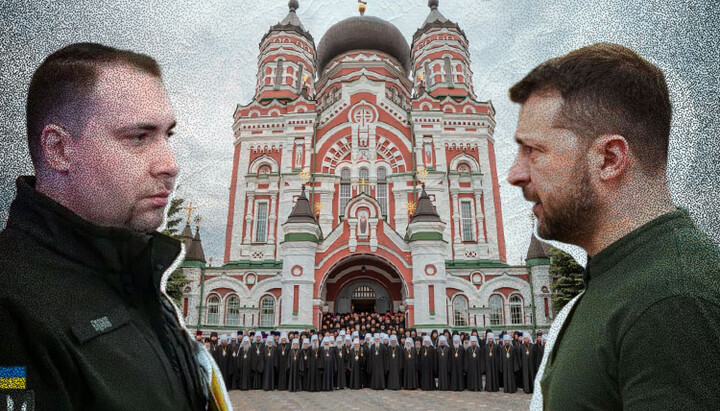
Who is lying about the UOC: Zelensky or Budanov? Photo: UOJ
On the eve of Pascha, the head of the Presidential Office Kyrylo Budanov made a sensational statement about the status of the UOC, which caused a stormy reaction among all "patriots." Responding to a journalist's question about the sluggish process of transitions to the OCU in Transcarpathia, Budanov emphasized: "When you say 'MP' (Moscow Patriarchate. – Ed.), this is manipulation. This is the UOC, they removed the 'MP' prefix. This is a fact. The fact that we need to find solutions, and not simply state that there are some problems – this is also a fact. At the same time, I want to remind you that Ukraine, like any other normal state, is separated from the Church. Therefore, give this process time, and everything will be resolved. We cannot rush here. The use of force in the spiritual sphere has never, in any state, brought results."
Budanov's statement that the "MP" prefix applied to the UOC is manipulation came as a surprise. After all, it was precisely this kind of manipulation that the country's leadership had been engaged in for nearly the last few years. Throughout this time, politicians, "experts," and public figures had been convincing our people of the exact opposite: that the UOC is indeed the "Moscow Patriarchate."
The words of such a high-ranking official are not just a dispute about the name. This is a rejection of the entire logic on which the campaign against the UOC was built: hang a label, present it as fact, and then subject it to administrative and judicial pressure. Is Ukraine's religious policy changing? It's not yet obvious.
Reaction of pseudo-patriots
It's not surprising that after such statements, a nervous reaction began in "patriotic" circles. The most telling was that of Chernivtsi religious scholar Oleksandr Brodetsky. The main argument in his angry and rather long post on Facebook was indignation that Budanov with his words "denies the validity of two professional religious studies expertises/research" by DESS, which precisely discovered ties between the UOC and Moscow.
Another religious scholar A. Sahan reposted Brodetsky's post on his Facebook and accompanied it with a caustic remark: "Visits to the Russian world Intercession (in Holosiivo) Monastery cannot but have long-term consequences."
And since Budanov's opponents appeal to the DESS expertise, let's turn to it.
DESS research
First, let's look at the team of "experts." Surprisingly, this research was conducted neither by a group of theologians, nor an independent religious studies council, and nor even an academic expert group. It was conducted by a group of DESS officials:
- First Deputy Head of DESS Viktor Voinalovych;
- Head of the Department of Religious Affairs Vyacheslav Horshkov;
- Deputy Head of this Department Victoria Kochubey;
- Head of the Department of Legal Support and Legal Analytics Vitaly Krasiy;
- Head of the Department of Administrative Services Maryna Khaustova.
There can be no talk of any real expertise. Subordinates always do what their superiors tell them. And how is Budanov's opinion as a "non-specialist" worse than the opinion of administrators or lawyers from DESS?
The next surprising moment is that DESS draws conclusions based not so much on the statutory documents of the UOC, but on the decisions and Statute of the ROC. The text of the research states that the provisions of Chapter X of the ROC Statute allegedly "are mandatory for execution" for the UOC and its Primate.
The list of sources for the research only confirms this logic of DESS:
- decisions of the Bishops' Council of the ROC;
- Statute of the ROC;
- decisions of the Holy Synod of the ROC;
- materials from the official website of the ROC patriarchia.ru.
It boggles the mind, but a state body of Ukraine, DESS, officially recognized the obligation for Ukrainian subjects of legal relations of documents adopted in the aggressor state. By this logic, should we recognize the inclusion of four regions and Crimea into the Russian Federation? After all, RF laws speak of this.
And based on all this, DESS concludes that the Kyiv Metropolis of the UOC is affiliated with the ROC.
A confirmation of the lack of validity of the DESS expert assessment can be considered the sluggish court proceedings regarding the ban of the Kyiv Metropolis of the UOC. On September 3, 2025, the Sixth Administrative Court of Appeal opened proceedings in case No. 855/11/25 on the termination of the religious organization “Kyiv Metropolis of the UOC,” and the first hearing was scheduled for September 30, 2025.
At that time, everything looked as if the state machine was confident of a quick victory and wanted to bring the case to an end as harshly as possible. But then the process noticeably stalled. The case materials are being transferred between the Sixth Court of Appeal and the Cassation Court, and there is still no substantive consideration.
In addition, on October 22, 2025, the court refused DESS interim measures, and in December 2025, the Supreme Court refused DESS an appeal against the refusal to arrest the property and accounts of the Kiev Metropolis.
From this, one can draw a cautious conclusion that the judicial system is not very eager to recognize RF documents as evidence in the case of banning the most numerous Ukrainian denomination.
What does Zelensky say?
As early as December 1, 2022, the President of Ukraine announced a course toward "spiritual independence," declared "numerous facts of connection of certain religious circles in Ukraine with the aggressor state," and reported that the NSDC instructed to submit to the Rada a bill on the impossibility of activity in Ukraine of religious organizations affiliated with centers of influence in Russia.
Here is Zelensky's quote from that time: "We will ensure full independence for our state. In particular, spiritual independence. We will never allow anyone to build an empire inside the Ukrainian soul."
In the same address, Zelensky instructed DESS to conduct an expertise of the UOC Statute for the presence of church-canonical ties with the Moscow Patriarchate.
Further, negative rhetoric toward the UOC escalated. Here are several examples.
On August 21, 2024, after a conversation with Patriarch Bartholomew, Zelensky declared: "An independent state and an independent people must also be spiritually independent. Today Moscow is losing another lever of influence on Ukraine and Ukrainians."
On August 24, 2024, in an address for Independence Day, there followed a generally crude statement: "Ukrainian Orthodoxy today takes a step toward liberation from Moscow devils." This was about the law banning the UOC adopted at that time.
In general, Zelensky’s rhetoric toward the UOC is not about religion, facts, or legal clarity. It is a rhetoric of political mobilization aimed at rallying his supporters.
And now Budanov’s remarks are being superimposed on this long-standing line. For what purpose?
What do Budanov's words about the UOC mean?
What did Budanov essentially say? In fact, he says: rely on facts rather than labels that you yourselves have attached; do not replace a complex church issue with loud political slogans; do not try to resolve by force what cannot be resolved by force; and do not rush where haste leads to the opposite result.
That is precisely why his words provoked such anger, because they are, in fact, quite obvious. But
if "UOC MP" is manipulation, then it turns out that society has been manipulated in recent years, and this was done primarily by the President of Ukraine.
Does this testify to confrontation in the corridors of power? It's not yet obvious.
The problem of unity
As early as 2022, when the authorities launched a campaign against the UOC, its hierarchs, priests, and laypeople repeatedly warned that such actions were dividing society, which is unacceptable in the context of war. The spokesperson of the UOC, Archpriest Mykola Danylevych, said these emotional words on Unity Day in 2023: “Does everything that is happening around our Church, all these attempts to ban it, to discredit it – does this really promote unity and conciliarity? This is a rhetorical question. Because Unity Day is a reminder that for 364 days we say one thing, and on one day of the year we must say that we are united. But where is our unity? We want to be united.
You understand, you constantly have to prove that you are not a camel. And that is wrong. We are being crossed out, they want to completely erase us from Ukrainian society. It has even come to the point where we are associated with Russians. ‘They took the Upper Lavra, and there are still Russians in the Lower Lavra,’ they write. They are widening these Overton windows. But how am I a Russian? I have said once, ten, twenty, thirty times that I am Ukrainian, that we are the Ukrainian Orthodox Church. No, you are Muscovites. And this is being done deliberately. Does this contribute to unity? Absolutely not. It seems to me that if I understand this, am I the only one who is so 'smart'? Don’t other people understand this?"
More than three years have passed since then, and the situation has only worsened. The persecution of the UOC has reached unprecedented levels. And suddenly, a top official began to address this issue, saying out loud that the problem of a lack of unity exists and that it is dividing society.
In February 2026, on his official Telegram channel, Budanov wrote: "This is probably the main lesson of the Russian-Ukrainian war: our strength is in unity." "We will survive only on the condition of unity and effective cooperation of the army, state, and nation."
On April 10, 2026, in an interview with "Ukrinform", the head of the Presidential Office spoke of some trigger event that requires unity. Quote: "We are now approaching again a so-called trigger event that will require unity from us. And unfortunately, if this unity is not there, there could be a catastrophe."
Finally, at the same press conference in Uzhhorod, Budanov again declared the problem of lack of unity in Ukrainian society, and that the Church's role in achieving it after the end of the war could be decisive: "The role of the Church, if not decisive, then one of the first, and maybe decisive, because almost every person in the state of Ukraine believes in God."
It turns out that Budanov's words can be perceived as a kind of signal from the authorities to themselves: now the country needs not a new church war, but maximum internal consolidation. Will this signal be heard? It's not yet obvious.
Conclusion
So which is telling the truth: Zelensky or Budanov? This question is posed in the article's title, and now it's time to answer it. But first, we need to say that these two people operate in completely different planes. Budanov – in the plane of facts, Zelensky – in the plane of political expediency, as he understands it. The logic of this "expediency" consists in the idea that if all Orthodox in Ukraine are driven into the "state-forming" OCU, then society will become united, and RF influence will disappear.
In the plane of facts and documents, Budanov is right: the UOC does not belong to the Moscow Patriarchate, does not receive governing instructions from the RF, does not spread Russian narratives in our country. The conclusions of the DESS expertise are based on documents of the aggressor country and cannot be considered adequate. The prolongation of the judicial process on the DESS lawsuit indirectly confirms this.
But Budanov's statements also say that in the plane of political expediency, Zelensky's concept is erroneous. Pressure on the UOC does not unite but divides society. And this, according to Budanov, threatens with a national catastrophe.
When life itself proves the validity of Budanov’s current statements, then, naturally, a number of questions will arise. Who exactly turned this into a manipulation of state policy? Who, for years, presented a contested political interpretation as an indisputable fact? And who will now explain why, on the basis of this interpretation, millions of Ukrainian citizens suddenly became second-class people because of their religious beliefs?
Read also
Why OCU hierarchy lacks canonical ordination: what Local Churches say
The OCU head refuses to address invalidity of his ordinations. But almost all Local Churches speak of it – even those that recognized the OCU.
Why nation-first advocates do not call for peace
Ukraine’s population is declining by nearly one million people a year, and experts are warning of the nation’s demographic extinction. Yet the leaders of the Orthodox Church of Ukraine (OCU) and the Ukrainian Greek Catholic Church (UGCC) continue to call for war and mobilization.
The deception that decided the fate of the Tomos
In 2008, the "Filaret problem" derailed Yushchenko's plan. In 2018, Poroshenko solved it in just one hour – with a police escort for the Greeks and verbal promises to Filaret.
Lawyers in the crosshairs: How UOC is being stripped of its right to defense
Activists harass UOC lawyers outside courthouses, call them “traitors” on air, and promise them a “warm welcome” at hearings. The Church’s right to a legal defense is at stake.
How to respond to persecution: Lessons from St. Silouan the Athonite
The Church can and should be defended, but without malice. Why love for persecutors is not weakness but the only way to preserve the Spirit of Christ in the midst of the struggle.
Where the Spirit of the Lord is, there is freedom
Reflections on the controversies surrounding the creation of the OCU.