How to properly observe Radonitsa and keep Paschal traditions?
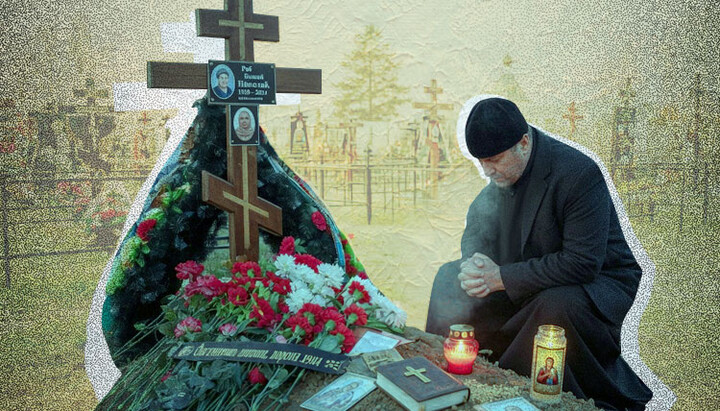
Prayer for the deceased. Photo: UOJ
– Father, on Radonitsa at Kyiv cemeteries, as everywhere else, it's simply a pilgrimage! Thousands of people, elderly and youth, in cars and on foot – practically everyone brings food and, as they say, "sets up feasts." Did all these people go to church on Radonitsa, and where does this tradition with drinking and snacks on graves come from? Doesn't this offend the memory of the departed?
– It comes from ignorance, a lack of faith, and not knowing the true meaning of Radonitsa. These are not only remnants of paganism but also of Soviet times, when people, lacking knowledge of the faith, tried in this way to honor the memory of their relatives and loved ones. From many years of experience, I know that practicing Christians do not allow anything like this.
You know, one elder used to call vodka “the blood of Satan” among drinking people. And yet people leave vodka in a glass on their relatives’ graves. What is that if not a satanic cult?
We go to the cemetery with Paschal greetings because the Resurrection of Christ signifies victory over death and prefigures the universal resurrection.
We know that with God all are alive, that there is no death. "Death, where is your sting?" the Church sings in the Paschal days. Of course, in memorial services we are united in soul with the departed, and they celebrate Pascha with us, they rejoice. This is a common joy. That's why it's called Radonitsa. On this day, praying for the deceased, we sing: "Christ is risen from the dead, trampling down death by death, and upon those in the tombs bestowing life!"
The duty of church people is to enlighten our relatives and acquaintances, to explain how to properly commemorate the departed and how to pray for them.
– Since what times has Radonitsa been celebrated?
– Already in the 4th century, Saint Ambrose of Milan recommended to the faithful that after celebrating Pascha they should share this triumph with the deceased, proclaiming to them the Resurrection of Christ. Since memorial services are not served during Bright Week, after Thomas Week it is customary to serve a parastas on the eve of Radonitsa and on Tuesday – memorial services after the Liturgy.
– But what about grief and sorrow for the dead?
– That's just the point – we cannot forget that the Lord by His Resurrection conquered death, which is especially vividly expressed in the Paschal hymns on Radonitsa. And we must bring this Paschal joy to our deceased, for God "is not the God of the dead, but of the living" (Mt. 22:32).
– Father, how was Pascha celebrated in your childhood? After all, it fell during wartime and the post-war period...
– Of course, a child's soul especially rejoices in the feast. For us children of that time, colored eggs and modest Easter breads were a joy, since those were hungry times. And in the Soviet period, when I was already a young construction engineer, the greatest joy was to make it into God's temple for Pascha. Only now do we understand that the years of persecution and various forms of oppression of believers turned out to be a kind of test of our faith. It should be said that faith was stronger; attending church was not a mere pastime, as can sometimes be seen today. Easter fell on difficult times, just as it does today. But the Lord has risen, heaven and earth rejoice, and the Paschal joy covers the whole earth. It covers those who grieve and weep, who lose hope, fall into despair, and are filled with fear and uncertainty. The Lord revives people's hearts.
My mother and grandmother told how in pre-revolutionary times the Paschal period was special, nationwide, and extraordinary. People came out after services onto the streets and exchanged the Paschal greeting, rich and poor, young and old, all rejoiced, all were like one family. People went to poor huts, went to prisons and military units. The Lord rose for everyone, and the joy was universal.
– Today non-church people go to OCU temples and don't know that these are schismatic temples, many of which were taken from us...
– I saw a report from the Kyiv Caves Lavra, which is closed to us, at Easter. A pitiful sight… You know, whoever wants will figure out where to go and why. I am confident that schism is a temporary phenomenon. The history of the Church shows that all schisms in all centuries have disappeared and dispersed like smoke. And those that somehow remained were and are a test of our faith, an examination of our faithfulness to Christ and His Church.
– Father, how should the Paschal period be properly spent?
– We must fear losing Paschal joy. You can hear: we've celebrated enough. To not lose spiritual joy, we need to attend all the services during this post-Paschal period. Each week is filled with remembrance of Gospel events from Pascha to the Ascension of the Lord. If we experience these events with our soul, then the soul itself will rejoice, because each time the Gospel word sounds anew for the attentive person, like a revelation. Such is the spiritual law. When prayer, participation in sacraments, in services are always primary and most important, all other everyday problems and difficulties become not so complex and are overcome with God's help.
Let us strive, my dear ones, not formally, but with all our heart to greet each other with the Paschal greeting: "Christ is risen! Truly He is risen!"
Read also
Honest atheism vs. spiritual hypocrisy
The 70th anniversary of Albert Camus’s Nobel Prize recalls an uncompromising challenge to Christianity. An honest unbeliever brings theology back to the mystery of the Cross.
The valley of trouble and the gateway of hope
One soldier buried an expensive cloak and some gold beneath his tent. Because of this, all Israel lost a battle. Why did one man’s sin bring disaster upon an entire nation?
From love spells to bishop's throne
Antioch’s most powerful sorcerer sent demons against a devout young Christian woman three times – and failed every time. In the end, a demon himself revealed the truth that led to his conversion.
The Weeping Queen of Blachernae
On the night of the Feast of the Protection, only two people witnessed the miracle in the Church of Blachernae. Everyone else prayed and saw nothing. Yet they, too, received grace.
Deadly spiral of human hatred
The tragedy of Lebanon's civil war lays bare how dehumanization and fear can turn human beings into monsters.
Woe to expectant mothers – or to those of little faith?
God commanded one prophet not to have children, yet told his people in exile to bear sons and daughters. What does this apparent contradiction tell us today?