A battlefield in the kitchen: the cost of family disputes over faith
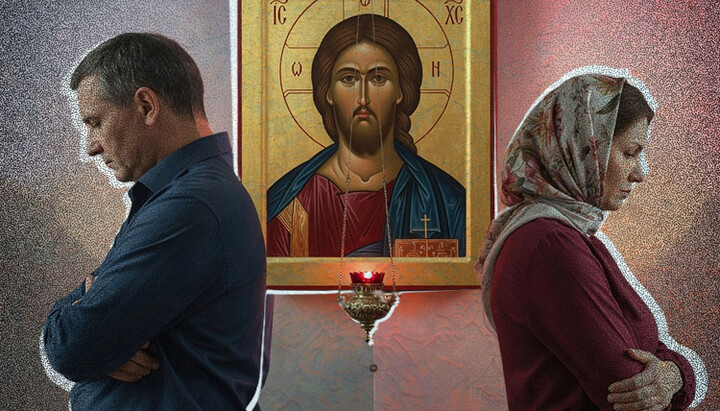
Conflict over faith. Photo: UOJ
It all begins with something small. An ordinary family dinner, with cooling tea and yesterday's pie on the table. Someone casually mentions news from church life or retells something heard in a sermon. One careless word, a momentary spark – and the cozy space of home collapses, turning into a cold trench.
The voices grow dry. We look at our mother or brother in bewilderment, almost with fear, no longer recognizing a loved one in this “ideological opponent.” In our minds, rows of arguments, canons, and dates feverishly line up. We don’t just want to object – we want to deliver a decisive blow, after which the opponent will finally acknowledge the obvious.
This happens in many homes where people seriously care about something greater than tomorrow's shopping list. In these moments, we sincerely believe we are defending truth itself. It seems to us that to stay silent now would be to betray Christ, to yield to schism, or to turn a blind eye to falsehood. But while we are desperately trying to “save” our loved one, that very person disappears from our field of vision. All that remains is a target to be struck with a quotation.
The sin of the "right" person
A believer often falls into the trap of a sense of duty. A strange conviction arises that another person’s canonical purity is my personal responsibility. We set out to explain, armed with the heavy artillery of references to authorities. At first we speak calmly, then more loudly – and when the other person digs in, we resort to personal attacks.
The tongue in such moments works faster than conscience. The Apostle James wrote about this: "Behold, how great a matter a little fire kindleth! And the tongue is a fire, a world of iniquity... it defileth the whole body, and setteth on fire the course of nature; and it is set on fire of hell" (James 3:5-6). These words are addressed precisely to us, sitting at the same table.
An argument about God in which we lose respect for our interlocutor displaces God Himself.
It is hard to imagine that Christ stands nearby and approves of our anger, even if it is directed against a "wrong" church position. Any truth spoken with malice ceases to be truth. It becomes an instrument of violence with which we try to break another's life to fit our standards.
The geometry of the circle
St. Abba Dorotheus in his "Directions on Spiritual Training" proposed an image that clarifies the situation better than any disputes. He suggested imagining the world as a circle, with God at the center. People are like radii-lines going from the edges to the center. The closer these lines approach the middle, the closer they become to each other.
In life this works as follows: the moment we push away a relative for the sake of "defending the faith," we make a movement away from the center. We move away from Christ together with all our correct arguments.
One can remain in absolute solitude with one's impeccable canonical righteousness, but in this emptiness God will no longer be present.
During the Liturgy, just before the whole church begins to sing the Creed, the deacon proclaims: “Let us love one another, that with one mind we may confess.” Love comes first here. Only as the fruit of this mutual acceptance does a common confession of faith become possible.
We often try to reverse this order, demanding that our loved ones first agree with our views, offering love only as a reward for the “right” thinking. But the Church teaches otherwise: unity of mind without love is mere party discipline, in which there is no breath of the Spirit.
The gesture of washing the feet
The Last Supper was a moment of extreme tension. Christ knew everything: both the price of Judas's betrayal, and Peter's coming denial, and that the rest would scatter. He had every reason to read the disciples a lecture about their lack of faith and mistakes. He could have analyzed in detail each one's wrong steps.
Instead, He silently took a basin of water and a towel. This gesture was the answer to everything. The washing of feet was the highest degree of care for those who at that moment least deserved it according to the logic of justice.
Christ did not prove His superiority with words. He simply served the disciples. This is a reminder that love "doth not behave itself unseemly, seeketh not her own" (1 Cor. 13:5). It does not demand immediate recognition of righteousness.
When the kitchen begins to smell of gunpowder, choosing silence is not capitulation. It is a decision not to throw dry wood into a fire capable of burning down the family.
To gain a new believer through humility is more important than winning a discussion.
The Apostle Paul advised Christians: "If it be possible, as much as lieth in you, live peaceably with all men" (Rom. 12:18). The reservation is important here: "as much as lieth in you." This means that my responsibility ends where I have done everything not to destroy peace. The rest is in God's hands and the will of the other person.
Tea instead of preaching
Priests who for years listen to confessions of people exhausted by family wars notice one pattern. As soon as one family member stops being a "domestic prosecutor" and abandons attempts to convince loved ones by force, the tension in the house subsides.
This requires enormous inner courage – to stop pressuring. It seems to us that if we fall silent, falsehood will triumph. But in reality, it is precisely the living example that triumphs. When a relative sees before them not an angry fanatic, but a peaceful loving person capable of listening and empathizing, they themselves begin to reach toward the source of this peace.
To love someone who thinks differently is perhaps the most difficult exam in life. Especially when it concerns what is sacred to us. God does not need our victories at the cost of torn family ties. He does not need "correct" words if they are spoken with foam on the lips.
At the Last Judgment we will hardly be examined on knowledge of all the subtleties of church history. But we will certainly be asked whether we saw Christ in that person who sat opposite us at the kitchen table.
If next time an argument begins to cloud your eyes, and a familiar voice begins to seem hostile, it's better to simply stop. There's no need for "final, most convincing facts." There's no need to prove that you are more informed or more spiritual. You can simply look at the person and remember that they are weak and fragile, like all of us.
Sometimes all that is required of us in that moment is simply to pour tea, and to be nearby, without insisting on immediate unity of mind. Preserving a living connection is more important than scoring a dramatic point in a theological argument. After all, it is precisely in this ability to fall silent at the right time and show tenderness that the space is born in which God can appear again.
Read also
Brother of tax collector and brother of Lord
The Gospel is silent about the son of Alphaeus, and commentators have argued for centuries over who he was. And the Church commemorates two apostles named James in close proximity.
Prayer commemorations instead of loving embraces
At every Orthodox wedding, the choir sings a hymn to the martyrs. For families separated by war, these words carry a special meaning.
Honest atheism vs. spiritual hypocrisy
The 70th anniversary of Albert Camus’s Nobel Prize recalls an uncompromising challenge to Christianity. An honest unbeliever brings theology back to the mystery of the Cross.
The valley of trouble and the gateway of hope
One soldier buried an expensive cloak and some gold beneath his tent. Because of this, all Israel lost a battle. Why did one man’s sin bring disaster upon an entire nation?
From love spells to bishop's throne
Antioch’s most powerful sorcerer sent demons against a devout young Christian woman three times – and failed every time. In the end, a demon himself revealed the truth that led to his conversion.
The Weeping Queen of Blachernae
On the night of the Feast of the Protection, only two people witnessed the miracle in the Church of Blachernae. Everyone else prayed and saw nothing. Yet they, too, received grace.