When Christ is turned into a tool
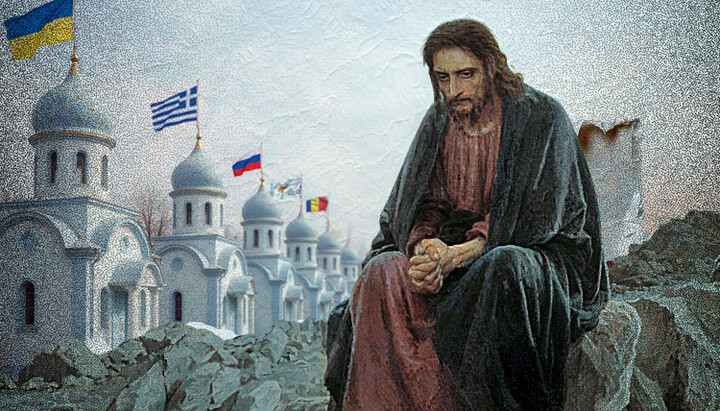
Is politics beginning to eclipse Christ in Christianity? Photo: UOJ
Why did Christ come into the world? The Apostle Paul answers plainly: “Christ Jesus came into the world to save sinners…” (1 Tim. 1:15). The Lord Himself says it differently, yet no less clearly: “For this I was born, and for this I came into the world – to bear witness to the truth…” (John 18:37).
Nowhere in the New Testament will you find even a hint that Christ came to liberate one nation from another, to secure independence for a state, to crown a revolution, or to vindicate any political system. Nowhere does He entrust such a mission to His disciples. “Go therefore and make disciples of all nations… teaching them to observe all that I have commanded you… and behold, I am with you always, to the end of the age” (Matt. 28:19–20). His Kingdom is not built by slogans, nor secured by force.
Political slogans in church rhetoric
And yet today, in the life of the Church, we increasingly see something altogether different. Sacred texts, Gospel images, the Cross and Golgotha are being drawn into the orbit of national mobilization, military rhetoric, and historical self-assertion. In January 2026, for example, the Synod of the Church of Cyprus inserted new troparia into the Lamentations of Great Saturday – prayers for the liberation of the homeland and the expulsion of occupying forces.
Into the most sacred words, dear to every believing heart – words in which the Crucified Christ is mourned – there suddenly intrude appeals “to rise swiftly and break the chains of slavery that bind Cyprus,” and “to behold freedom from the descendants of Hagar.” Of course, praying for the liberation of one’s homeland is not forbidden. But why do so at the most tragic moment in human history, when “He who hung the earth upon the waters hangs upon the Tree”? Does such “innovation” not come dangerously close to sacrilege?
Do not texts that compare “Thy three-day Resurrection” with “the resurrection of the Cypriot fatherland” sound perilously like blasphemy?
Undoubtedly, the liberation of territories from invaders is important. But how can it be placed on the same plane as the Resurrection of the Savior of the world – the One who conquered death and opened the path to eternity for every human being? How can such things even be compared?
And yet – they are.
In Ukraine, we have already grown accustomed to the slogan: “Christ is risen – Ukraine will rise!” It resounds today at nearly every religious and state occasion. But we were taken aback to hear it from the Ecumenical Patriarch himself. In February 2025, in the Church of St. Nicholas in Jibali, he declared: “As Christ’s Passion is followed by His Resurrection, so we believe that Ukraine will rise.”
And it was not Patriarch Bartholomew who first coined this.
One may recall the long-standing rhetoric of the head of the UGCC, Sviatoslav Shevchuk, who draws a direct parallel between the deaths of Euromaidan activists and the Passion of Christ: “The meaning of the Paschal sacrifice of the Revolution of Dignity will be revealed ever more deeply.” He calls their deaths “life-giving” and names the place where they were killed by unknown snipers as a “Ukrainian Golgotha.”
Such parallels continue even today. In one Lviv church, the Epitaphios bearing the image of Christ was surrounded by an “iconostasis” of portraits of fallen soldiers, with a children’s honor guard placed nearby. In another, a militarized performance was staged around the Shroud: children in embroidered shirts, camouflage trousers, and combat boots marched in formation before it and back again.
In a church of the OCU in Podilsk, Odesa region, while blessing Paschal baskets, a cleric shouted in the same breath: “Ukraine above all!” and “Christ is risen!”
In the official “Prayer for Holy Rus’” of the ROC, we hear: “Those who desire war have risen against Holy Rus’, seeking to divide and destroy her one people… Arise, O God, in help of Thy people and grant us victory by Thy power.”
And these are only a few examples.
A substitution of meaning
The Church has every right to pray for peace, for the fallen, for the suffering, for the imprisoned, for its people. There is nothing reprehensible in this. But when Christ ceases to be the Savior of the world and becomes a symbolic resource for political narratives – even ones that seem just and understandable – a dangerous substitution of meaning takes place.
Pascha comes to signify not so much Christ’s victory over death as the “resurrection of the nation.” Golgotha and Christ’s descent into hell on Great Saturday are reinterpreted not so much as the mystery of our salvation as images of national trauma. The temple becomes a space for the expression of collective historical emotion.
The problem is not love for one’s people or one’s country. A Christian may and must love his people. The problem lies elsewhere: Christ ceases to be the end and becomes the means. It is no longer the people who are led to Christ – Christ is pressed into service for the people, for the state, for historical pain, for political will. This substitution may appear devout, but that only makes it more dangerous.
If we dig deeper
If we look deeper still, we see how church leaders – those called to teach what Christ commanded – are shaping the consciousness of people in an entirely different direction. The Gospel teaches that the central tragedy of every human being, and of humanity as a whole, is the Fall and the estrangement from God. But the examples above compel people to see the tragedy elsewhere: in war, in occupation, in national humiliation, in the deaths on the Euromaidan, and so on.
The Fall is not denied – but the emphasis shifts dangerously. And this is understandable: the Fall happened long ago, whereas war, occupation, and national suffering are wounds that bleed today. Yet by focusing on these, church leaders push the Gospel’s meaning into the background, replacing it with tragedies that are immediate, visible, and emotionally overwhelming.
Scripture tells us that our true enemy is our sinful passions, that our true struggle is “against principalities, against powers, against the rulers of the darkness of this age, against spiritual hosts of wickedness in the heavenly places” (Eph. 6:12). But instead, we are taught to see the enemy as another human being – one who differs from us in faith, nationality, or political convictions.
Yes, one who comes with weapons, destroys homes, and kills civilians is rightly called an enemy. But we are speaking here of the rhetoric and actions of clergy – heirs of the apostles. For them, the enemy must прежде всего belong to the spiritual realm: the devil, demons, the powers of darkness. Priests are called to teach what Christ taught – not what happens to be deemed correct by the political moment.
The Christian’s ultimate hope is salvation and eternal life with God. Yet the narratives described above direct people’s hope toward the historical success of their nation. It is closer, more tangible, more contemporary.
Unfortunately, this is not new
In essence, there is nothing new here.
Two thousand years ago, people expected the Messiah to solve their earthly problems: to restore the Jewish kingdom, to free them from Roman occupation, and so on. Christ deliberately refused to do this – and for that reason, He proved to be “not the one” they were waiting for.
Blessed Augustine asked: “Why did He withdraw when He learned that they wanted to seize Him and make Him king?” And he answered: because the crowd wished to force Him into becoming the ruler of an earthly kingdom.
Already then, people – and above all religious leaders – sought to make Christ convenient, expected, politically useful. But Christ did not meet their expectations. He did not lead a liberation movement. He did not turn religion into an instrument of earthly revenge. He did not subordinate His mission to the demands of the historical moment. “My Kingdom is not of this world… My Kingdom is not from here” (John 18:36), He told Pilate when asked whether He was a king.
The Christ who gets in the way
History repeats itself. Just as two thousand years ago Christ was unwanted by those dominated by national consciousness, so it is today. Does the real, living Christ fit into narratives of victory in war, support for revolutions, liberation of territories, restoration of historical justice? Do His calls to forgiveness, meekness, and love for enemies fit into all this?
No – Christ stands in the way.
In The Brothers Karamazov, Feodor Dostoevsky places on the lips of the Grand Inquisitor these words: “Why have You come to hinder us? For You have come to hinder us…” There is no more precise formulation.
The true Christ always stands in the way of those who want to make religion convenient. He stands in the way of turning the temple into a space of sacred national self-assertion. He stands in the way of vengeance. He stands in the way of hatred. He stands in the way of “restoring historical justice” by force of arms.
Conclusion
And so it becomes easier to keep Him as a symbol – a slogan, a Paschal metaphor, a national emblem. Many do precisely this. The Church does not cease to be the Church when it weeps with its people, prays for peace, and shows compassion. It begins to lose itself when, instead of leading the people to Christ, it begins to reshape Christ to fit the demands of the moment.
When Christ is used, it is no longer service to Him – it is betrayal.
Using Christ as a symbol is easy. Following Christ is hard.
And it is precisely to this difficult path that the Church must call and be called.
Read also
The deception that decided the fate of the Tomos
In 2008, the "Filaret problem" derailed Yushchenko's plan. In 2018, Poroshenko solved it in just one hour – with a police escort for the Greeks and verbal promises to Filaret.
Lawyers in the crosshairs: How UOC is being stripped of its right to defense
Activists harass UOC lawyers outside courthouses, call them “traitors” on air, and promise them a “warm welcome” at hearings. The Church’s right to a legal defense is at stake.
How to respond to persecution: Lessons from St. Silouan the Athonite
The Church can and should be defended, but without malice. Why love for persecutors is not weakness but the only way to preserve the Spirit of Christ in the midst of the struggle.
Where the Spirit of the Lord is, there is freedom
Reflections on the controversies surrounding the creation of the OCU.
Pentarchy with Rome: A return to the roots or a new schism?
Patriarch Bartholomew wants to revive a council of five patriarchates, including Rome. What would reunion with Catholics look like, and what role would be left for the other Churches?
Concubine or daughter? On words that cannot be used about the Church
An archon of the Church of Constantinople likened the UOC to Moscow’s “concubine.” But for St. Epiphanius of Cyprus, “concubines” are heresies.