Prayer service on a stool and a revived church: in memory of Fr. Feodor Sheremeta
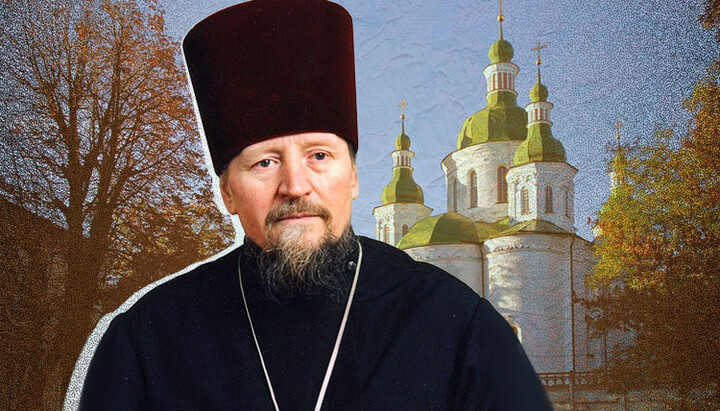
Archpriest Feodor Sheremeta. Photo: UOJ
Books should be written and films made about people like Father Feodor. They inspire one to learn selfless service to Christ, faith, and that tireless energy with which they labor for the good of the Church. The holy Psalmist David sang of such people: “The righteous shall flourish like the palm tree; he shall grow like a cedar in Lebanon” (Psalm 91:13).
Encounter in the year of the millennium of Rus' Baptism
I recall 1988, the year of the millennium of the Baptism of Rus'. I, then still a young Soviet journalist, was taking my first steps in the Church and tried to listen to the advice of experienced parishioners. They explained the main thing to me: in church life, one needs a spiritual father.
At that time, at the Intercession Monastery there served a gray-haired war veteran, Archpriest Mikhail Boyko, well known throughout Kyiv. There was always a huge line for confession to him, and I, a neophyte, also decided to go to him. But the elderly nun Polyxenia from the candle shop (now reposed), having given me an old Psalter and a Gospel, advised me to turn to the 46-year-old Archpriest Feodor Sheremeta instead. She explained that Father Mikhail was already overwhelmed with people, while Father Feodor was a wonderful, experienced pastor, a Candidate of Theology, and a lecturer at the Kyiv Theological Seminary, which had only just reopened after the Khrushchev persecutions.
Having gone to confession to Father Feodor, I asked him to become my spiritual father. He modestly objected, noting that Father Mikhail was far more experienced than him. But I insisted on my choice. Thus was born our spiritual connection, which lasted 23 years, right up to his repose. However, it continues even now, simply having passed into another dimension.
It was by his blessing that I began to write about the life of the Church: first in secular media, and then, by God's will, organizing and heading the first official newspaper of the UOC in 1989.
- Times are changing, Sergiy, Father Feodor said then. Favorable but difficult hours are coming. The Church must be defended, and people must be enlightened.
Prayer services in the courtyard of a psychiatric hospital
The beginning of the turbulent 1990s. A group of believers registers the St. Cyril community. Its territory is the vast Pavlov Psychiatric Hospital. There is no church, nor even a suitable помещение. The famous 12th-century St. Cyril’s Church, with frescoes by Vrubel, was under the strict control of the “Sophia of Kyiv” museum.
At that time, none of the Kyiv clergy dared to go there. Only Father Feodor responded. He began his ministry in the courtyard of “Pavlovka,” right by the hospital buildings. He would set up an ordinary stool and serve prayer services for health. I remember how patients walking along the alleys of the clinic would curiously gather around the priest, touch his cassock, and ask:
- Are you a real priest?
Having received a cross or icon from Father Feodor's hands, they would walk away satisfied. From these molebens by the hospital walls began many years of work to create an amazing parish, which over time grew into a men's monastery.
From hospital laundry to monastery
Father Feodor went to the chief physician of the clinic and managed to secure his support. Soon the community was given the building of the old hospital club, where before the revolution (when the clinic was an almshouse for wounded soldiers) a laundry was located.
You should have seen the priest in those days! From morning till evening, with a team of helpers and construction tools in hand, he labored at the site. Truckloads of rubbish were hauled out of the basements. Later the sacristy was placed there. The assembly hall was converted into a church: the roof was dismantled and rebuilt, a dome was erected, windows were opened up, new floors were laid, heating was installed, and an iconostasis was set in place. Only the walls remained of the old building. Thus a new church, dedicated to St. Basil the Great, began to shine in all its splendor.
Under the priest's leadership, in another abandoned building they built a spacious refectory, kitchen, and newspaper editorial office. The sisterhood "Joy and Consolation" was also established there, which to this day cares for patients in 24 departments of the clinic. And on the upper level of the hospital, by the oak grove and ancient cemetery, appeared a little "hermitage" - a residential building with a garden, vegetable plot, and apiary.
Father Feodor literally lived at the parish. For more than a year he slept in a tiny basement room under the church. Having studied the history of St. Cyril's Monastery (where young Dimitry of Rostov once labored and where his parents were buried), abolished by Catherine II, the priest was absolutely certain: after 200 years the monastery should be revived.
Parish services followed the strict monastic rule, and at the litanies prayer was always offered "for this monastery." And his faith bore fruit: soon after Father Feodor's death, by decision of the Synod of the UOC, a men's monastery was officially established here.
Ancient church and fraternal meal
A special page in Father Feodor's life was his struggle for the return of prayer to the ancient St. Cyril's Church. The priest and his helpers went to the mayor of Kyiv as if to work, sitting for hours in reception rooms. And he achieved his goal! An agreement was concluded with the museum for joint use of the church. In the altar, where cast-iron radiators stood right on the site of the altar table, they installed a beautiful altar table brought from abroad. Services in these ancient walls were so elevated that it seemed we were transported to the times of the Venerable Caves Fathers. Today the ancient church is seized by the OCU, and the monks serve only in the Basilica Church, but the monastery, through the prayers of its restorer, continues to live.
Father Feodor was a man of extraordinary spiritual warmth. I remember how, on the eve of Sunday, he would sit with his driver (now Archpriest Bohdan) in an old Škoda and go to the shop to buy fish for the parish. And after the liturgy, he would approach everyone who had served in the altar and gently remind them:
- Be sure to go to the meal. The fraternal meal is a continuation of prayer!
And most of the parishioners would go to have lunch together, because the priest received everyone with great fatherly love.
Today, many priests and parish rectors, who grew up under Father Feodor’s care, whom he brought up and gave a start in life, serve in Kyiv.
In his final years, he bore a heavy cross of illness. Due to complications of diabetes, he had toes amputated. But he did not give up: he continued to serve, hear confessions, and receive people.
The elder reposed on May 1, 2011, in his 70th year of life. He was buried on the territory of the ancient monastery, to whose revival he devoted 19 years of his life.
Eternal memory to you, our dear father and mentor!
Read also
Weeping Queen at Blachernae
В ночь Покрова чудо во Влахернском храме видели только двое. Все остальные молились и не видели ничего. Но благодать досталась и им.
Deadly spiral of human hatred
The tragedy of Lebanon's civil war lays bare how dehumanization and fear can turn human beings into monsters.
Woe to expectant mothers – or to those of little faith?
God commanded one prophet not to have children, yet told his people in exile to bear sons and daughters. What does this apparent contradiction tell us today?
The help God never asked for
Uzzah wanted only to keep the Ark of the Covenant from falling into the dust. Why did this well-intentioned act cost him his life, and who was really responsible for his death?
Freedom begins when there's nothing left to take
Fear of persecutors takes root in our attachment to possessions. We turn to St. Basil the Great to understand why the prefect's threats held no power over him.
The bride in the window frame
The author of the earliest account of St. Thecla’s life was defrocked. Yet it was his book that preserved the only ancient description of the Apostle Paul’s appearance.