Why do we turn to the saints if God hears us directly?
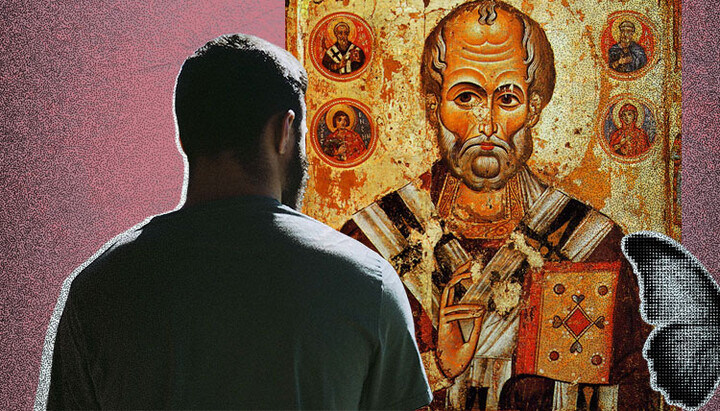
Prayer to the saints. Photo: UOJ
To many, it seems that Heaven is arranged like a government office. God cannot be reached directly, so one has to file a petition with the relevant ministry – to St. Nicholas for travel matters, to St. Tatiana for student concerns, to Blessed Matrona or the Great Martyr Panteleimon for health.
If God is all-powerful and hears every word, why do we need intermediaries, long lists of names, troparia, akathists? Why not simply tell God everything without witnesses? The answer to this question is not found in canons; it lies in the realm of our spiritual life.
God is not a president
The habit of projecting earthly bureaucracy onto Heaven is remarkably stubborn. The state has taught us: you cannot get through to the head of state; first comes the office, then the clerk, then the deputy minister, while the president himself is far away and unreachable. And so a person leaves the passport office and enters a church – and inside, the same mechanism is already at work. “I will never get through to God; He is too busy. I’ll pray to St. Nicholas – he handles these matters.”
But God is not busy with detached management of galaxies.
Any clerk at a district clinic is obliged to accept our paperwork – while God attends to each of us continuously, with a fullness of attention that not even any mother possesses.
He has no queue and no office hours. His door is always open. So why, then, do we need the saints?
The lesson of Cana of Galilee
The answer comes in the scene of a village wedding in Cana of Galilee. A poor family. In the middle of the feast, the hosts run out of wine, and a simple human shame appears: there is nothing left to pour for the guests. And then the Mother of God says to Her Son: “They have no wine” (John 2:3).
What follows is strange. Christ replies: “My hour has not yet come” (John 2:4). In other words, this miracle was not part of His messianic plans. And yet He performs it. Why? Because His Mother asked Him.
Not because God did not know – He knows all things. But because the love of a righteous heart for people caught in embarrassment, according to the experience of the Church, is able to enter into God’s plans and draw a miracle after it.
God responds to the compassion of the Mother of God and does what, it seems, He had not intended to do.
This is the simple key. It matters to God that love should flow between people. And He is ready to work miracles in response to that current of love.
The faith of friends
The house in Capernaum where Christ was teaching was packed full – there was no way in, neither through the door nor through a window. Four men brought their paralyzed friend on a stretcher and saw that they could not enter. Then they did something astonishing: they climbed onto the roof, tore it open, and lowered the stretcher right down before the Teacher.
“And when Jesus saw their faith, He said to the paralytic, ‘Son, your sins are forgiven you’” (Mark 2:5). Not “seeing his faith.” Seeing their faith – the faith of the four men who carried their friend in their arms and tore open someone else’s roof.
The paralyzed man could not believe – most likely, he lay there in despair. His friends believed. And Christ healed him because they did not give up.
The saints are those very friends who hold our stretcher when we ourselves lie paralyzed.
We have no strength to rise toward God; perhaps we do not even have faith. But they believe for us. And their faith often has greater weight precisely when we are powerless.
The antimension and relics
In the first centuries, Christians hid in the catacombs of Rome. They celebrated the Liturgy underground, in corridors where niches had been carved into the walls for the bodies of murdered martyrs. And here is the astonishing thing: the first Christians consciously chose the stone tomb of a martyr for the Eucharist. They served on it, turning the burial slab into an altar.
The first Christians did this because they believed that the martyr beneath the altar was there beside them and shared in the Table. The wall between the world of the living and the world of the departed, which seems impenetrable to us, was for them as permeable as vapor.
This tradition is alive today. Every Orthodox antimension – the rectangular cloth on which the Liturgy is celebrated – contains a sewn-in particle of a martyr’s relics. Without it, the Eucharist cannot be served.
In every church where a service is taking place, beside the Holy Table lies a tiny fragment of bone from a person who gave his life for Christ. It is there as a sign of the holy martyr’s presence at that service and of his spiritual communion with us.
This is called koinonia – communion, fellowship, participation. It is the word the New Testament uses to describe the Church as a living organism with one circulatory system. And in that system there is no boundary between the living and the departed.
The icon as a window into Heaven
In the iconographic tradition, saints are always depicted facing forward or slightly turned – so that their eyes can meet the eyes of the one praying. Demons, executioners, and Judas are painted in profile, with only one eye and half the face visible. The refusal to look into the eyes in iconography is a refusal of communion. The saint is always turned toward us. An icon is, from the beginning, made as a window for a two-way conversation.
As St. Silouan the Athonite said, in Heaven everything lives and moves by the Holy Spirit. But on earth, too, there is that same Holy Spirit: He lives in our Church, in the Sacraments, in Scripture, in the souls of believers. The Holy Spirit unites everyone – and therefore the saints are close to us. According to the elder’s testimony, when we pray to them, they hear our prayers in the Holy Spirit, and our souls feel that they are praying for us.
This is the experience of St. Silouan, who spent years praying at night in his Athonite cell. And it is the experience of anyone who, even once, has asked with childlike simplicity a departed, God-loving grandmother: “Grandma, pray for us” – and then received in response an inexplicable warmth in the heart, as though one had spoken with a beloved person face to face.
A hand in the darkness
Psychologists observe that modern people have thousands of “friends” on social media, instant access to any corner of the world – and yet an unprecedented loneliness. When things become truly frightening, it turns out there is no one to call.
Christianity insists: the closest, most empathetic, and most unfailing friends are those who died centuries ago. They prove more real and nearer than the contacts in a smartphone, and they have no connection problems.
When you are sitting in a cold basement during an air raid alert, there are things others do for us: air defense protects the sky, rescuers are ready to go out at any moment, neighbors are anxious nearby. But in those moments, you need something else as well: for someone on the bench simply to take your hand. Simply to place a warm palm over yours, giving you hope.
When we pray to the saints, we ask for the support of family. God is already with us. But God has made us, together with the saints, one great family. And in a family, when one person is suffering, the others come near, place a hand on the shoulder, and stand beside them. Silently. Simply so that we know: we are not orphans.
Read also
Prayer commemorations instead of loving embraces
At every Orthodox wedding, the choir sings a hymn to the martyrs. For families separated by war, these words carry a special meaning.
Honest atheism vs. spiritual hypocrisy
The 70th anniversary of Albert Camus’s Nobel Prize recalls an uncompromising challenge to Christianity. An honest unbeliever brings theology back to the mystery of the Cross.
The valley of trouble and the gateway of hope
One soldier buried an expensive cloak and some gold beneath his tent. Because of this, all Israel lost a battle. Why did one man’s sin bring disaster upon an entire nation?
From love spells to bishop's throne
Antioch’s most powerful sorcerer sent demons against a devout young Christian woman three times – and failed every time. In the end, a demon himself revealed the truth that led to his conversion.
The Weeping Queen of Blachernae
On the night of the Feast of the Protection, only two people witnessed the miracle in the Church of Blachernae. Everyone else prayed and saw nothing. Yet they, too, received grace.
Deadly spiral of human hatred
The tragedy of Lebanon's civil war lays bare how dehumanization and fear can turn human beings into monsters.