Spiritual blindness and the cost of true freedom
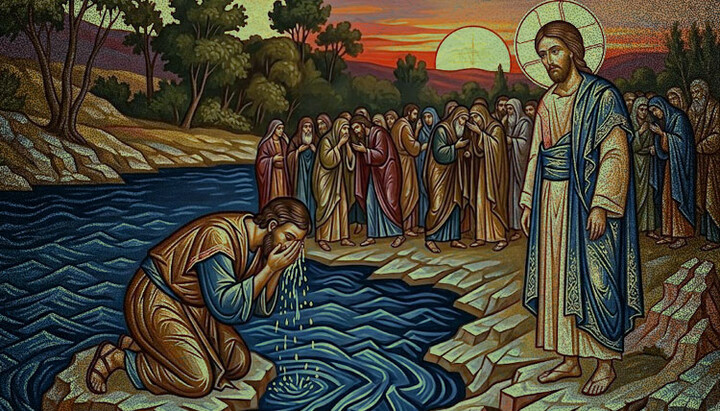
The healing of the man born blind. Photo: UOJ
The Gospel narrative of the man born blind is not merely an evangelical account of a miracle that took place. It is a metaphysical mirror placed before humanity. At the center of the drama is a radical contrast: physical blindness that became a conduit for Divine Light, and physical sight that turned into spiritual paralysis.
Society's fear and absolute freedom
The fearlessness of the healed man is the fruit of his ontological nakedness. The one who received sight fears nothing because he has just gained everything he wanted. His parents, on the contrary, embody the "cowardice of the sighted." Their gaze is fixed on social structures, on the "synagogue" and the fear of exclusion. For them, the world is a system of threats; for the healed man, the world is the radiance of Christ. Here lies the boundary between the religion of fear and faith as a form of absolute freedom.
The parents of the healed man, possessing biological vision, remain in the dungeon of social conformism. Their trembling before the "synagogue" is the fear of losing earthly status, which proves more precious than Truth. The healed man, on the contrary, becomes an ironic "philosopher of the spirit." He does not merely believe – he knows, and this knowledge makes him invulnerable to judges. His question "Do you also want to become His disciples?" is the voice of freedom, which always seems like madness to those who are chained by their fears.
In Orthodox understanding, dispassion is not psychological callousness. It is a state of ultimate centeredness on God.
When a person is troubled by the imperfections of the Church's earthly enclosure, they reveal their inner disunity. True courage is the recognition that salvation is accomplished not in ideal conditions, but in the "crucible of sorrows" within the holy Church. The dispassionate soul does not seek "comfortable Orthodoxy"; it goes straight, knowing that Christ is not the external decoration of our life but its Cornerstone.
Three keys of spiritual sobriety
The path to acquiring grace lies through strict asceticism of attention and "hygiene of consciousness." Patristic teaching offers us three fundamental keys to the practice of sobriety.
- Cardiocentrism (attention in the spiritual heart) – the spiritual heart is not an organ of emotions but a point of contact between the human and the Divine. Outside the heart, any theology turns into mental acrobatics and intellectual conviction.
- Prayerful vector of the mind – a mind not attached to prayer is like the prodigal son, squandering life's energy on "citizenship" in a foreign country.
- Spiritual immunity (struggle with thoughts) – mental chatter is the entropy of the spirit, a "conversation with the devil," where a person voluntarily rents out his inner space to chaos. It is important to understand: we struggle not with thoughts, but for the purity of God's presence. Trying to defeat each thought individually means multiplying them. The only way out is radical renunciation: not to argue with darkness but to be rooted in Light.
Living theology against empty knowledge
There is a huge chasm between academic theology and the experience of knowing God. An abundance of knowledge without the skill of humility is a "heavy burden" that drags the soul to the bottom of pride. A well-read but graceless Christian risks becoming an "Orthodox dictator" or an arrogant intellectual. One who has neither knowledge nor grace becomes a slave to superstitions.
True theology is written with the "dew of the Holy Spirit" and is born in silence.
Genuine knowledge of God is not a sum of theses, but a thirst that transforms into a persistent search for paths of salvation. Purity of heart here is not moralizing, but a state of spiritual transparency. Without "wings of the spirit," our desires are doomed to the gravity of earthly torments.
Sorrows open the path to Light
We live in a world of earthly ordeals, where vanity is the convulsions of fear in the struggle for survival. It blinds us, hiding the "dispassionate face of eternity." Sorrows in this coordinate system are not punishment, but a gift of awakening that destroys the illusion of our self-sufficiency.
The ultimate goal of the earthly path is rooting in love. Love is a mystery in which all words cease.
When Christ heals our "intelligent eyes," we discover that our entire path, full of pain and doubts, was a path of God's tender care for our salvation. Every temptation was not an obstacle but a step; every tear was a drop that purified our vision. And in this light, we, like the Gospel blind man, acquire the ability not just to look but to see the infinite wisdom of God.
Thus, true enlightenment is not a final stop but only the threshold of a genuine event. The healing of physical eyes was a means so that a person could bear the radiance of the Face. In the finale of the drama of the Gospel Sunday reading, when all disputes fall silent, the healed man pronounces the highest formula of human existence: "I believe, Lord!" and worships Him.
In this gesture is the limit of metaphysics and the beginning of Life. Here ends the "theology of the mind" and begins the "theology of presence."
To find oneself face to Face with the Source of Light means to realize that all our long wandering in darkness was only preparation for this single moment. In this contemplation, fear is finally consumed in the fire of Divine love, and social conformism crumbles to dust before the majesty of eternity.
May our vision, purified by the asceticism of attention and washed by tears of humility, not become for us a cause for pride but serve as a window into the Unwaning Light. For ultimately, what matters is not how much we have learned about God, but whether God has recognized His features in us. To receive sight means to see Him not in book lines but in the depth of one's own heart, which has become the throne of the Living Christ. And in this silent standing before Him, we finally find rest in the One who is the Way, the Truth, and the Life.
Read also
Drinking priest, or the flip side of parish life
In his epistle, the Apostle Jude describes a scene familiar to anyone who has seen a church meal turn into a drinking party.
A lesson from a speechless donkey
The famous seer struck his donkey three times for refusing to go forward. All the while, she was saving his life – and seeing what he could not.
The time when the soul ripens
Modern society has turned youth into a cult and old age into a period of merely “living out one’s days.” The Christian perspective reveals the profound spiritual meaning of our later years.
Faith is not a checker piece in a spectator sport
Arguments about faith on social media increasingly resemble no-holds-barred fights. We turn to a saint who, sixteen centuries ago, knew how to speak to those interested only in turning theology into a combat arena.
The metropolitan who fought with a pen
St. Cyprian of Kyiv was robbed, expelled, and barred from his see. He answered with letters, books, and canons – and before his death, forgave everyone.
Loneliness under one roof
Spouses can share a home for years, raise children, and faithfully attend church – yet remain strangers to each other.