A mirror over the icon: the trap of “proper” piety
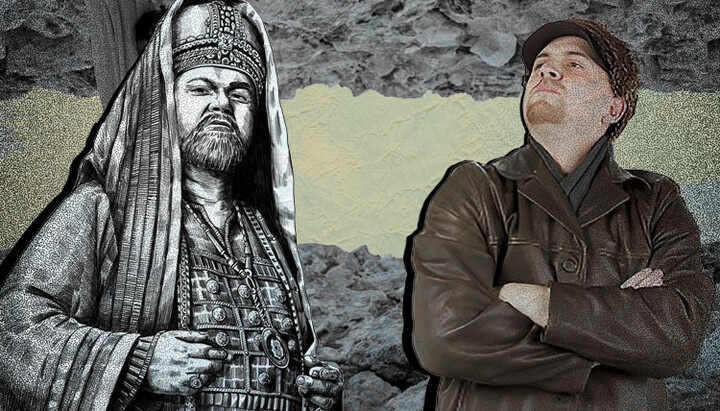
Ancient and Modern Pharisaism. Photo: UOJ
We are all unbearably tired. Nighttime sirens, checkpoints, news that makes our breath catch every morning. When the world we knew is collapsing before our eyes, the instinct of self-preservation demands that we find at least some point of support. For us, that support has traditionally been the church, the morning prayer rule, the familiar order of services. We cling to the prayer book and the fasting calendar like handrails in a falling train carriage.
And here, in this frantic attempt to preserve our inner balance, something strange happens.
Immersed in saving piety, we may miss the moment when the focus quietly shifts.
In the Gospel of Luke there is the parable of the publican and the Pharisee. Hidden in the original Greek text is a detail softened by the Synodal translation. Describing the Pharisee’s prayer, the translators offer a gentle phrase: “he prayed thus with himself.” But if the construction is rendered literally, a terrifying picture emerges: standing there, he “prayed to himself.”
A man comes to the holiest place, stands before the altar – and in his mind takes out a mirror, places it directly over the icon, and begins gazing intently at himself. At his correct posture, his disciplined fast, his own blamelessness.
Someone else’s child in our museum
We stand in church, trying to gather our thoughts, and suddenly somewhere behind us a child begins to cry loudly. Or someone awkwardly drops a candle onto the stone floor. Or a confused first-time visitor asks too loudly at the candle desk where to place a candle for the departed. Let us remember that wave of irritation rising inside us, that heavy, scanning look with which we sweep over the child’s mother.
Let us honestly ask ourselves in that moment: are we really defending the silence of the divine service? Or are we angry because someone has dared to break into our carefully curated museum of spirituality? Because someone has disrupted our beautiful standing before God?
St. Ignatius Brianchaninov, in his Ascetic Experiences, called this condition “the delusion of opinion.” It is a quiet but deadly illness.
A person does not see angels in dreams or hear demonic voices – he exalts the importance of his own prayer, believes in his own exceptionalism, and that belief becomes more important than the One to Whom the prayer is addressed.
Now, when churches are being closed, when alien locks appear on familiar doors, this substitution feels especially painful. Standing outside, it is easy to withdraw into a deafened defensiveness. To tell oneself: “We are freezing here because we are the true confessors, while everyone around us is lukewarm and treacherous.” That thought comes almost imperceptibly. And behind it stands not repentance, but a sense of superiority that turns tragedy into a pedestal.
The caltrop and counterfeit humility
The problem is that our ego can adapt to anything. St. John Climacus has a striking and precise image – the tribolos, an ancient military caltrop thrown under horses’ hooves on the road. However it falls, one sharp spike always points upward.
Vainglory works the same way. Climacus wrote about it simply: I fast – and become vain; I break the fast so that no one notices my abstinence – and become vain about my wisdom; I dress elegantly – and am conquered by pride; I put on old clothes – and become even prouder.
C.S. Lewis, in The Screwtape Letters, showed the same survival mechanism of pride. An experienced demon advises catching a person precisely at the moment of humility, of poverty of spirit, smuggling in the thought: “Look how humble you have become.” And if the person comes to his senses and tries to suppress that pride, the demon must make him proud even of that effort.
We see this everywhere. Believers post aesthetic photos on social media of an open prayer book beside a cup of coffee, accompanied by meaningful texts about the sorrows of our time.
Mother Maria Skobtsova spoke of spiritual egocentrism – a state in which we read our rules and stand through services solely to feed our own righteousness. A person seems to be acquiring grace, yet keeps it entirely for himself, becoming utterly deaf to the pain of those living just beyond his wall.
Rebellion before the mirror
Sometimes we do notice this falsehood. We grow tired of our own “correctness,” see that we have become icy – and then make a sharp turn. We begin ostentatiously breaking the fasts, abandon the morning prayer rule, allow ourselves biting sarcasm. And we say defiantly: “At least I am honest. I am who I am, not a hypocrite.”
But if we look more closely, the mirror has not gone anywhere. We have simply changed our pose before it. Yesterday we admired our strictness; today we admire our audacity. In the end, we are still looking only at ourselves.
The church rule, long services, dietary restrictions – these are not the cause of Pharisaism. They are scaffolding, tools for spiritual growth.
Today, when the familiar supports are giving way beneath our feet, our piety is tested by simple things. A neighbor’s house has been damaged by shelling; a relative is panicking over draft notices and cannot pull himself together; a teenager is terrified by drones flying overhead – how do we treat them? What do we do for them?
We have learned to live without milk and meat, we know how to fold our hands for a blessing, and we know when to make prostrations. But when was the last time we looked at the person beside us not as an irritating obstacle to our “regimen of piety,” but as Christ Himself?
Read also
Weeping Queen at Blachernae
On the night of the Feast of the Intercession of the Mother of God, only two people witnessed the miracle in the Church of Blachernae. Everyone else was praying and saw nothing. Yet the grace was bestowed upon them, too.
Deadly spiral of human hatred
The tragedy of Lebanon's civil war lays bare how dehumanization and fear can turn human beings into monsters.
Woe to expectant mothers – or to those of little faith?
God commanded one prophet not to have children, yet told his people in exile to bear sons and daughters. What does this apparent contradiction tell us today?
The help God never asked for
Uzzah wanted only to keep the Ark of the Covenant from falling into the dust. Why did this well-intentioned act cost him his life, and who was really responsible for his death?
Freedom begins when there's nothing left to take
Fear of persecutors takes root in our attachment to possessions. We turn to St. Basil the Great to understand why the prefect's threats held no power over him.
The bride in the window frame
The author of the earliest account of St. Thecla’s life was defrocked. Yet it was his book that preserved the only ancient description of the Apostle Paul’s appearance.