Reservation via renunciation: How UOC clergy are being driven into a trap
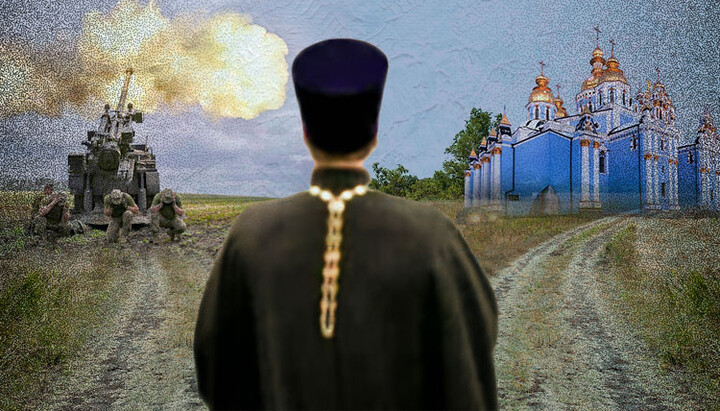
The authorities are offering UOC clergy a choice: lose your life – or lose your conscience. Photo: UOJ
The situation surrounding the mobilization of UOC clergy has long since ceased to be a dispute over wording, statutes, and registries. This is no longer dry legal casuistry debated in government offices. It has become an open and ruthless crackdown on those deemed undesirable.
In early May, on the Rivne–Lutsk highway, military recruitment officers stopped a vehicle carrying Metropolitan Volodymyr of Volodymyr-Volynskyi and Kovel, diocesan secretary Archpriest Oleksandr Kobenko, and Deacon Dmytro Manetskyi. The clergymen possessed documents granting deferment from mobilization, and the metropolitan himself had been removed from military registration on health grounds. Nevertheless, the officers violently dragged them from the vehicle, sprayed gas, insulted the hierarch, beat Fr. Oleksandr, and behaved with extreme aggression.
This is far from an isolated case. Another example: on February 11, 2026, in Chernivtsi, military recruitment officers attempted to detain Bishop Nykyta of Ivano-Frankivsk while he was on his way to a divine service. The bishop’s car was escorted by police vehicles, and His Grace was forced to seek refuge inside the Holy Spirit Cathedral.
On September 2, 2025, recruitment officers detained Bishop Seraphim of Novovorontsovsk, a vicar of the Nova Kakhovka Eparchy, together with Hieromonk Gavriil. They were taken to a military training ground in Rivne region. The fate of the clergymen remains unknown.
And these are only cases involving bishops. Priests and deacons are being seized on a daily basis, to the point that it has become systemic. The clergy of the UOC are not merely experiencing pressure – they are being forced into a choice: fidelity to the Church or exemption from mobilization.
Why is the UOC denied exemption?
The State Service of Ukraine for Ethnopolitics and Freedom of Conscience (DESS) gives a deeply peculiar answer. Allegedly, UOC clergy are denied exemption because UOC structures are not included in the list of religious organizations recognized as critically important for the functioning of the economy and the sustenance of society during a special period.
But what matters is not merely the refusal itself, but the reasoning behind it. First Deputy Head of DESS Viktor Voynalovych stated that UOC organizations supposedly fail to meet the requirements because their statutes are no longer valid with regard to their official names. The reason, he claims, is the failure to comply with the 2018 law requiring the UOC to rename itself the “UOC of the Moscow Patriarchate.” In other words:
Call yourself a “Moscow priest” – and you will receive protection.
As a result, a UOC priest is denied exemption not because his pastoral ministry is unnecessary, not because he lacks a parish, and not because that parish has ceased to exist as a religious community. He is denied exemption because his Church refused to accept a state-imposed name that does not correspond to reality.
At first glance, it may appear that DESS is offering the UOC a way out: comply with the 2018 law, change the name, and obtain exemption for the clergy. In reality, however, this is a legal snare.
The first trap: no renaming – no exemption
Law No. 2662-VIII of December 20, 2018, requires any religious organization affiliated with a religious center located in an aggressor state to reflect that affiliation in its official name. Otherwise, the organization’s statute loses force in the section concerning its official name.
The logic of DESS is simple: the UOC did not rename itself – therefore, its statute “does not function” with respect to the name; if the statute “does not function,” then UOC organizations cannot be included among critically important institutions; if they are not included, then UOC clergy receive no exemption from mobilization.
The fact that Law No. 2662-VIII invalidates not the entire statute, but only the section concerning the name – meaning the religious organization itself continues to exist legally – appears to be of no interest to DESS officials. Nor does the fact that the UOC has no governing center anywhere outside Ukraine.
But let us imagine, hypothetically, that the UOC agreed to rename itself the “UOC of the Moscow Patriarchate.” What then?
The second trap: agree to the renaming – get a ban
In 2024, Ukraine adopted Law No. 3894-IX “On the Protection of the Constitutional Order in the Sphere of Religious Organizations.” This law explicitly bans the Russian Orthodox Church and all organizations affiliated with it from operating in Ukraine.
In essence, DESS officials are using exemption from mobilization as bait to induce the UOC to declare itself affiliated with the ROC. But the moment it does so, it immediately falls under the legal ban, and its clergy certainly will not receive any exemption afterward.
Exemption as a reward for the “correct” identity
The OCU is there. The UGCC is there. Catholics, Baptists, Pentecostals, Old Believers, and “Ancient Orthodox” groups are all there. Even exotic neo-pagan organizations are included: the Orthodox Native Faith Academy, the Religious Community of Ukrainian Pagans, the pagan community “Fern Flower” – altogether 10,922 legal entities.
But the largest religious body in Ukraine is excluded.
Why does the state regard a community called “Fern Flower” as critically important for the economy and the life of the country, while the UOC – with its thousands of parishes, hundreds of monasteries, and millions of faithful – is not considered worthy of the same recognition?
Because this DESS exemption list sends perhaps the clearest possible message to UOC clergy: renounce your Church, become anything else – pagans, mystics, worshippers of flowers – and the draft offices will leave you alone.
In today’s Ukrainian realities, exemption for clergy is no longer about acknowledging their importance to society, nor even about respecting the Christian prohibition against bearing arms. It is about having the “correct” religious affiliation. In practice, it is about renouncing one’s Church.
The price of fidelity – human life
For remaining faithful, UOC priests are paying an immense price. Sometimes that price is life itself.
In September 2025, mobilized UOC priest Archpriest Mykola Khlan of the Shepetivka Diocese was killed at the front. He had served as rector of the Transfiguration parish in the village of Mynkivtsi in Khmelnytskyi region.
His mobilization was blatantly unlawful, since Fr. Mykola was at that time a defendant in a criminal case for allegedly “inciting religious hatred” after publicly criticizing the OCU. An appeal hearing had already been scheduled, yet he was mobilized and immediately sent to the front, where death awaited him.
Freedom of сonscience: an export product and a domestic reality
The authorities work tirelessly to persuade the international community that freedom of religion is fully protected in Ukraine. For example, on September 23, 2025, during a meeting with Patriarch Bartholomew, Volodymyr Zelensky stated that “there is no religious persecution in our country.”
But when priests and even bishops are seized on the streets, dragged from vehicles, sprayed with gas, and sent to the front – is this not religious persecution? After all, such treatment is reserved exclusively for UOC clergy. The “clergy” of other religious organizations are spared these humiliations and brutalities.
Nor does it seem to trouble the authorities that abroad, fewer and fewer people are willing to believe official mantras about unprecedented religious freedom in Ukraine.
For instance, in February 2026, the UN Human Rights Monitoring Mission in Ukraine once again stressed that freedom of religion must not be restricted under the pretext of national security. Human Rights Watch, in its World Report 2026, likewise noted that the DESS lawsuit seeking the liquidation of the Kyiv Metropolia could result in restrictions on freedom of religion.
What is the real choice?
To sum up, the authorities’ actions toward the UOC and the mobilization issue resemble the tricks of a street swindler operating a shell game: the Church is encouraged to declare itself “Moscow-affiliated” in order to obtain exemption for its clergy – only to be outlawed by the state precisely because of that same “Moscow affiliation.”
What the authorities truly seek from UOC clergy was voiced openly a year ago by DESS head Viktor Yelensky: simply change jurisdictions.
A priest is left with two paths: take up arms and lose his priesthood – or betray his Church. Lose your life, or lose your conscience.
This is a choice between fidelity and betrayal, between serving earthly powers and serving Christ. Fidelity is difficult today – but this is precisely what the Lord spoke about: “Do not fear any of those things which you are about to suffer. Indeed, the devil is about to throw some of you into prison, that you may be tested, and you will have tribulation ten days. Be faithful unto death, and I will give you the crown of life” (Rev. 2:10).
Read also
The deception that decided the fate of the Tomos
In 2008, the "Filaret problem" derailed Yushchenko's plan. In 2018, Poroshenko solved it in just one hour – with a police escort for the Greeks and verbal promises to Filaret.
Lawyers in the crosshairs: How UOC is being stripped of its right to defense
Activists harass UOC lawyers outside courthouses, call them “traitors” on air, and promise them a “warm welcome” at hearings. The Church’s right to a legal defense is at stake.
How to respond to persecution: Lessons from St. Silouan the Athonite
The Church can and should be defended, but without malice. Why love for persecutors is not weakness but the only way to preserve the Spirit of Christ in the midst of the struggle.
Where the Spirit of the Lord is, there is freedom
Reflections on the controversies surrounding the creation of the OCU.
Pentarchy with Rome: A return to the roots or a new schism?
Patriarch Bartholomew wants to revive a council of five patriarchates, including Rome. What would reunion with Catholics look like, and what role would be left for the other Churches?
Concubine or daughter? On words that cannot be used about the Church
An archon of the Church of Constantinople likened the UOC to Moscow’s “concubine.” But for St. Epiphanius of Cyprus, “concubines” are heresies.