Fire in the Chalice
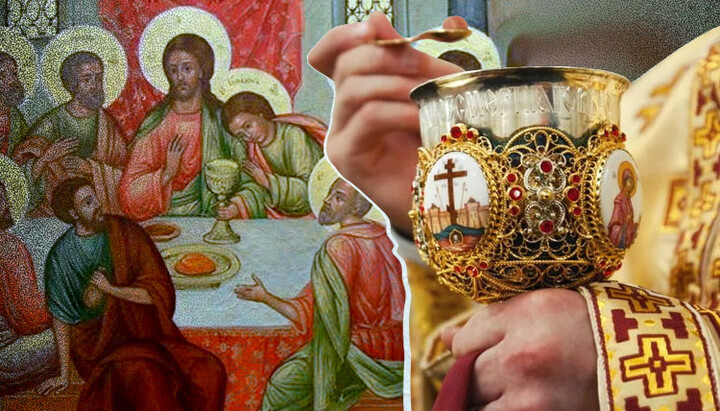
The mystery of the Eucharist. Photo: UOJ
An ordinary Sunday morning in church. Someone sighs quietly, someone shifts from foot to foot, thinking about household chores, food prices, or yesterday's news. The choir in the kliros sings the liturgical hymns in the usual way, following familiar notes. Everything feels very mundane, calm, and even a bit sleepy. We know this order too well to be surprised by anything.
But then the Royal Doors open. The priest brings out the Chalice, and a barely audible sound is heard - the light click of the spoon against the inner edge of the Chalice.
At this very moment, right here – just a few steps away from the parish candle stands and ordinary people worn out by the week – something takes place before which the ancient texts call heaven and earth to stand still in sacred fear. We approach the ambo, folding our hands across our chests, expecting the familiar comfort of spiritual consolation, but instead of a soothing remedy, pure Fire comes forth to meet us.
Christ's hard word
The rational person of our age finds the idea of faith without external obligations very appealing. Why go somewhere on a damp morning, stand in line, and receive something from a spoon? It's much easier to agree that God should be exclusively in the soul. This makes religion cozy, turns it into a comfortable philosophy or an ethical circle for good people.
However, the authentic Gospel resists such simplification.
In Chapter 6 of the Gospel of John, we find an episode often referred to as the Capernaum crisis. Christ tells the gathered crowd they must eat His Flesh to attain life. The listeners begin to protest; to them it sounds like madness. By all logic, a preacher in such a moment ought to soften the wording immediately and explain that He is speaking in a spiritual, metaphorical sense.
But He does not do this. Interpreters of the New Testament often draw attention to one detail in the Greek text. At first, Christ uses the ordinary verb phagein, which simply means “to eat.” But when the crowd begins to murmur, He deliberately changes the word to the harsher trogo. In ancient Greek, this verb was used when speaking of chewing food – literally, to crunch with one’s teeth.
Christ deliberately leaves His statement firm and uneven. It was precisely after this conversation that many disciples became frightened, turned around, and no longer followed Him. They had followed a wise teacher of morality but encountered a demand for complete, substantial union with Him.
Living warmth in the Chalice
We often forget how much Christianity is rooted in matter. The Creator does not disdain earthly substance. Just before bringing out the Gifts, the priest pours hot water into the Chalice. In Orthodox tradition, this action has deep liturgical meaning - the wine in the Chalice acquires the temperature of a living human body. Thus we are given to feel the warmth of the presence of Him Who is alive here and now.
The ancient Church treated this event with deep reverence. While composing the prayers before Communion, Symeon Metaphrastes found remarkably powerful words, unusual to our ears. He called the Holy Gifts a fire capable of scorching the unworthy, and he asked God to enter into every part of the human being, into the limbs, the joints, and the heart.
The Apostle Paul in his epistle to the inhabitants of Corinth directly wrote that due to careless, superficial attitude toward the Body of the Lord, many in the community were seriously ill and even dying. This is a serious warning.
Grace is not a harmless psychological resource. It cannot be touched simply out of boredom or for the sake of tradition.
If cold malice, unwillingness to forgive, or deaf stubbornness reigns in a person's heart, the encounter with God at the Chalice can become a painful burn for them.
Medicine against despondency
Today, many of us live in a state of constant, exhausting stress. Chronic anxiety, fear for our children’s future, distressing news – all of this gradually drains a person, leaving behind only a dry shell within. When our inner strength is exhausted, no self-help lectures or moral exhortations can help anymore. A person needs something greater than merely the right words. He needs Life itself.
The Holy Martyr Ignatius the God-bearer at the turn of the first and second centuries called the Eucharist the medicine of immortality. This is the most accurate definition. At the altar, the weary person is offered union with Christ not merely in name, but at the deepest, almost cellular level. We are grafted into the life of the One who has already passed through loneliness, the betrayal of those closest to Him, suffering, and death itself – and yet conquered it.
When we begin to realize this tangible reality of the Chalice, our entire perception of church life changes.
We cease to be merely random people standing together in the same room on Sundays. Communion unites us with one another, forming a single living body capable of enduring amid any historical upheavals and catastrophes.
The next time the distinctive sound of the Communion spoon is heard in the stillness of the church, it is worth setting aside every distracting thought. At that moment, the Savior comes forth to meet us, offering us not a temporary soothing of the nerves, but His eternal strength. All that remains for us is to open our hearts to this Fire.
Read also
Weeping Queen at Blachernae
On the night of the Feast of the Intercession of the Mother of God, only two people witnessed the miracle in the Church of Blachernae. Everyone else was praying and saw nothing. Yet the grace was bestowed upon them, too.
Deadly spiral of human hatred
The tragedy of Lebanon's civil war lays bare how dehumanization and fear can turn human beings into monsters.
Woe to expectant mothers – or to those of little faith?
God commanded one prophet not to have children, yet told his people in exile to bear sons and daughters. What does this apparent contradiction tell us today?
The help God never asked for
Uzzah wanted only to keep the Ark of the Covenant from falling into the dust. Why did this well-intentioned act cost him his life, and who was really responsible for his death?
Freedom begins when there's nothing left to take
Fear of persecutors takes root in our attachment to possessions. We turn to St. Basil the Great to understand why the prefect's threats held no power over him.
The bride in the window frame
The author of the earliest account of St. Thecla’s life was defrocked. Yet it was his book that preserved the only ancient description of the Apostle Paul’s appearance.